


Emerson College students traded Boston Common and lobster rolls for traditional Catalonian dishes and Barcelona’s architecture over spring break.
In one of Emerson’s longest running traditions, the School of Communication sent 14 students and two faculty members to the 35th annual Barcelona spring break trip. The group visited historical landmarks connected with Emerson’s international partner, Blanquerna-Ramon Llull University, and met Emerson alumni.
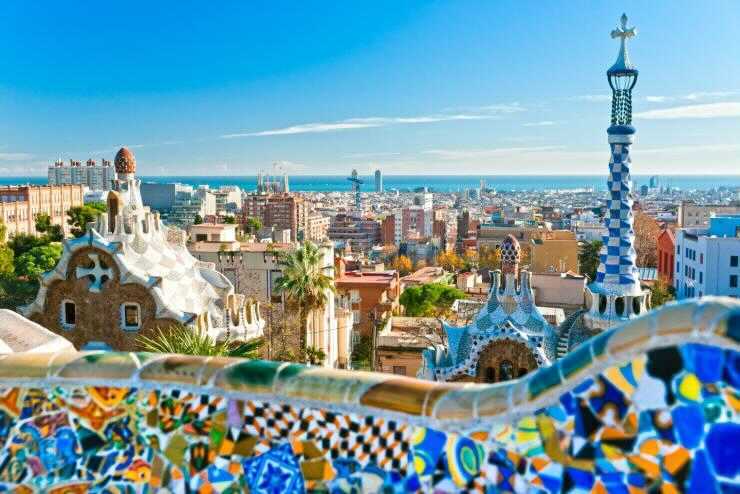
During the week of March 8, students in the School of Communication visited a range of sites across Barcelona, including the Catalan Parliament and La Sagrada Familia, where the architecture and design left a lasting impression.
“The lighting through the stained glass made one side feel warm and the other cool,” said Cole Gustafson, a sophomore visual and media arts major. “It was really powerful visually.”
The trip mixed academic programming with cultural exploration. Students attended presentations and professional events, including a communications session with Antonio Noguero, a public relations expert in the communications industry.
They also had a networking opportunity with students from Blanquerna-Ramon Llull, a Barcelona-based communications university.
Emerson’s partnership with Blanquerna-Ramon Llull aims to provide education, professional training, and research opportunities across the arts, sciences, and technical disciplines. Both institutions exchange students for cross collaboration and studies in communications. Its main function is to educate and train journalists, publicists, public relations professionals, and professionals in cinema and television, according to Emerson’s Center for Global Communication.
“It was great to connect with students studying a similar field in another country,” Gustafson said. “It felt like a real networking experience, especially for communication studies majors.”
But it’s not only local students the group found itself connecting with. Early on in the trip, students worked together in a cooking class — an experience they said helped them build connections that carried throughout the trip.
“That first night really brought everyone together,” Gustafson said. “After that, people were constantly making plans and exploring the city in groups.”
Jaclyn Kotora, a junior political communication major, praised Emerson’s planning and itinerary, stating that the events helped the group feel “closer together.”
“It was also a really great group. I didn’t know anyone going into it, and it was a mix of majors and ages, but everyone bonded really well,” she said.
Shawn Sims Jr., a sophomore VMA major, who helped document the trip through photography and video, said his role focused on capturing the student experience.
“We were creating narratives through storytelling,” Sims said. “A lot of it was about Emerson students experiencing a new place.”
One such event was visiting the Catalan Parliament, where students sat in on a hearing and voting session. Experiences like these and the opportunity to travel internationally were a major motivator for Sims to attend the trip.
“I’m always open to new experiences, especially traveling,” he said. “Getting the chance to go to Europe and see Barcelona was really exciting.”
Both Sims and Gustafson said they would recommend the experience to others.
“It’s definitely worth it,” Sims said. “You get to experience a different culture and see how things are done in another part of the world.”
Beyond the itinerary, the trip highlighted Emerson’s growing international presence and its emphasis on global communication.
“It was clear that Emerson has real, long-term relationships with these places, which made everything feel a lot more personal and welcoming,” Kotora said. “They’re trying to build more opportunities for exchange and study abroad in the future.”
Gustafson agreed, saying that it gave him a broader perspective on his academics and future studies.
“I think the goal was to understand how communication differs across cultures, but also how it’s similar,” he said.
Students said that regardless of culture, they learned the importance of human emotions when communicating information.
“It’s more about emotion over fact when you’re trying to reach an audience,” said Gustafson. “Fact is still important, but emotion is what really convinces people and keeps them engaged.”
During the trip, students were given the opportunity to work with Emerson’s “professional partners” like Tinkle, a public relations and communications firm in Portugal and Spain, Escola Superior de Comunicação Social, part of the Instituto Politécnico de Lisboa, and Blanquerna University. Everything centered around communications and digital storytelling, students said.
“A lot of the partner visits didn’t feel overly formal either; they felt more like real conversations where we could ask questions and hear about people’s actual experiences,” Kotora said.
Kotora said the trip also made her reflect more on the current state of U.S. politics, international relations, and travel.
“It felt a bit strange at times to be there, especially given the current moment and how Americans are perceived globally,” she said.
An August survey of 3,000 Europeans and Americans by travel media company Upgraded Points found that 27% of Europeans said they have a negative opinion about American tourists, and 36% said they think American tourists behave worse than others.
Barcelona has seen protests this past summer against the rising tourism in the country. Barcelona hosted 15.5 million visitors last year, eager to see Antoni Gaudí’s La Sagrada Familia basilica and the Las Ramblas promenade. There has also been a merging of the pro-housing and anti-tourism struggles in Spain, whose 48 million residents welcomed a record 94 million international visitors in 2024.
“Barcelona already has a reputation for tension around tourism, and at times, it felt like there was an added layer of skepticism or contempt directed at us as Americans,” Kotora said. “That made the exchange even more meaningful; it created space to engage with and challenge those perceptions through real conversations.”
![“[Global Pathways] is something I think Emerson is really proud of. It’s something that I think is unique to us," College Official Corey Blackmar said.](https://berkeleybeacon.com/wp-content/uploads/2018/09/Photo-Sep-19-9-29-46-PM-1002x1024.jpg)