


The familiar shriek of the Green Line underneath Boylston Street will come to a halt later this week, as infrastructure upgrades will suspend significant portions of the line starting Monday. The shutdown is scheduled to run from Dec. 8-22, with service remaining paused through much of the holiday season.
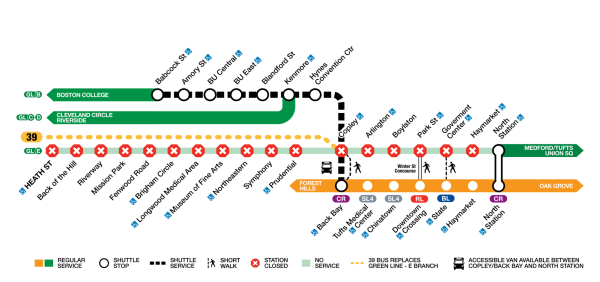
Service from North Station through Kenmore, Heath Street, and Babcock Street will be suspended. Commuters traveling inbound from areas including Boston College, Boston University, and Northeastern University will experience disruption.
Shuttle bus service will replace the B line from Babcock Street to Copley; E line riders are encouraged to take the 39 bus, which will be fare-free. C and D Line service will not be impacted, but once the lines reach Kenmore, riders will have to take the shuttle to Copley. Once at Copley, riders are encouraged to walk to Back Bay and use the Orange Line to travel further inbound, per an MBTA press release.
The Green Line runs on a catenary system, which involves overhead wires that are stored in wooden troughs in the tunnels. The troughs are over a century old, and the scheduled maintenance aims to replace them with more durable metal.
“That trough is 130 years old,” MBTA Chief Operating Officer Ryan Coholan told reporters alongside General Manager Phillip Eng in November. “When you think about the age of that infrastructure and how important it is to stay ahead of that, this is the opportunity to cure that.”
In addition to replacing aged infrastructure, the installation of the Green Line Train Protection System will be completed. The protection system is designed to prevent train-on-train collisions and enforce speeding, and has already been implemented along other parts of the line.
The fifteen-day suspension is longer than many recent shutdowns, and officials hope to make it as efficient as possible.
“We could have segmented work,” Eng told reporters. “We could have, but that impact is actually worse to the public. By taking this and having the diversion links where it is, it allows us to do all this work in this one period and be done and get out.”
Downtown Green Line riders, including Emerson students, will not be offered shuttle service as a replacement and are instead encouraged to utilize the Red and Orange Lines.
“In the fall and winter, every public transit system in the U.S. is at its peak ridership,” said James Mayes, a freshman writing, literature, and publishing major. “Suspending one of the busiest lines for two weeks at the busiest time of the year and then providing no alternative [Downtown], it’s like, what are we doing?”
The suspension will impact around 100,000 weekday passenger trips, and trip times are expected to be at least 20 minutes longer than usual, an MBTA spokesperson confirmed with The Beacon.
“The T’s already busy enough, and the Green Line is one of the busiest lines,” Mayes added. “You’re just kind of shoving everyone who takes the Green Line, and then you’re pushing all that onto the Orange Line. It’s just way too crowded.”
Mayes, from Ayer, Mass., said he goes home every other weekend. He takes the Green Line to North Station, where he boards the Commuter Rail, and said that the shutdown will affect commuters the most.
“I think it affects commuters a lot more,” he said. “If you at any point have to go through Downtown using the T, it does affect that.”
Paige Bayliss, a senior creative writing major, lives near the Harvard Avenue Green Line stop. They said the suspension will require them to add a bus ride and an Orange Line transfer to their commute.
“[It] is just a bit of a hassle and about fifteen minutes longer,” Bayliss said. “I’m not the biggest fan of the bus, but the 66 isn’t too bad, and I’ve taken it before at least.”
After the suspension, underground Green Line tunnels will boast modern metal catenary troughs and a new safety system. Riders are hoping the service they receive will reflect these improvements.
“I think the T over the past two, three years has made a lot of improvements,” Mayes said. “But I think if they are shutting it down for two weeks they should be fixing other problems as well.”
Bayliss agreed, expressing a desire for additional trains in the colder winter months.
“I don’t really have that much of an issue with the Green Line outside of frequency of trains,” Bayliss said, recalling waiting upwards of 10 minutes for a train in the cold. “I hope the shutdown could mean faster service.”
MBTA officials remain hopeful that this will be the case.
“It really is getting a lot of work done, and I understand every diversion we do impacts the public and our riders. At the same time, this is gonna give them a lot longer term reliability,” Eng added.