



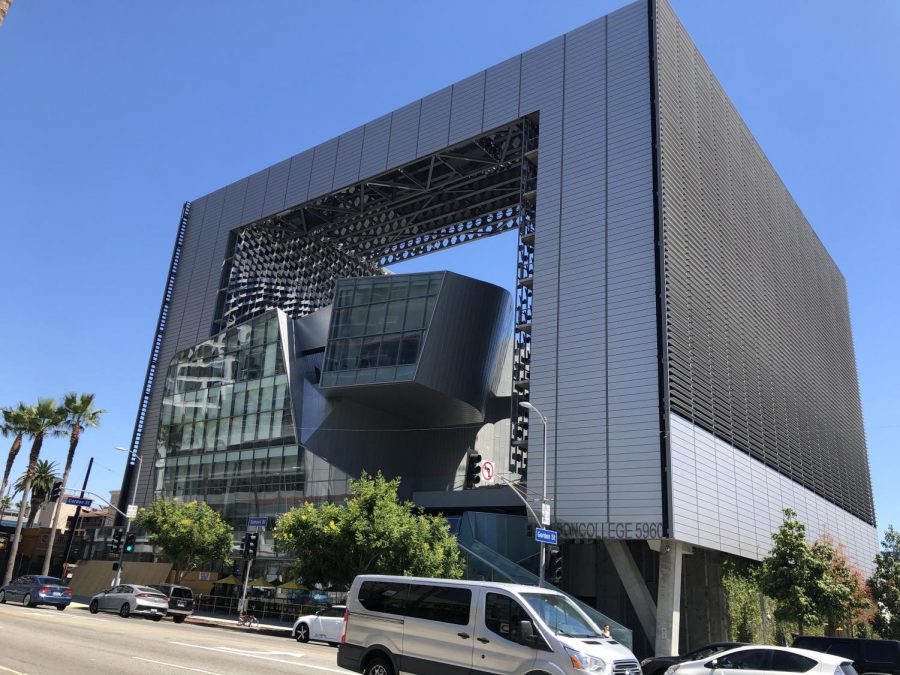
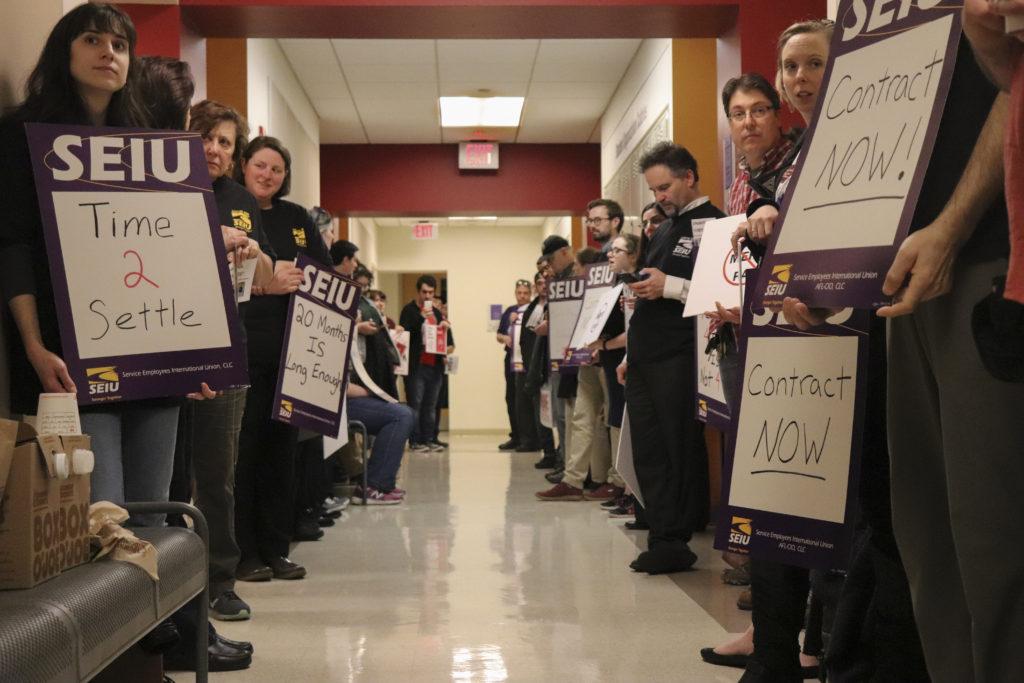
Members of Emerson College’s Staff Union held several actions last week in support of Emerson Los Angeles staff who voted to join the union amid stalled contract negotiations.
The union says the college is pushing the five unionized ELA staff members to negotiate an entirely new contract instead of revising the existing union contract, leaving members without a contract or union protections. The college told The Beacon that, nationwide, it can take up to a year to reach an agreement on an initial contract.
Daniel Sotelo-Reiner, a now-unionized senior events and IT support administrator at ELA, said he feels the staff at ELA has been siloed by the administration, excluded from union talks, and intentionally isolated from their colleagues on the East Coast.
“[It] doesn’t feel conducive to what we want, [and] I also don’t think it’s conducive to what management wants at the end of the day either,” he said. “Our proposal for an expedited contract is something that will be in line with what we…both want at the end of the day, in a way that isn’t isolating us.”
The staff and management secured a meeting with the college after the bicoastal Valentine’s Day action, according to instructional technologist and union leader Illona Yosefov, although the college told The Beacon the meeting was scheduled prior to the action. Yosefov said the union gave the college a proposal to add ELA staff to the current contract, which included conditions on the differences between labor practices at the two campuses. The college said the proposal was incomplete.
Yosefov said the college ultimately rejected the proposal, citing a different “work culture” that was more in-person than hybrid workers, and had a different academic calendar at ELA. About 80 staff union members at the Boston campus signed a petition in support of ELA staff members joining their contract.
In an email statement to The Beacon, a college spokesperson said that the college remains “committed to bargaining in good faith and adhering to all applicable laws with the intention of reaching an agreement with these staff members.”
It continued, “We continue to be engaged in many conversations with SEIU leadership about these contract negotiations and have clearly communicated the need to be cognizant of both California and Massachusetts laws and regulations, which operate very distinctly.”
Sotelo-Reiner disagrees with the “stalling” nature of the negotiations.
“We feel very strongly that there [are] no real legs for [the college] to stand on in that argument,” Sotelo-Reiner said. “They have to be paying lawyers to negotiate this contract, so that is wasting time and money for literally just five staff members.”
Sotelo-Reiner said negotiations would otherwise be expedited by how swiftly the union could amend the Boston staff union’s contract.
“They’re basically asking us to [negotiate] from the beginning … which is a process that could take months and months and months,” he said. “This is a process that is taking our time away as well, time that we want to be able to 100% focus on the students at ELA, the job we have to do there.”
One of the biggest detriments for staff of these prolonged negotiations is the lack of a cost-of-living adjustment (COLA). While everyone else, union and nonunion alike, received a 3.3% raise at the start of the new year to match inflation, the five ELA staff members have not received one because of the lack of a contract.
“Our wages [will not keep] up with inflation until we receive that [COLA],” Sotelo-Reiner said. “That is one of our primary reasons for wanting to get on the contract as soon as possible.”
Forcing this to drag out for months, Sotelo-Reiner said, impacts other facets of the ELA workflow. For example, any changes the new ELA dean might want to make that would be negotiated with a unionized body of staff members will instead be made on an individual basis.
Sotelo-Reiner said that by allowing them to join the existing contract, management and the dean will gain more flexibility in union negotiations and operations.
“We want to join the main contract because we have the power, the solidarity with the 150+ [unionized] staff that are in Boston,” he said.
The ELA faculty union wrote a statement in support for the five ELA staff in an email to The Beacon. In it, they said that the staff in LA’s work depends on “a foundation of equity.”
“As we welcome a new Dean and a new era for our campus, we must ensure no one is left behind—especially the dedicated ELA staff members who have absorbed increased workloads without a cost-of-living raise in 2026,” the statement reads. “ Staff working conditions are student learning conditions, and the ELA Faculty Union stands in full solidarity with our colleagues in their call for fairness, urgency, and the professional respect they have earned.”
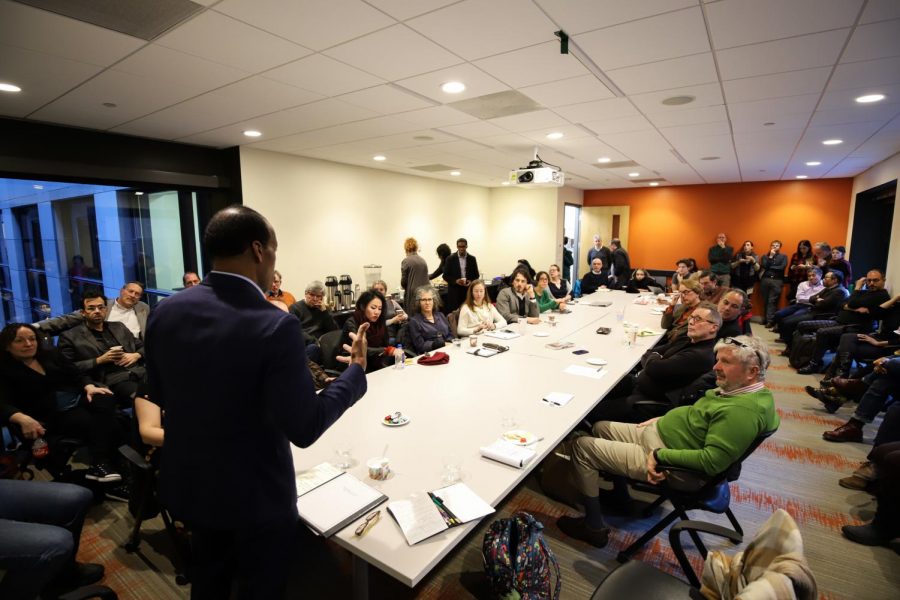
The five staff in ELA have garnered support from staff on the Boston campus, too, like Paul Kruczynski, a web services team member of six years. He showed up to leaflet outside the Little Building last Wednesday, March 18, where an ELA information session was taking place last week, to raise awareness among community members about this issue.
“It doesn’t make sense … It seems like a waste of money,” he said. “The administration keeps stonewalling us … This relationship is so adversarial,” Kruczynski added, saying union negotiations at his former employer, the State University of New York, were “no big deal.”
For Sotelo-Reiner, attempts to isolate ELA staff from the Boston staff union are antithetical to the college’s credo.
“Emerson really espouses unity. At the end of the day, ELA is just an extension of the Boston campus,” he said. “We have the same students that go to the Boston campus … so why would you want to have staff that have a different set of protections when we are all supposed to be one Emerson, one campus?”








Thanks for covering this issue! It’s essential for us to support our staff in order to adequately help them help our students. Their assistance is more crucial than ever and they do so much for us!