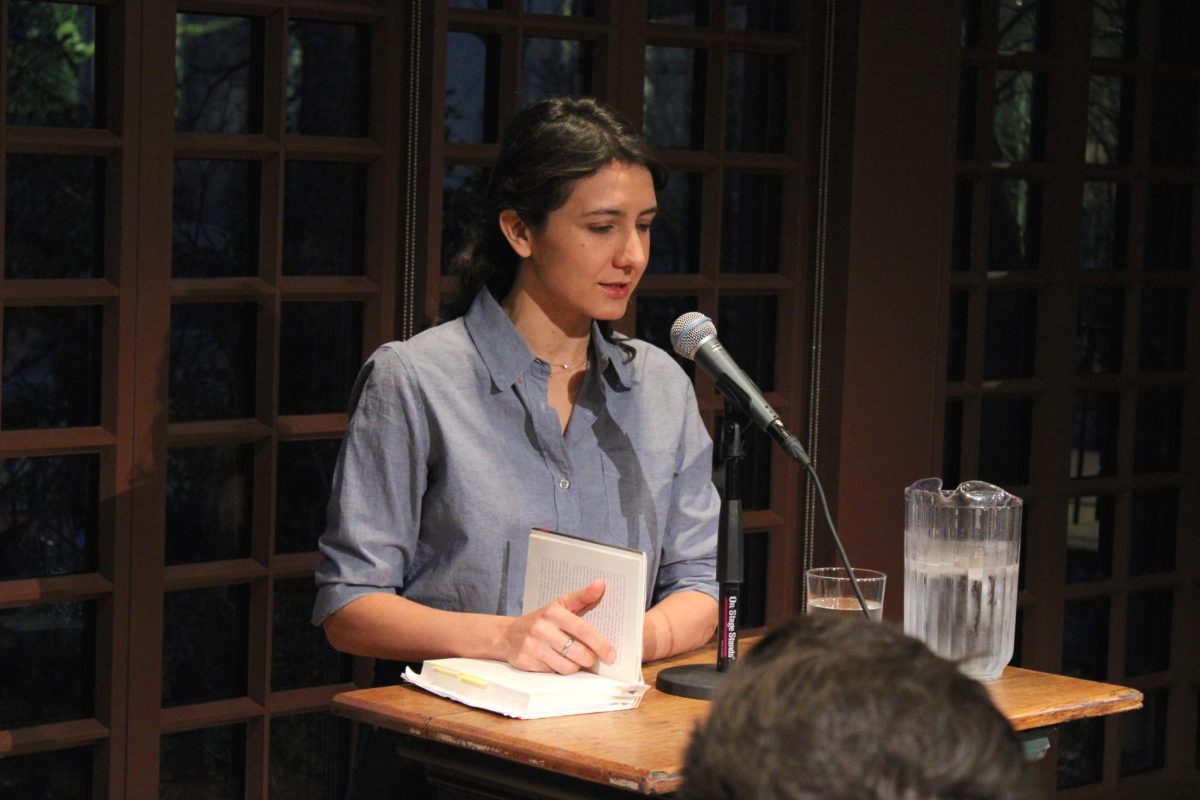



Like most modern writers, writing, literature and publishing professor and author Margot Douaihy uses a laptop to write. But, perhaps unlike most modern authors, she also always has a notebook — lovingly adorned in stickers — and a pen next to her. For each novel written, three to four of these notebooks are filled with her ideas, scribbles, and thoughts.
“I’m always scribbling, drawing when writing…” she said in an interview with The Beacon. “There’s craft and precision and technical acumen [in writing], but it is also alive.”
That creativity flourishes in Douaihy’s latest book “Divine Ruin,” the third in her “Sister Holiday Mysteries” series. The books follow a queer, punk-rock nun living in New Orleans who, in this new addition, investigates a series of fentanyl overdoses among her music students.
Douaihy started teaching at Emerson College in 2023, drawn to its unique program that focuses on genre fiction and popular fiction, also known as “PopFic.” She said that Emerson, compared to most other literature and publishing programs, uniquely recognizes the depth and breadth of genre fiction in all its possible forms.
“It’s one of the few academic spaces where you can really invest in genre fiction,” Douaihy said. “Unlike other institutions that have somewhat of an exclusionary or outdated snobbery around the value of what genre fiction is and can be.”
Douaihy invested in the genre early on, centering her doctorate in creative writing around the thriller genre. There, she merged her study on topics like queer and mystery theory with her own takes on thriller narratives.
“Mysteries provide something really focused in terms of…reader engagement,” she said. “It feels very magical and powerful.”
Despite the pull mystery novels have on readers, Douaihy described her road to publication as “twisty and meandering.” When she was working on the first novel in the series, she found many publishers enjoyed her material, but believed they would have a difficult time marketing it. She said they attributed that concern to the novel’s unconventional overlap of the mystery genre with that of spirituality and queerness.
Enter Gillian Flynn, writer of mystery classics like “Gone Girl” and “Sharp Objects,” who started her own mystery-focused imprint in coordination with the independent, women-founded publisher Zando. She immediately took an interest in Douaihy’s work.
“[Flynn is] devoted to platforming and discovering new writers who are taking big creative swings, and who want to be weird and honor what thrillers and mysteries can do,” Douaihy said.
The imprint has published all novels in the “Sister Holiday Mysteries” series, including “Divine Ruin,” and is set to publish one more to complete the quartet.
But after finding her books a home, Douaihy recalls the innovative ways she supported her art over the years, working odd jobs such as at a hair salon and at a college campus as a security guard. She said she prioritizes honesty about her experiences with her students.
“To make our art, we have to be scrappy sometimes…but if you believe in it, if you love it, you can never give up,” she said.
She said that writing has always been something to turn to when everything else looks dire and discouraging. She is inspired especially by the individual nature of each piece of art and how it outlives its creator.
“Only you can tell your story your way,” Douaihy said. “Only you can write your book your way. Only they could make that film that way.”
This sense of individuality is apparent in her “Sister Holiday Mysteries” series. While originally from Scranton, Pa., Douaihy gained the inspiration for her series when she was living and working in New Orleans for two years. She merged her newfound love for the city with her experiences attending Catholic school as a child.
“I see the setting itself as a character,” she said, speaking to the rich history and vibrant culture of the city.
Within the human characters, especially in her version of a traditional hard-boiled detective sleuth, Sister Holiday, Douaihy wanted to test the boundaries of that often masculine, eccentric archetype and make it more personal to her experiences.
“How can identity, how can queerness, how can your religion be something that you actually get to determine and define for yourself?” she asked. “As well as being part of a lineage with history and roots that are very real?”
The thriller genre in particular is suited to handling these larger questions as well as more granular ones, Douaihy said. There are the obvious ones, such as who the murderer is, but then also ones that ask about those investigating the murder, and dissect their obsession. As a writer of these mystery novels, Douaihy said she asks larger questions about power, about the reasons behind collusion and corruption and systemic issues.
“Mystery thrillers, especially noir, they’ve always been asking these big questions, but rooted in very personal stakes too,” she explained. “I love the genre for its ability to speak truth to power, but also entertain at the same time.”
Douaihy said she hopes those who encounter her work take part of it with them after they finish reading. She understands the power that certain characters within a book can have on a reader, and her fictional universes are no different.
“If my characters can surprise themselves, then they could surprise me as the writer and they could surprise you as the reader,” she said. “So that freedom, that play, the scribbles, the ink, that’s all part of it.”