


When people think of Frankenstein’s monster, they think of a green, lumbering creature with a wide forehead and scalp studded with electrical bolts. The 1931 smash hit film “Frankenstein,” which starred Boris Karloff as the Creature, cemented this iconic image widely seen on Halloween decorations and costumes today.
But now, director Guillermo del Toro wants to depict the truth about a tale originally written in 1818 on a stormy night by an 18-year-old Mary Shelley that practically invented the science fiction genre. Del Toro watched the “Frankenstein” film and then read the book as a young adult, and he has wanted to make a film adaptation of it since.
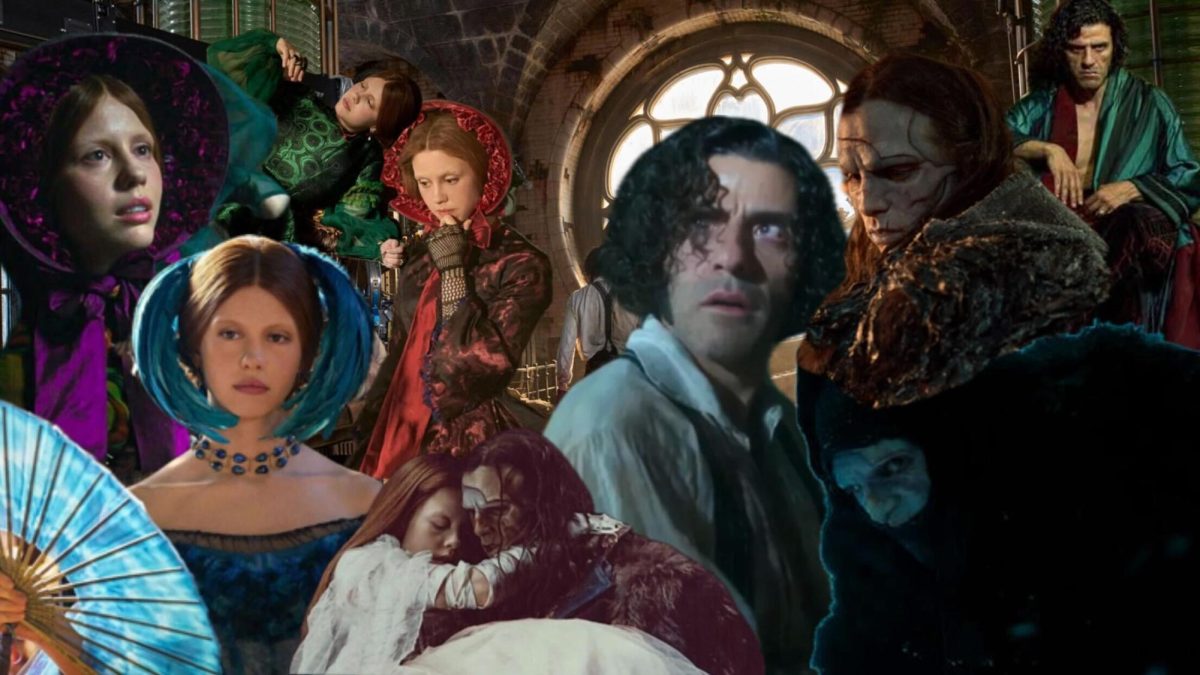
“Frankenstein” hit Netflix on Nov. 7 after a select theatrical release in October. The film stars Oscar Isaac as lead Victor Frankenstein, Jacob Elordi as the Creature, Mia Goth as Victor’s sister in law, Elizabeth, and Felix Kammerer as Victor’s brother, William Frankenstein.
One of del Toro’s main goals was to keep the film more accurate to the novel than previous adaptations, especially when it came to the characterization of Victor Frankenstein and the more humanoid design of the Creature. In an interview on the Inklings podcast with Jack Edwards, he said he especially wanted to humanize the characters, showing how pain from childhood and familial relationships can eventually manifest in destructive ways. Victor’s father was a surgeon, and that his view of his son as never being good enough has supercharged Victor to eventually create the Creature to prove his capabilities.
As a child, Victor was very close with his mother, and even after her death, she continued to influence him and his choices. This is shown through the dialogue—including Victor’s narration as he begins the story by speaking about his childhood—but also through color symbolism. For example, the color red becomes a motif between the pair, as Victor’s mother is first seen in a gauzy and billowing red dress, and wears red for all of her time on screen. Subsequently, Victor’s outfits as an adult feature pops of red, such as in his tie and his gloves.
Another example is how Elizabeth is first seen in an equally billowy and dramatic green dress, which symbolizes her love of nature and her caring nature. That disposition becomes evident when she is the only one to show the Creature any amount of kindness in the film. Goth’s performance is bewitching, providing a shrewd and emotionally intelligent voice to a film otherwise dominated by men who, as del Toro himself described it, can often be “emotionally stupid.”
Stark color contrasts also appear in the overall cinematography of the film, in striking scenes of black-attired funeralgoers set against snowy landscapes, and the towering bright, almost neon green electrical equipment Victor uses in his laboratory when building the Creature.
Every set in the film is elaborate, and the majority of them are physical rather than CGI. A large portion of the story takes place on a ship, which, due to its larger-than-life design, becomes its own sort of character that viewers become familiar with as the film progresses.
A stand out performance is that of Jacob Elordi as the Creature. The star broke into the scene as Nate Jacobs in the HBO series “Euphoria”—a part that threatened to pigeon hole him as a teen drama actor—though with this role, alongside his explosive performance in 2023 film “Saltburn,” he leaves Nate firmly in his past.
Elordi’s all-encompassing and deeply poignant performance holds the emotional core of the film. He all but disappears into his role and immerses viewers in the tragedy of the tale, performing the physicality of the Creature without the acting getting lost behind intricate full body makeup.
Elordi’s strong performance was central to the success of the film, since this adaptation puts the Creature front and center by showing over half the film through his point of view, rather than the whole story being told through Victor’s narration. This narrative structure allows the audience to connect directly with the Creature and understand his struggles, eventually rooting for him amidst the disgust he receives from Victor.
The film does fall short in its pacing, as it sets up what audiences are led to believe is a three-act structure.The first part of the film is labeled ‘Victor’s Tale’ and the second is labeled ‘The Creature’s Tale,’ which made it seem as if the film would contain a third part that would finish both tales. It feels as though the Creature’s tale does not have a distinct ending, and there is confusion as to whose point of view the last thirty minutes of the film comes from——if it has one at all.
Regardless of this confusion, the movie still manages to capture the main themes of the story, and provide a satisfying emotional conclusion. Victor receives his due comeuppance for the lack of humanity he provided the Creature, being punished for his actions that stepped outside the laws of mortality in an effort to cheat death and create an immortal living being.
This skirting of a mortal boundary points back to the original book’s subtitle, “The Modern Prometheus,” an allusion to the Greek mythological figure eternally punished for taking fire from the gods and giving it to humans. The film presents the question of who is truly the man, and who is the monster, and that the answer is not simply solved by outward appearances.
This beautiful moody and gothic film does justice to a seminal classic, setting a new standard for book to film adaptations that will be difficult to fully meet.
