

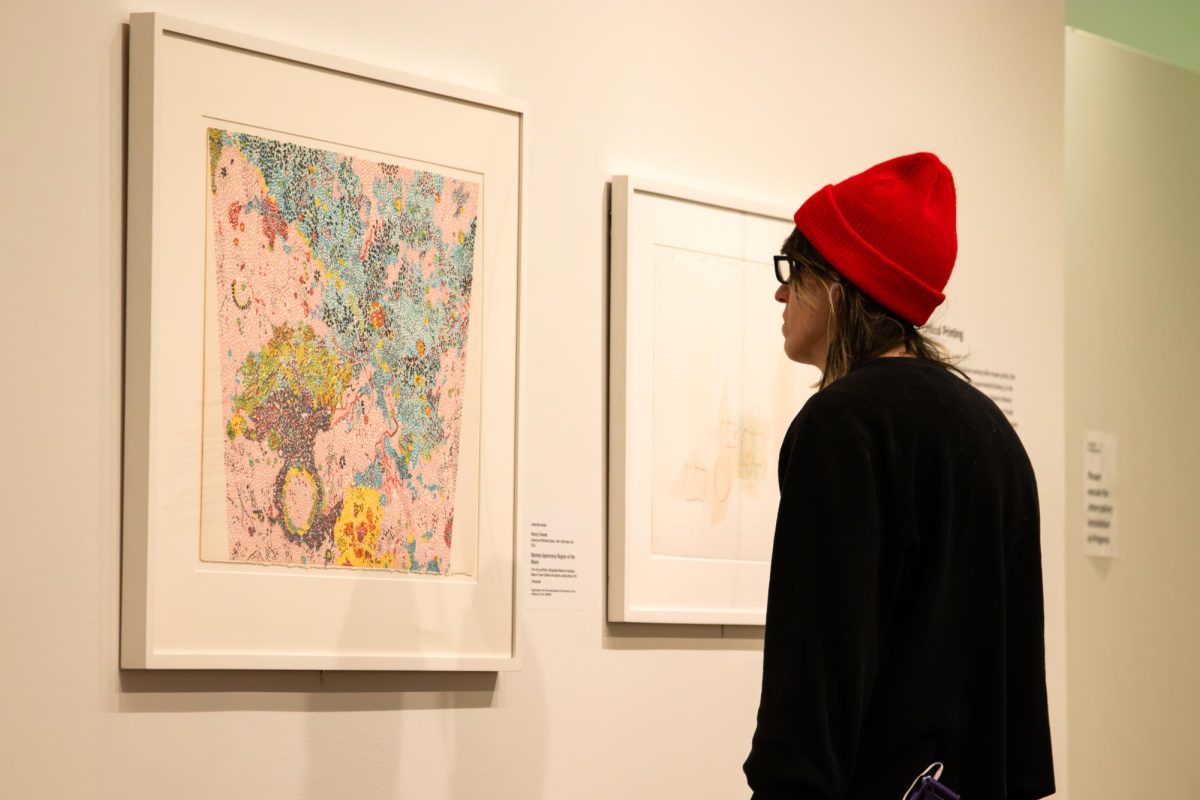
Dimensions, portals, biologic (relating to living organisms), energy, pulp and goo, and living with rocks. These are the various abstract subsections the prints and objects making up the “Critical Printing” exhibit at the Harvard Art Museum have been grouped into. With no specific theme besides the medium of printing itself, the exhibit flips the traditional experience of viewing art on its head, leaving the responsibility of creating connection between its pieces up to the viewer.
The exhibit is named after a class offered at Harvard University which aims to expose students to the various techniques behind printmaking and the history of the art form. Taught by professors Matt Saunders and Jennifer Roberts, the class encourages students to link what they learn to their own crafts.
The academic focus of each student varies greatly, said Saunders, resulting in a collection of studied prints and objects that represent the intersectional nature of art. The selection process for the pieces in the exhibit came directly from the dynamic of the classroom, cutting across the curriculum and each student’s disciplines.
“We’ve had physics students and music graduate students. This year we’ve got history and science,” Saunders said in an interview with The Beacon. “It’s really interesting to see what perspectives come in because printing is such a capacious field.”
Located on the third floor of the Harvard Art Museum, one of the first pieces in the exhibit viewers see is “Locus #2,” This large folded piece of paper made through etching and aquatint by Dorothea Rockburne, categorized under the subsection “Dimensions,” was prompted by a physics student Saunders had in class. Saunders pulled the object out of Harvard’s collection to intertwine printmaking with the movement of three-dimensional space.
“We looked at it together and found it super intriguing to think about the way an object is never quite in a state of rest,” he said.
This association between an individual’s field of study and the physical entity in front of them is what allows the prints to serve as bridges between worlds, as the exhibit’s introduction panel outlines. It reads, “In the unorthodox groupings on these walls, new approaches to the medium and new avenues for research are waiting to be discovered.”
This is the heart and soul of the exhibit, an opportunity for viewers to visually consume the art and postulate with no expectation of what their concluding assessment may be.
One of the pieces in the exhibit that most boldly captures this concept is Masaaki Sato’s “Subway No. 24.” The screenprint transforms the typically bland and grey scene of a subway station into an entrancing void that embodies the liveliness of a club, with vivid and repetitive color sequences on the ceiling and floor. As its grouping under the exhibit’s subsection “Portals” suggests, the piece emits a euphoric yet distorting sensation of going on a spiritual journey and ending up somewhere unexpected.

Whatever this unexpected place may be is completely determined by what the viewer brings to the table of mental deliberation. The result, Saunders hopes, will be a fruitful energy that fills the exhibit, drawing lines between each piece and current unknowns.
“It’s the opposite of a show that is trying to present a history to make an argument,” Saunders said. “It’s two people who’ve spent a lot of time now with this collection building a kind of idiosyncratic group of works that we hope might be generative.”
There’s a lot of a technical understanding behind print, leading to certain avenues being centered in the medium, he said. He added that it hasn’t yet “gotten outside of the box” as much as other art forms.
With pieces ranging from lithographs, etchings, silkscreens, woodblock prints, to Xerox toner on paper, “Critical Printing” is an ocular saga that pushes the artistic vehicle of print out of its comfort zone, leaving what might possibly lay outside of this zone to be explored and determined by the viewer.
“Critical Printing” is on display at the Harvard Art Museum through May 10.