


Walking into the exhibit on the 4th floor of the Institute of Contemporary Art, you are immediately greeted by a painting by Ojibwe artist George Morrison. Using cubism, the painting breaks a landscape into geometric shapes and overrides the details with bold, evocative colors, disorienting the scene and bringing the audience in all at once.
The “untitled” canvas is just one of the more than 60 art pieces featured in the “An Indigenous Present” exhibit at the ICA. The collection, which is on display through March 8, exhibits over 100 years of contemporary Indigenous art pieces and contains new commissions by 15 artists focusing on the use of abstraction.
The purpose of using abstraction in this exhibit is for the artists to create art that doesn’t aim to be a historical survey or a boxed-in portrait of reality. Abstraction allows artists to depict stories driven by emotion and plays with distortion, the real and unreal, while telling personal narratives, thoughts, traditions, and opinions.
The exhibition was co-organized by artist Jeffrey Gibson and independent curator Jenelle Porter. The two of them believe abstraction is a flexible tool and gives the artists the opportunity to explore the themes they wish to express without putting themselves in a box.
“There is the potential flattening effect of terms like Native American Art and Indigenous Art,” Gibson stated in “Conversation: Jeffrey Gibson and Jenelle Porter on ‘An Indigenous Present.’”
“These terms don’t always promote the diversity among Native artists and their individual backgrounds. I have questioned the best way to present these artists and their work on their own terms,” he said.
The organizers of the exhibit didn’t want to limit the artists by putting a specific label on the exhibit. Porter added that she “craves complexity, even when it’s an occupational hazard.”
“I don’t want to be able to describe an artwork in one sentence. That’s a sales tactic and it’s pretty much the opposite of what art is to me,” she said.
“We have cultural influences that are present in the showbook. They’re not the focus,” Michelle Kelley, a graduate student lecturer at the ICA, said about Gibson and Porter’s goal of the collection during a tour of the exhibit. “Jeffrey Gibson and Jenelle Porter, they looked at this art and they said, ‘This art is strong. It can stand on its own.’”
This is clear with Caroline Monnet’s 2019 sculpture, “The Flow Between Hard Places.” The piece is centered in the middle of the room, allowing guests to get a 360-degree view of the dips and ridges of the sculpture. To the eye, it’s not completely clear what the artist is trying to say or even replicate. While it might appear that the sculpture is of ripples in the ocean, a waterfall, or a river, it’s actually modeled after a soundwave.
Monnet recorded an elder saying “Pasapkedjinawong,” which is the Anishinaabemowin language for “the river that passes between the rocks.” It is also the name of a vital riverway for the Anishinaabe people. From there, she added more versions of the phrase, layering them and recordings of moving water in order to get a three-dimensional structure. She then sculpted the soundwaves of the recording into a ductal concrete sculpture that is on display.
Walking into the next room, guest’s eyes immediately go to the red and orange hues of 120 cylinder-like objects mounted across a white wall. By the color alone, it’s easy to understand where Sonya Kelliher-Combs got the title “Salmon Curl.”
Combs, an Alaska-based artist, was inspired by traditional salmon drying techniques when creating this piece. During the process of salmon drying, the fish skin curls at the edge and turns a vibrant orange and red color which is replicated in “Salmon Curl.”
This final piece is composed of two separate works, as the original “Salmon Curl” was created in 2023, and the most recent addition, “Salmon Curl II,” was made in 2025.
“You can tell the difference between the two because the second one is still sort of curing,” said Kelley. “So ‘Salmon Curl II’ are these darker red pieces and these lighter ones are the original ‘Salmon Curl.’ So you can see they are intermingled across the wall.”
The pieces are made out of acrylic polymer, which Combs was able to bend and then stitch into shape, giving the objects shine. Reindeer and caribou hair was also mixed into the acrylic polymer, along with the red pigment that makes “Salmon Curl” stand out.
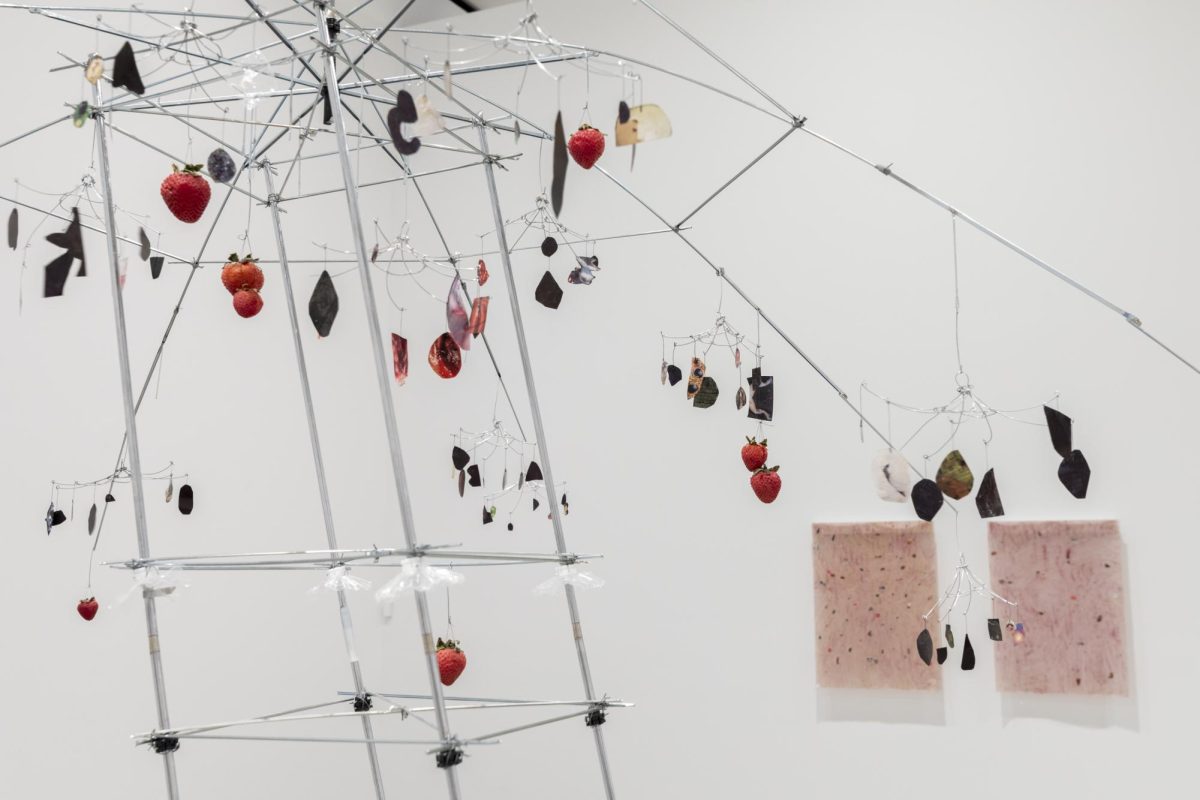
A couple rooms over, guests will find Gabrielle L’Hirondelle Hill’s “Site Paradise Dice Paradise.” The sculpture is much more delicate compared to others in the exhibit, almost seeming off-kilter. The piece is composed of disassembled umbrellas, paper cutouts, spider cocoons, wires, and strawberries. Yes, real strawberries.
“The strawberries are actually changed out. They are dipped in vinegar to keep the pests at bay, but you can see some of the strawberries maybe looking a little bit fresher than others,” said Kelley.
A disassembled umbrella holds on top of the unsteady tower, with wires that branch off of each other like a spider plant, creating smaller versions of themselves. From these offshoots dangle the strawberries, along with paper cutouts displaying evocative images such as frog legs, eggs, fruit, and other organic materials.
One of the major themes Hill works through in her art is the ambiguity she feels surrounding motherhood, which can be seen in the reproductive symbolism in the piece like the eggs and seeded fruit. The piece brings to light the beauty, disorientation, delicacy, and rawness within reproduction, motherhood, and parenting.
The exhibit asks viewers to consider what is legible in the art works, and what is obscured, offering guests a chance to consider gaps in their own knowledge about indigenous art and culture.
“An Indigenous Present” is, in a way, a spin-off from Gibson and Porter’s 2023 publication — also titled “An Indigenous Present” — which is a collection of Native North American contemporary artists, musicians, filmmakers, choreographers, architects, writers, and photographers. “An Indigenous Present” at the ICA can be thought of as their book, but in the flesh.
Porter said that the exhibit rejects “monolithic categorizing,” rejecting the idea that indigenous art has a single story, and instead offers guests to view each art work individually rather than as a whole.
“We hope [“An Indigenous Present”] offers an occasion to think through artworks with specificity,” she said. “What do we know? What is legible? What is obscured? And how can we begin to learn more about networks of influence?”