

Families can be messy. They’re layered with blurred boundaries, expectations, and generational trauma. Regardless of one’s history, familial experiences shape how someone loves, or how they argue.
Joshua Harmon’s play, “We Had a World,” is playing at The Huntington Theatre in Boston from Feb. 12 through March 15, bringing generations of family trauma and heavy drama between its members to the stage. The show portrays the way families can shape the past and present versions of individuals.
The autobiographical play follows Harmon’s life growing up with his mother and grandmother, eventually addressing the death of his grandmother. Written during the COVID-19 pandemic, the play is based on Harmon’s family, which he got permission from his grandmother to write about.
The opening scene is derived from a recording of the final conversation Harmon had with his grandmother before she passed. In the scene, Harmon navigates their complicated relationship almost as a way to communicate with her one last time.
Told through the characters on stage and flashbacks narrated by Harmon, the show is a behind- the-scenes look at how his family operated throughout the years, dealing with issues like alcoholism and absent parents. Fights behind closed doors show the true colors of each family member, and reveal a side of them that the public would have otherwise never known.
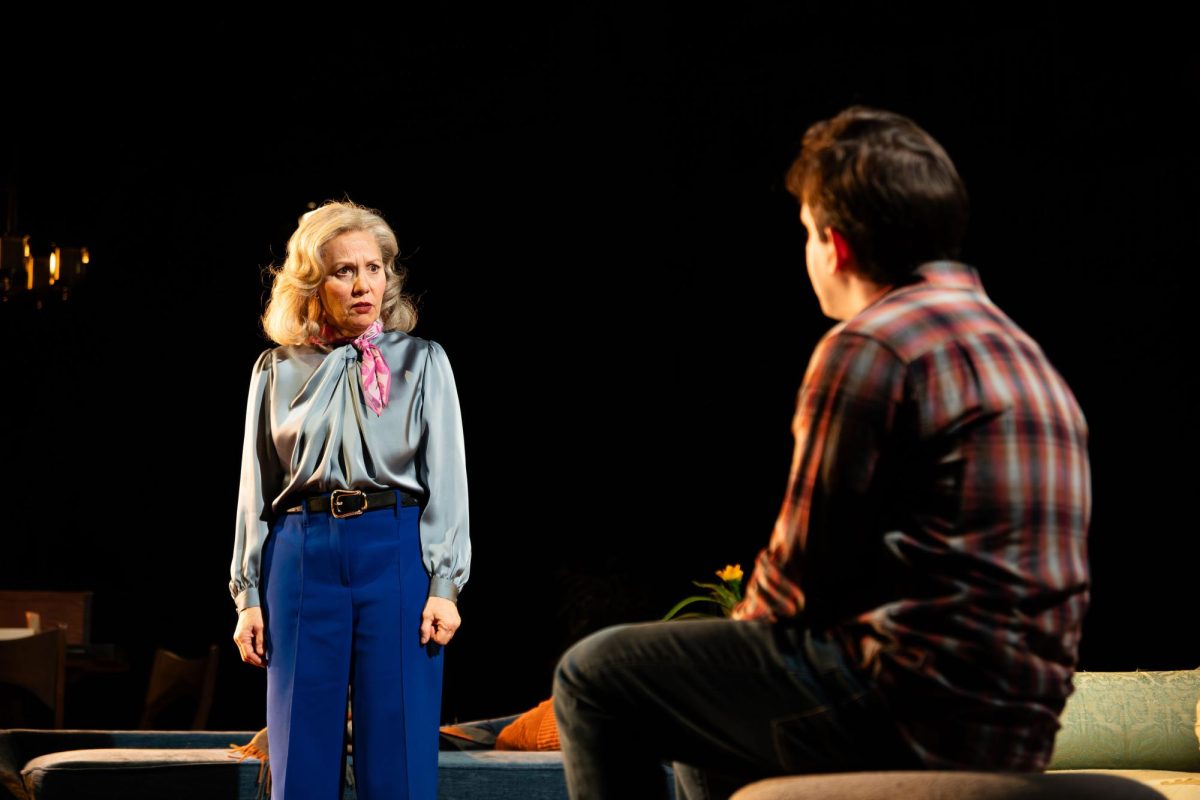
The three-person cast includes Harmon (Will Conard), Harmon’s mother Ellen (Eva Kaminsky), and Harmon’s grandmother Renee (Amy Resnick). Being the only ones on stage, the three have a chemistry that brings together their characters as a family unit, creating a dynamic that feels authentic.
“There’s a catharsis to witnessing people behave in ways that maybe we don’t behave in public, or don’t want other people to see,” said Conard in an interview with The Beacon. “Seeing that surrounded by a large group of people can be very useful, and I don’t mean that in a practical sense, I mean useful emotionally.”
Renee is portrayed as having an extremely close relationship with her grandson, taking him to see movies, musicals, and museum exhibits. To Harmon, she encapsulates a sort of childlike wonder and a deep care for people. But as Harmon gets older, and conversations with his mother get more serious, viewers come to understand that his grandmother has created contention within her family due to her struggle with alcoholism, leaving marks on her daughter’s life.
Conard, Kaminsky, and Resnick began rehearsals in mid-January 2026. After this rehearsal process, they held five or six previews before the show opened to fine-tune audience reactions.
“There’s even stuff that I’m kind of surprised that audiences respond to, and it alters the rhythm,” said Conard. “You have to find a way to kind of continue momentum, and to invite in the laughs.”
The timing of jokes was clearly well rehearsed, as the audience was filled with laughter throughout the show, even during some sentimental moments — which there was no lack of either. As opposed to the jokes filling the dialogue and making for a punchy, fast-paced rhythm that keeps the audience constantly engaged, the emotional moments utilized silence to give the audience time to truly feel the emotional impact of each line and experience the hurt of the characters on the stage.
“Especially because there’s so much direct address with the audience, it’s really nice to get to interface with them and see people out there,” said Conard.
Despite the audience witnessing decades of Harmon’s family trauma, the story and characters still resonate with audiences. They can watch the show through the lens of their own pasts, lives, and familial relationships.
“This story is about a particular family, but ideally, I think [Harmon’s] hope is that it would make people think about their own families whatever way it hit them,” said Kaminsky in an interview with The Beacon.
Conard echoed his castmate, speaking of how he hoped their performances would impact audiences and prompt important discussions around family dynamics.
“All that we can do is give our full selves,” said Conard.“Hopefully there will be some conversation between the character that we put on stage and the people who the audience [members] know.”
That desire for connection shaped not only the way the cast approached the show’s themes, but also how they built their characters from the foundation given to them by Harmon. The cast created the characters without ever meeting the people they are based on, giving a different life to the personalities written into the script.
“That’s sort of the fun part — for us to create fully fleshed out humans that other people can relate to, and then the rest is sort of out of our hands,” said Kaminsky. “We just tell a story and hope for the best.”
Kaminsky believes that shared human experiences, such as family dynamics, are one of the most universal and personal themes that can be explored in any kind of art. She said this is what she wants to come through the performances given on stage.
“Any time we see someone else go through something that we’ve gone through,” said Kaminsky. “It is comforting to have the idea of the human experience, and that we’re all human beings muddling through.”