


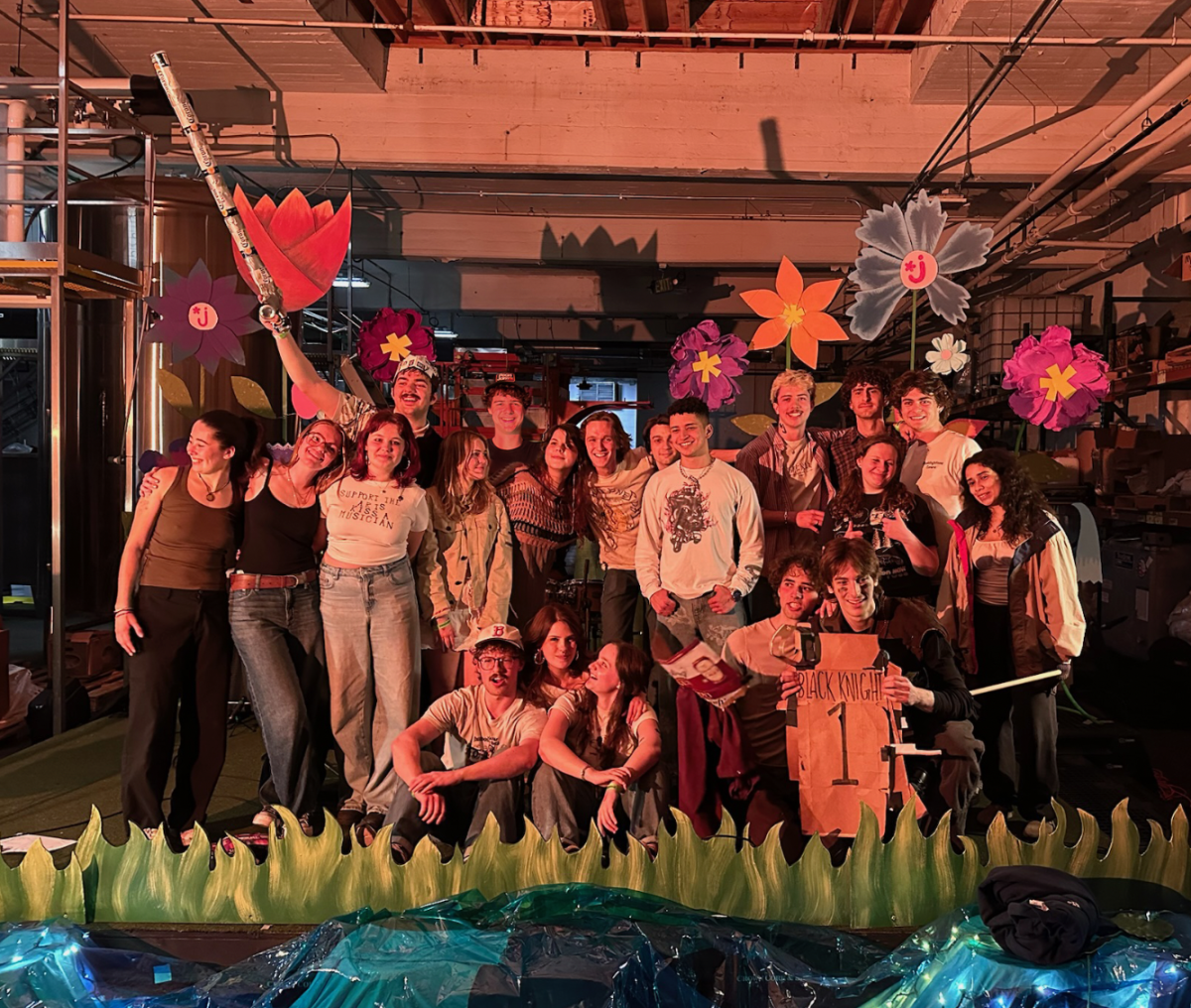
When going to a *junkyard event, you can expect to enter a space intentionally curated for lovers of live music, whimsy, and collectivity. Handmade on-theme props such as quilts, cardboard cut-outs of flowers and hearts, and streamers cover the walls and stage as a lineup of local bands waits for their turn to serenade a crowd of young people from the Boston area.
*junkyard is many things. In the words of its creative director, Quinlan Harp, it’s a “pile of ideas in motion.” Logistically, it’s an LLC and event producer. Founded only two and a half years ago, it’s pretty young, operates solely on the dedicated work of volunteers, and has amassed a decently sized crowd of supporters. Now, the company has arrived at a moment of reflection, taking stock of its functionality, what has allowed it to be so successful, and looking toward other outlets for funding and community cultivation to continue serving young enjoyers of Boston’s underground music scene.
Jeremy Serbee, co-founder of *junkyard, was first introduced to DIY shows when he visited his friend Leo Belsky at Bard College for Halloweekend in 2022. Watching Belsky perform, he was enthralled. When he returned to Boston as a sophomore at Northeastern, he began a search for a similar scene.
What he found was a “beautiful hub of culture” that he immediately fell in love with.
Before discovering the underground music scene of Boston, Serbee said he was lonely, and felt that he hadn’t found the social space that was right for him. But the first few shows he went to resonated with him so intensely he was brought to tears.
“I remember turning to the friends I was with and saying ‘I need to be in this space more for the rest of time,’” Serbee said.
He then joined a fraternity where he was able to put together a few shows. But wanting more, and acknowledging that he wasn’t really “a frat guy,” he started brainstorming ideas with co-founder Owen Silleck — who graduated from Emerson College last year — over the summer of 2023.
*junkyard’s first show took place on Sept. 30, 2023. Wanting to have an artist who had an established audience to draw people in, they booked Dejima, whose real name is Kaveh Hodjat, as their first-ever headliner.
“Kaveh put his trust in us as a pretty big fucking deal artist. He was like, ‘Yeah, I’ll play. It sounds like a cool gig,’” Serbee said. About 150 people attended, and so *junkyard continued, now having produced 25 events to date.
Morgan Burke, *junkyard’s production designer, hiring manager, and a senior media arts production major at Emerson College, said that the company has shifted from trying to make events feel like a “well put together party” to an “elevated event.”
Burke was the first person who went through an application process to work with *junkyard, joining in January 2025. Starting out with a base of informal volunteers, the company now has a variety of positions like talent buyer, head of strategic partnerships, and other administrative roles. Burke said this helped *junkyard become more organized in their production efforts.
When producing an event, *junkyard’s crew browse various venues, working with Harp and head of merchandise Chloe Bilstad, a junior media arts production major, to create an overarching bit for the event, hiring actors to perform it. The crew then pitches local artists to figure out which will best fit their vision. Next comes the logistics: building the stage and scenery and making sure they have enough staff — typically 18 to 25 people — to man doors and do crowd control.
Sometimes, people will just show up the day of an event to help out because of how much they care about the project.
The main challenge *junkyard has faced in continuing to produce shows lies in its financial sustainability, since as Serbee puts it, “there’s not a lot of money in music.”
The majority of the company’s income comes from ticket sales, being used to pay the bands performing at their shows and to fund their next project. This breakdown typically leaves Burke with a budget of $100 to complete production design for an event. Because of this, almost all the decorations for *junkyard events are handmade by Burke themselves and other crew members.
A lot of the skills required by *junkyard’s crew to successfully produce events have been learned on the job by simply just figuring it out.
“I don’t know if a single thing I’ve learned from my formal education has translated into the *junkyard world at all,” said Serbee.
In its journey, *junkyard has reapproached its structure, aiming to develop in a way that is still in line with their values, but will help them grow and stay financially stable. This pivot is a combination of producing more events at larger venues and working with vendors to diversify their income.
Transitioning from DIY spaces to venues was a difficult feat. When scouting locations, the *junkyard crew has to consider how their artistic concept will translate into the space and if they can afford it. But, larger venues means more attendees, which means more ticket sales.
Most recently, the company produced an event at the Dorchester Brewing Company called Once Upon a Beer, taking place inside the company’s brewery. The *junkyard crew initially reached out to the company asking if they would be interested in sponsoring them. Instead, the company offered up their space for an event, wanting to platform local artists.
For the summer, *junkyard announced a monthly market series taking place at the New Edgerly Plaza in collaboration with The Fenway Alliance. The series will include vendors and live music on April 26, May 23, and June 20.
But even though *junkyard will be expanding this summer, the intent and motivation behind their events hasn’t changed.
“*junkyard is really just a bunch of people that love live music and a community coming together to make that happen,” said Burke, adding that this type of space is crucial for college-aged individuals.
It was hard to find affordable music events that also allowed them to venture outside the “Emerson bubble,” Burke said. They explained that *junkyard became that vital third place, connecting them with like-minded individuals and challenging them creatively.
“I often say ‘*junkyard saved my life’ because it genuinely did. I probably wouldn’t have made it through college without it,” they said.
With a co-founder who was invigorated by a similar experience, the spiritual connection between an individual’s essence and music makes up the internal framework of how *junkyard operates, allowing each of its events to be an extension of that philosophy.
“Just by putting on shows and putting in so much effort into our shows, we’re saying to the world that live music matters and community matters,” said Burke.