

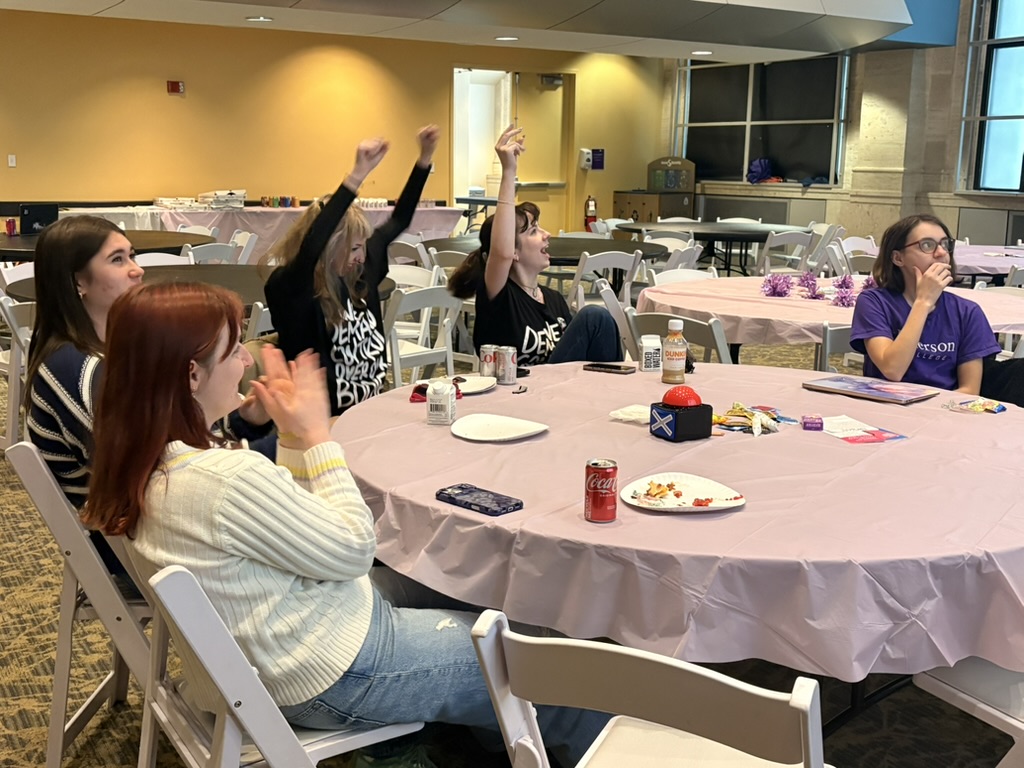
Emerson College’s chapter of Planned Parenthood Generation Action decked out the Bill Bordy Theatre in pinks, purples, and pop music to host a Family Feud on Saturday that included questions about Women’s History Month and sex trivia that aimed to educate participants in a fun and non-judgemental space.
The event was mediated by PPGA Vice President Haley Kirchhoff, a junior musical theatre major acting as iconic Family Feud host Steve Harvey. Two teams — Glitter Clitoris and the Satin Dams — faced off against each other. One player from each team raced to hit the buzzer to answer questions that ranged from different kinds of sex positions to the activist who co-founded the first National Woman Suffrage Association.
Keandra Hunts, a graduate theatre education and applied theatre major, said she enjoyed the bright decorations and playing the game. Hunts participated in a game that involved guessing the most common answer to a sex ed question from an online survey that was sent out to Emerson students. Although some answers from her peers, she said, concerned her, as they presented a lack of proper sexual education.
“I was really surprised that we were getting our answers from … TikTok, Reddit, and Google,” Hunts said, referencing a question that asked where students looked for answers about sexual health. “I was hoping that talking to friends would be at least higher.”
Being from Texas, Hunts’ health classes growing up mainly emphasized abstinence from sex. She said she relied heavily on the knowledge of her friends about sexual health and education before she took a course at Texas Tech University called Life, Love, and Money. The course taught her how those three things tie into a person’s wellbeing in maintaining personal, social, and emotional skills.
“I would 100% advocate for there to be a course [at Emerson] about sex [and] how to live your life outside the arts,” she said.
Parker Greaves, a freshman creative writing major who recently joined PPGA as an events coordinator, had a positive experience helping organize the event.
She explained how she was surprised by how many of the survey participants, when asked about their sex education in school, said they wished they had been taught more about pleasure or queer sex. This was different from Greaves’ experience at her school in Oregon, which she described as being very comprehensive.
“I had an initial sex ed that mostly focused on puberty in middle school, and then a family and emotional health class in my junior year,” she said. “So it was pretty thorough based on what I hear from people.”
Maile Damon-Tollenaere, a University of Connecticut student invited by her friend, Greaves, who participated in the event, said she had a good foundation of sexual health, despite spending half her high school years in Catholic school, but expressed disappointment in the public school system overall.
She said students’ survey answers about wanting to learn about safe sex practices beyond abstinence “really show how lacking our sexual education is in the U.S.”
The event was intended to be an intercollegiate effort with PPGA chapters from Northeastern University, Suffolk University, and Boston University, none of which had students attend. BU and Suffolk canceled within a week of when the event was supposed to take place.
“It ended up just being Emerson students, but we were happy to have the Emerson students that showed out, and I think we still had fun anyway,” said PPGA president and co-founder Anna Knepley.
Knepley said she was impressed by the diversity of survey answers related to the services Planned Parenthood offers.
“I was impressed that people were able to name resources other than abortion … like STI testing and other answers,” Knepley said. “I was impressed that we are kind of combating that stigma here and that people are more aware of the other options that Planned Parenthood has.”