


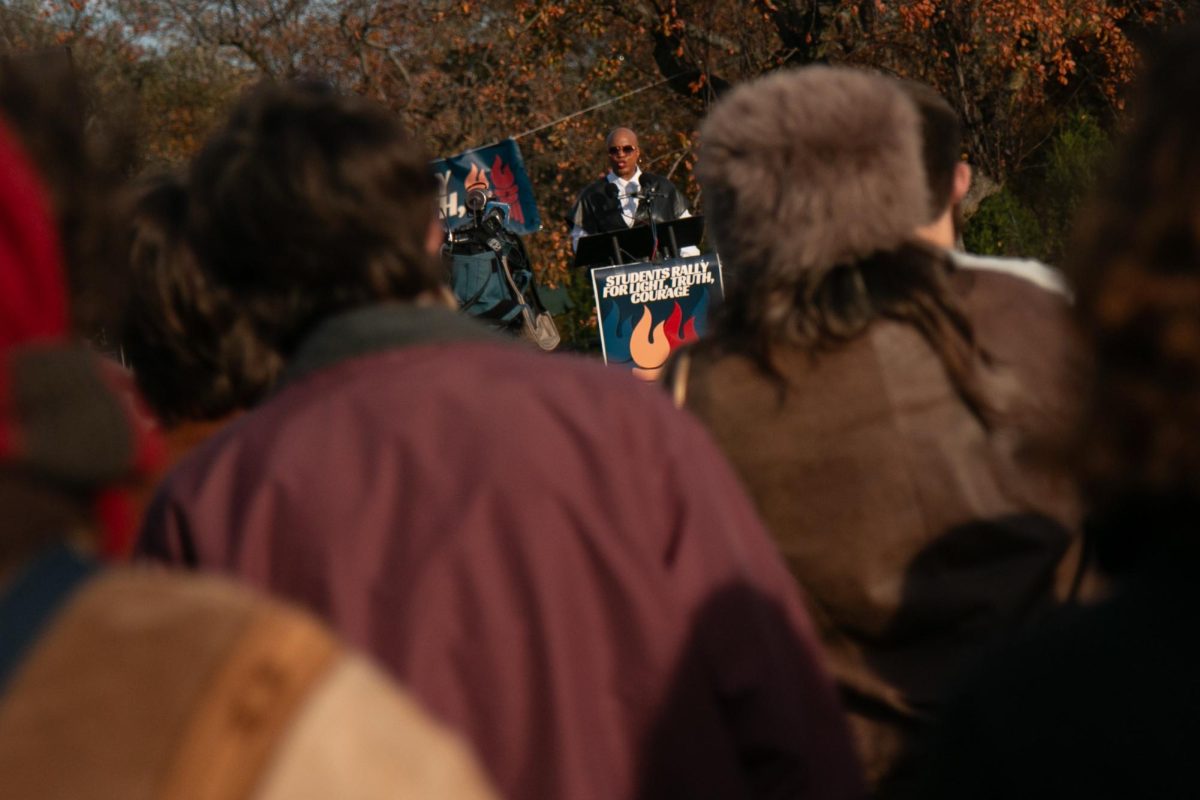
Hundreds of protesters gathered at the Back Bay Fens last Saturday to demand that universities protect their students amid President Trump’s attacks on higher education. The protest, organized by The Educational Freedom Project, included outreach efforts from student and local advocacy groups and speeches delivered by political leaders, student advocates, and Boston area labor leaders.
The event, named the “Students Rally for Light, Truth, and Courage,” specifically called out the Trump administration’s policies on immigration, diversity, equity, and inclusion, and research funding. Brynna Quigley, a Northeastern student volunteer with the EFP, told The Beacon that these issues are not just national problems—they also directly affect higher education.
“What we want right now is for our universities to stand up and say we want protection and transparency,” Quigley said
“There’s so many students who feel like there’s no way to help, and they’re overwhelmed by what’s happening with the federal government and at our schools,” said Kate, another Northeastern student and event organizer for the EFP, who declined to give her last name. “I think this is a great opportunity for them to have tangible actions.”
Recent cases of Boston College students being detained by ICE have sparked widespread concern among Boston area lawmakers, civil liberties groups, and campus communities, many of whom view the detentions as politically motivated overreach that creates fear and uncertainty for students across the city. One of the most prominent instances in the last year was the detention of Tufts international graduate student Rumeysa Öztürk in March. Öztürk was detained and transported out of state by immigration officials after the publication of a pro-Palestine Op-Ed she co-wrote for the Tufts Daily.
In an interview with The Beacon, Councilor At-Large Julia Mejia, who spoke at the event, said it was important for students at all institutions, even those that she called “small but mighty,” like Emerson, to make their voices heard.
“It’s the heart of the students that are in those institutions that should be leading,” Mejia said. “The administration, those who are in higher positions, need to understand that they wouldn’t be in those positions unless you guys were paying your tuition.”
The Trump administration’s attacks on research funding for institutions that practice or include DEI initiatives have put a dent in academic funding. Many universities are dependent on the federal government for the most important work their doctors, engineers, and scientists do, with American universities spending $60 billion in federal money on research and development in fiscal year 2023 alone. Emerson College has renamed some of its offices and positions related to DEI program pages.
In an interview with The Beacon, Congresswoman Ayanna Pressley, who also spoke at the rally, echoed Mejia. She said that students at smaller institutions can get involved in opposing the national government.
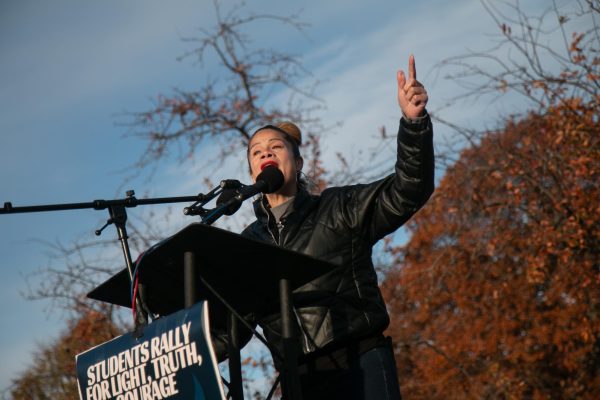
“Recognize that your silence will not save you. You don’t want to be complicit in the harm done to you.” Pressley said. “And this is not the sort of thing that you can retreat to the corner and just hope that it’s going to work out. We have to actively resist, reject, and agitate.”
Pressley said students should hold their institutions accountable for complying with Trump policies, and reminded students that their schools are “not anything without you.”
Kate added that students have historically been actors of change and that they must continue that legacy.
“If you look at history, students are [a] huge group of people that can get things done through activism,” she said to The Beacon. “It’s important to show the current generation that it should continue, and we have the power.”
Kate said that maintaining protection for international students under Trump’s administration is incredibly important, and that they were an integral part of universities in Boston and across the country. She pointed to Northeastern, which has the second-highest international population in the country, with more than 20,000 students representing 141 countries.
Mejia said that the attacks by the Trump administration against immigrants and the LGBTQ+ community were “the training ground” for the eventual stripping away of everyone’s rights. Since returning to power, Trump has proposed rolling back LGBTQ+ rights, including the elimination of protections for transgender students.
“It’s so important to have young people standing up … and that they stand up when everybody else is bowing down,” Mejia said to the crowd.
The event also demanded greater transparency from institutions about campus policies, in particular surrounding free speech and protest. Free speech on university campuses has continued to be a much-debated topic across the country since Trump took office. Emerson College is among those grappling with these issues, with many calling into question protest policies that were implemented after the arrest of 118 protesters during Emerson’s pro-Palestinian encampment in 2024.
Northeastern University’s campus has been embroiled in similar debates to Emerson’s. Protest policies allow for peaceful demonstrations by students, faculty, and staff if they apply for permission in advance and follow specific guidelines. However, students have pushed back against the policy, arguing it restricts free speech and creates barriers to organizing. They say the policy is inconsistent with the university’s stated commitment to free expression and have called for reform and greater student involvement in shaping the rules.
“We shouldn’t have to go through this obstacle course to be able to speak our minds, whether that be in the classroom, at a demonstration, or on our campus,” Kate said. “Schools are a place to learn and present any opinion, no matter what that may be, and our schools aren’t really protecting that.”
She continued, explaining that it was important to represent the beliefs of those in universities, and that the school administration “isn’t the school.” She said that students, faculty, and others are more representative of what the school is.
Another goal of the event was to encourage direct action. Kate explained that, in the face of the current federal administration, many students feel lost in what they can do.
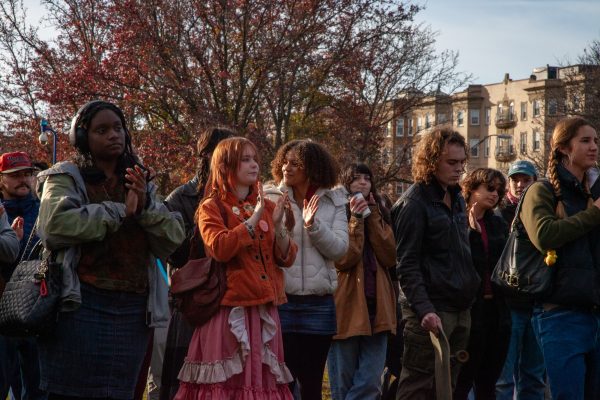
One group present at Saturday’s protest was the Assembly for Civic Engagement in Mass. Higher Education (ACE), a coalition of students, including those from Emerson, whose “goal is to increase student collaboration with the state of Massachusetts in order to better influence policies that affect education,” according to their website.
A stand promoting the group was run by Wellesley College students, who told The Beacon why they felt it was important to make the trip to Northeastern to spread awareness about their message.
Sidney Briggs, an ACE member, said that a lot of work has been done by EFP to get more students involved, such as creating events on and off campus and growing their message. Briggs hopes that ACE can grow by doing something similar so that they can “get more schools represented.”
Kate agreed with this notion, explaining that she hopes more schools will come together to hold their institutions accountable. She said that she hopes the event shows those who are feeling threatened by the Trump administration’s policies that there are people fighting for them.
“I hope that some people see this rally, that there are people who are willing to take real action and are working on it tirelessly,” she said.
Mejia said that students should never feel that their voices are not important and that they have the power to promote change.
“You’re not as powerless as people have led you all to believe, you have to step into your power and demand it… We have to show up,” Mejia told The Beacon.