


This article contains spoilers.
In 2011, fans watched the last scene of their favorite characters fade to black as the iconic John Williams score played the second part of “Harry Potter and the Deathly Hallows” to its end. The blockbuster “‘Harry Potter” series concluded after 10 years of nonstop film releases that made it one of the highest grossing franchises of all time.
But to fans’ delight, in 2015 the author of the original series J.K. Rowling announced a play that would act as a sequel to those beloved books and movies. It opened on the West End in 2016 to the immense enthusiasm of its audience, thrilled to see the magic they loved back in front of them again.
Now, that eighth story has come to Boston in the show’s first American national tour.
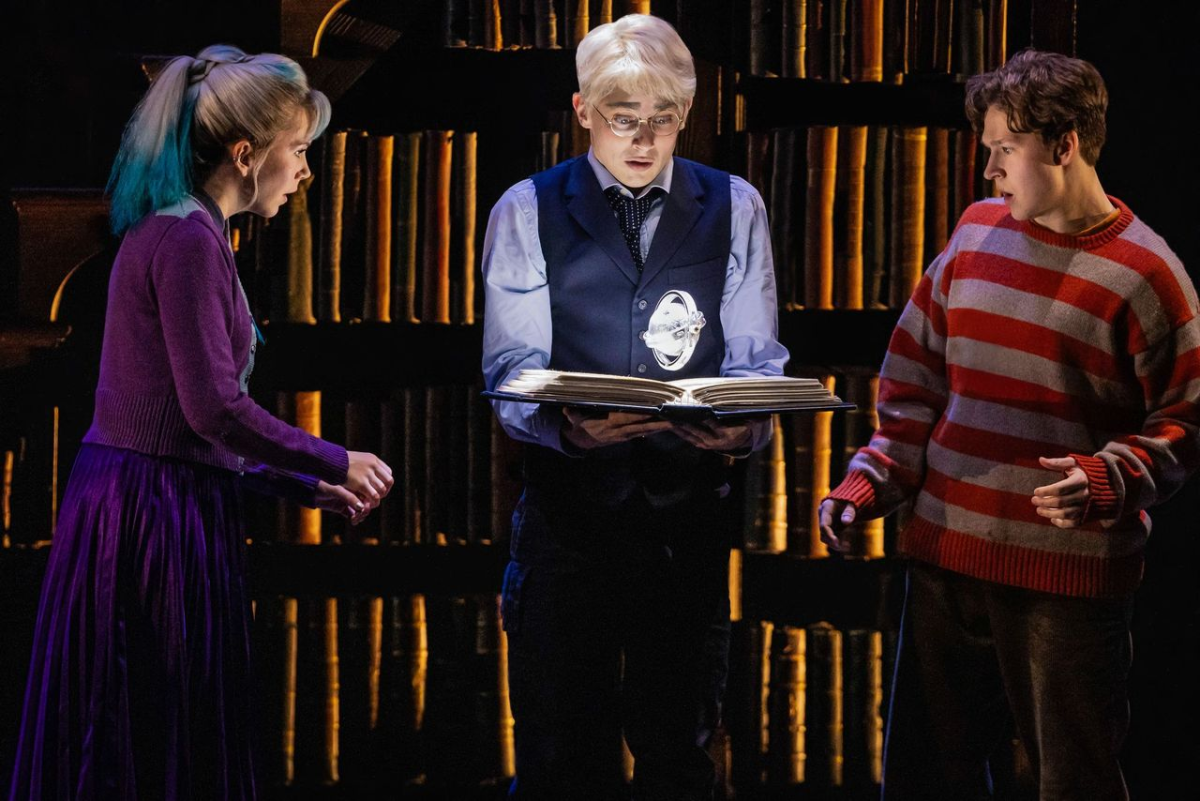
“Harry Potter and the Cursed Child,” an original story written by Rowling, Jack Thorne, and John Tiffany, will play at the Colonial Theatre from Nov. 9 to Dec. 20. The play follows Harry Potter’s (Nick Dillenburg) middle son Albus (Adam Grant Morrison) going to Hogwarts. He becomes best friends with Scorpius Malfoy (David Fine), the son of Harry’s rival Draco Malfoy (Ryan Hallahan). Albus’ tumultuous relationship with his father sets off a chain of events that might rewrite the history of the whole wizarding world.
This brilliant performance explores the emotional demons that Harry himself had yet to face, including his reckoning with the sacrifices people made for him, and his complicated relationship with his mentor, Dumbledore. The play is as much Harry’s story as it is Albus’, homing in on the theme of father-son relationships and what the legacy of Harry’s fame means to them.
Albus and Harry’s journey takes fans back to Hogwarts in a way that feels fresh while still incorporating nostalgic elements, like the different color specific house uniforms, and seminal moments like sorting the first years into those houses. Familiar characters from the movies, such as Professor McGonagall (Katherine Leask), Hermione Granger (Rachel Leslie) and Ron Weasley (Matt Harrington), appear to the glee of longtime fans eager to see more of their favorites.
The show features some incredibly impressive practical effects. Ghostly dementors, the guards of wizard prison Azkaban, floated down toward the audience like real apparitions. Time Turners, a time-machine-like device, levitated in the air as clocks throughout the set turn back furiously, the lighting making the stage seem to bounce into focus as the characters arrive in the past. Bookcases swallow up intruders, characters turn into one another by use of the agonizing Polyjuice Potion, and paintings offer advice as they talk and move in their frames.
Bringing magic to the stage required a delicate choreography between actors, practical effects, and sound design, which was executed flawlessly throughout the show. The unlit back of the stage became an innovative way to make the magic happen, as it shadowed people dressed in black who moved chairs and other items through the air, creating the impression that the items were moved by magic. Fire shot out in the air for one spell, while others lit sparks into the air.
The play covered four years of Albus’ time at Hogwarts, and to show the lapse of time, the ensemble performs ‘robe choreography,’ using dramatic swooshes of their billowing Hogwarts robes in synchronized movement in dance-number-like sequences. This, alongside the sweeping score and lighting effects that flashed as the ensemble moved, creatively denoted the transitions between places and points of view. The iconic Hogwarts moving staircases help with this too, gliding across the stage to pull characters apart and back together as time passes.
The main conflict of the show stems from Albus’ struggle at Hogwarts, which leads him to resent his father’s fame. So, when Albus overhears a conversation in which Amos Diggory (Larry Yando) begs Potter to bring his son, Cedric, back from the dead, which Harry refuses, Albus takes it upon himself to right his father’s wrongs. Cedric was the “spare” that was killed to get Harry alone and resurrect Voldemort in the fourth film, and the aging Diggory father agonizes over his son who was taken too soon.
Albus and Scorpius meet Delphi Diggory (Julia Nightengale), Amos’ niece, who agrees to come along with them on their mission. Their endlessly comedic wild goose chase of stealing a time- bending Time Turner from Herminone Granger’s office and returning to their parents’ pasts, changing them, eventually leads to a sobering, dark new reality at the end of the first act.
Scorpius discovers a world in which Voldemort was resurrected due to their meddling with the timeline. With the help of Severus Snape (Larry Yando), he fixes Albus’ and his mistakes, and returns to the present to tell Delphi and Albus of that dark world. Delphi becomes transfixed with that possibility, revealing she is actually the daughter of Voldemort himself, who was born to bring about the dark wizard’s return.
Delphi was fun to watch on stage, and her true identity added tension to the play. However, this aspect of the play went too far off the track set by the original books and movies. The revelation is a cop out to bring Voldemort back from the dead to make him a villain yet again. The explanation of the reveal felt rushed and glossed over, making it harder for the audience to believe. For longtime Potter fans, the fact that Voldemort, who is canonically unable to love or even desire anyone, would ever want a child was too far-fetched to believe. The production did the best they could with the source material, but the plot detail felt unfaithful to the original story.
Despite the odd changes, the play is an incredibly human tale about both the relationships between a father and a son, and between a boy and his best friend. Albus and Scorpius grow closer among the pains of adolescence, while Harry learns to connect with his son and be a better parent.
The play charms old and new fans alike by bringing magic to life before the audience’s eyes. It brings people into Hogwarts as if they were students themselves, suspending their disbelief by bringing magic to life on the Colonial’s stage.

This show being at Emerson, a school renowned for being its queerness is WILD. I genuinely hope ticket holders know that J.K. Rowling gets a HUGE profit cut from this show and uses it to lobby for anti-trans legislation in the UK. She literally defunded a woman’s shelter for appointing a trans woman on the board of directors. She’s not a controversial figure. She’s a Holocaust denier and an anti-trans lobbyist. As a trans student it’s disheartening and sickening. Especially right now.