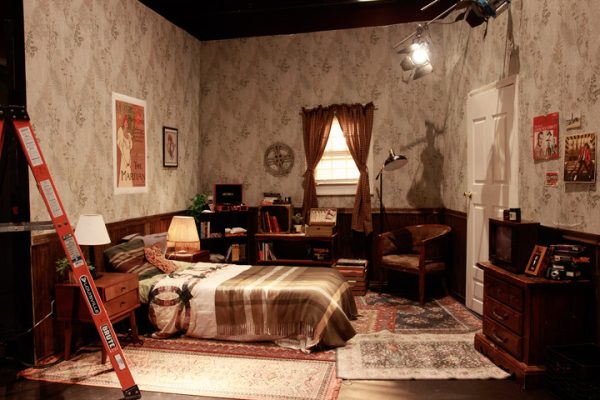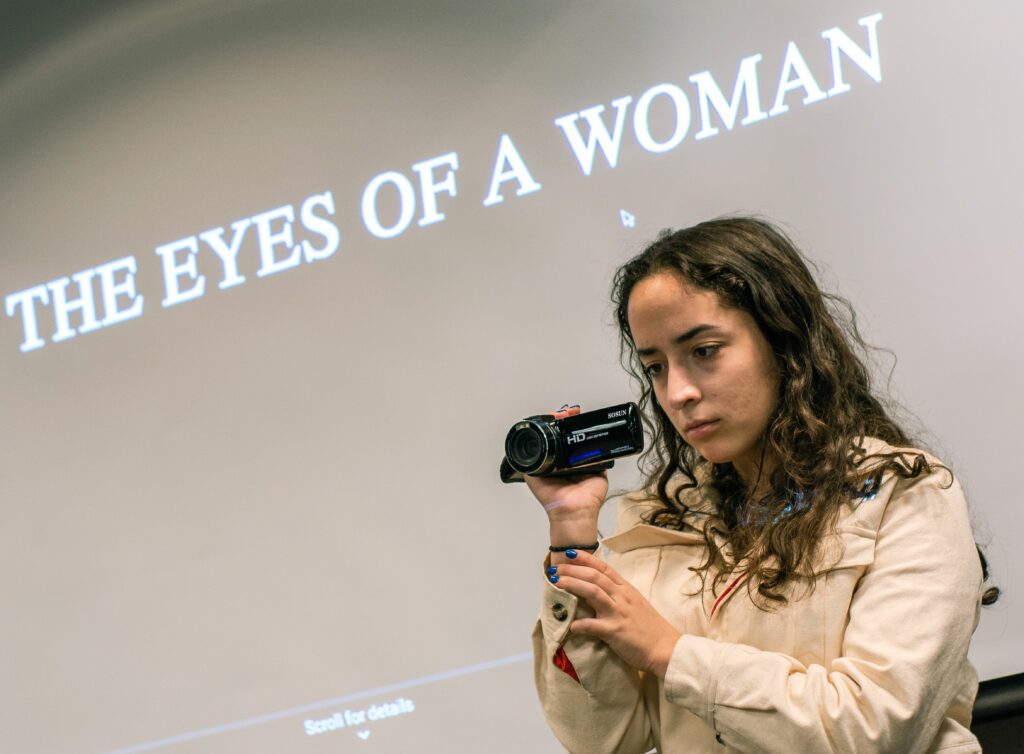



Jonathan Kirkpatrick set the bar high when he submitted his senior capstone BFA pitch a year ago: staging a play with a live audience as a film. This past weekend, it was brought to life in the form of “When Summer Ends,” an experimental theater-film hybrid performance.
Instead of the typical one-medium theater experience one would expect, two camera operators took turns on stage filming various scenes of the play to create a separate short film that was livestreamed on a screen above the stage. The idea for the BFA came to Kirkpatrick before Emerson College, when he was fully immersed in high school theater in Virginia and not yet a visual and media arts major.
“I got into theater and developed a real love for live performance, but I definitely felt like there was something missing,” Kirkpatrick said in an interview with The Beacon.
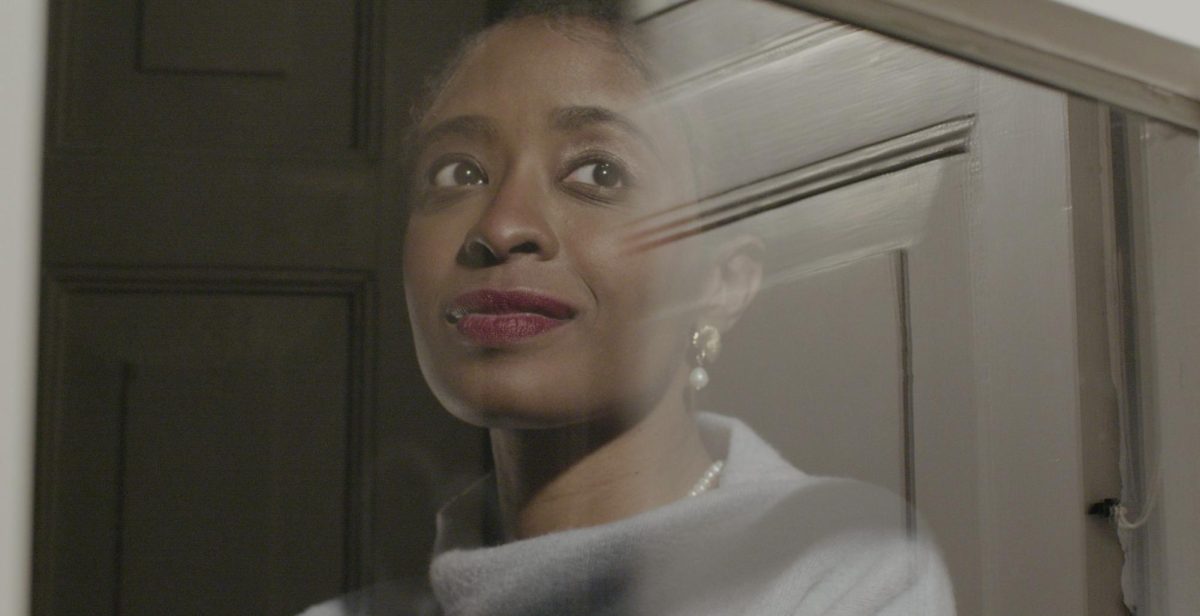
“When Summer Ends” tells the story of two artists, Eli (Liad Lewandowsky) and Danny Joy (Alexandra Azan), who fall in love and move to Los Angeles. Through a unique never-before-seen collaboration of the School of Film and Office of the Arts, Kirkpatrick found that missing piece, setting the stage — and the set — for this production to exist.
“I wrote the first scene you see in the show and actually submitted it as a script sample to Emerson,” Kirkpatrick said. “I honestly just threw that application out there in the hope that if they wanted to do something experimental and different, they would accept me. And they did.”
Such an unprecedented production did not come easily to the cast and crew. When he was approved for his BFA a year ago, Kirkpatrick quickly called in talent he previously worked with to prepare for the two-semester-long undertaking. Producers Victoria Capitano, Beckett Hobbs, Claire English, Luca Bevilacqua, Sofia Belgiovine, Ellie Abbey, and stage manager Nora Beirne had their first meeting in July 2025 with Kirkpatrick to set expectations and assign roles.
Hobbs, English, and Bevilacqua spent the fall semester nailing down location. While originally pursuing off campus locations, the producers ultimately landed on the Jackie Liebergott Black Box in the Paramount Center through anything but ordinary means.
“There’s definitely territorialism within each department, and that comes from students, faculty, and a lot of places,” Kirkpatrick said. “It was really a matter of finding and making connections to the right people who really saw our project for what it was hoping to be and were willing to share their resources to make it happen.”
Paramount Soundstage manager Travis Trudell helped with rehearsal spaces for the BFA production as School of Film students are not typically allowed in performing arts spaces.
“The opportunities for collaboration were exciting, and Jonathan was put into a rare position as being the first student to combine all of these disciplines together,” Trudell said. “To do it in such a professional and sensitive way, and succeed as well, made it all the more poignant and extraordinary.”
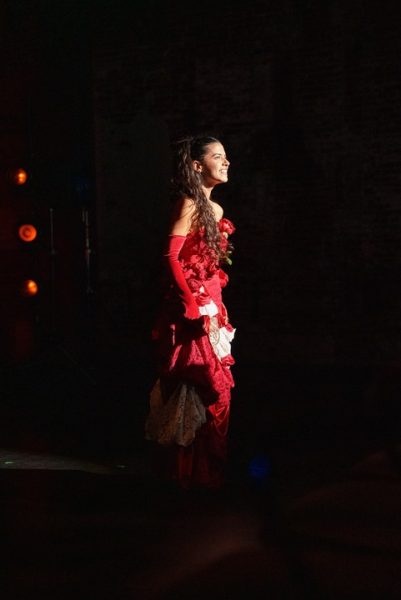
These logistical hurdles didn’t deter Kirkpatrick’s grand vision for this project; every detail of the show was meticulously planned and sought after. One of the first phone calls he made last June was to Morgan Burke to create character Danny Joy’s final costume, an old Hollywood inspired red velvet dress stunningly handsewn with fabric roses.
“Jonathan called and asked me specifically to make the rose dress for the last scene of the show,” Burke said. “It was 30 hours of work for one minute on stage, but it was a very important last moment and one of the first distinct visions Jonathan had that stayed consistent.”
Burke’s laborious work for a singular moment in the play was not an outlier but the norm for “When Summer Ends.” As opening night approached and the crew went through tech week, Capitano spent long days focused on the smallest of details. A week before the performance, she spent an entire nine-hour day alongside her team figuring out the mechanics of pulling a specific type of curtain, which took up only 30 seconds of the 50-minute play.
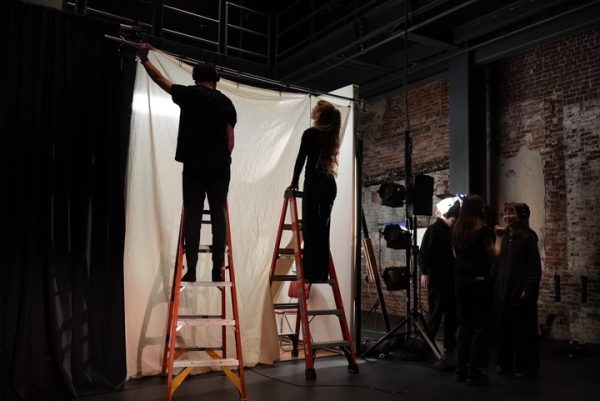
“We all worked together to create the idea of it. It was a lot of physics and trial and error, but it ended up being one of the coolest parts of the show and my favorite thing we figured out,” Capitano said.
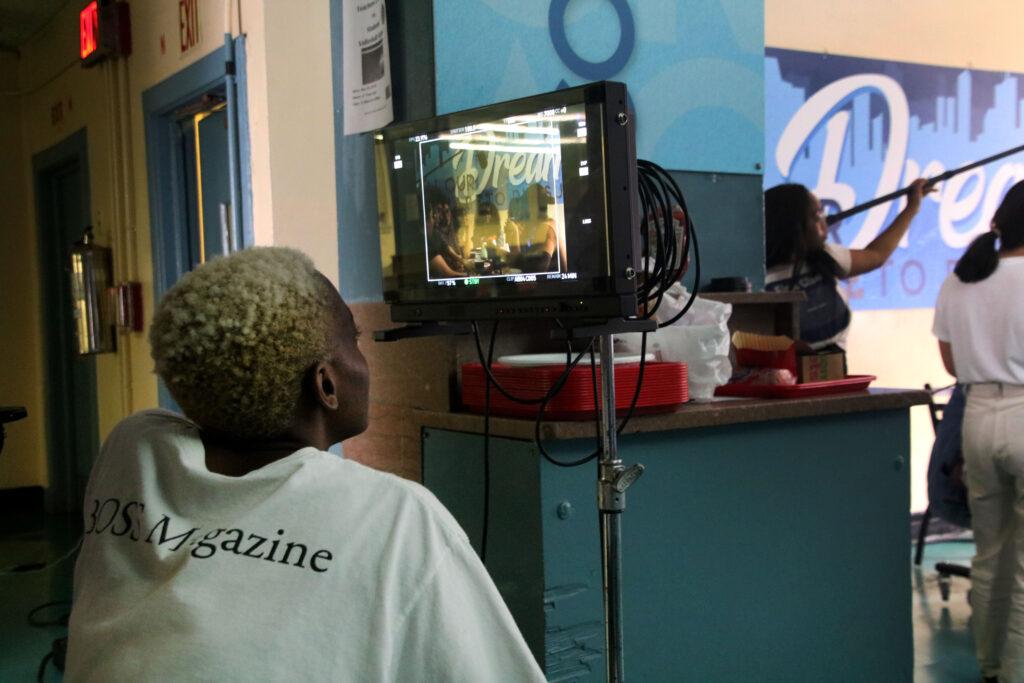
Ela Moss also worked long hours during tech week as one of the gaffers, working with a team of grips and programmers for the show’s lighting system. A lot of the programming could not be done until close to production time due to lack of access to a lighting board.
“It was a lot of hard work from the programmer, and by tech week, we were just really having fun with it,” Moss said.
“When Summer Ends” doesn’t just mesh theater and film together, but also uses dance as a form of storytelling. Abby Moser choreographed the couple’s dance for Lewandowsky and Azan — and for camera operator Caleb “Cable” Van Epps, who filmed the show from on stage.
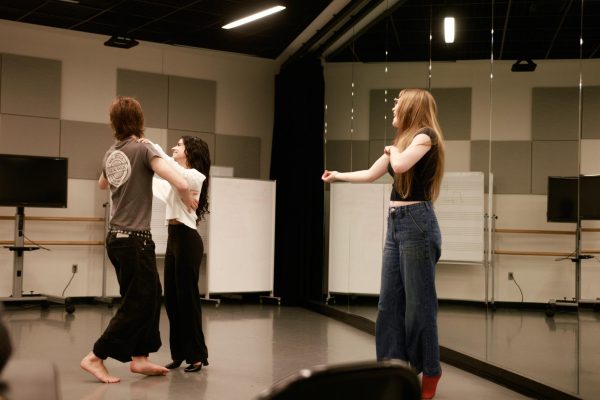
“I knew there was going to be dancing, but I didn’t know I was going to be the one to shoot it,” Van Epps said. “I’m not used to [being on stage] because usually I’m invisible. I’m normally performing just for the look on camera, but this was also me performing for the audience.”
Van Epps interchanged camera work with Evan Junas, who was also director of photography. The pair, who previously had only worked on traditional film sets, said their roles were unlike anything they had done before. Being a part of the performance was not something they were used to, but they took it in stride, becoming a pivotal part of the viewing experience.
“A lot of people at Emerson don’t know what goes into film,” Junas said. “When we implemented the camera into scenes, I became a third character, enhancing the performance through the camera work on stage.”
While focusing on the two main characters, the show also includes the director character (Sofonyas), who appears more for the live audience than the cameras, almost haunting the stage narrative. Donning red gloves, which Danny Joy and Eli wear at the end of the performance, the director represents the control the film industry often has over performers, ultimately showing how even the two protagonists can’t escape it.
“‘When Summer Ends’ is such an innovative achievement that still has me thinking about it,” affiliate School of Film professor David Bendiksen said. “This was unlike anything I’ve seen before.”
While the crew wrapped up their live performances on March 21, the story is not over for “When Summer Ends.” Many of the show’s producers are shifting focus to their own BFAs this summer. Hobbs is directing his BFA, “Bow,” this May, with Kirkpatrick and others being producers on set. Capitano is in pre-production for her BFA, “Dearly Beloved,” shooting July, tapping Kirkpatrick as director of photography.
“Coming out at the end of any project that you’ve been working on for a year, you’re going to be a very different filmmaker by the end of it than you were at the start,” Kirkpatrick said. “In order to pull off a project of this scope and scale I had to find and put my trust in so many people that were not me.”