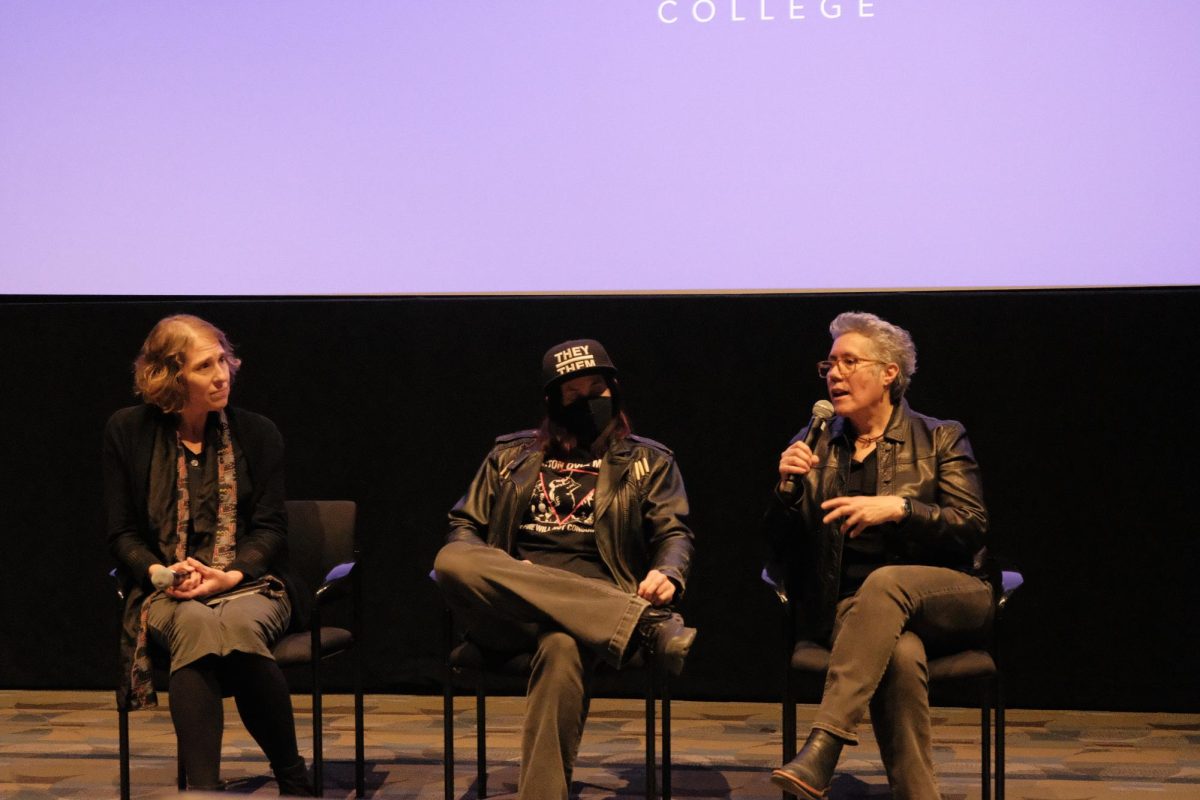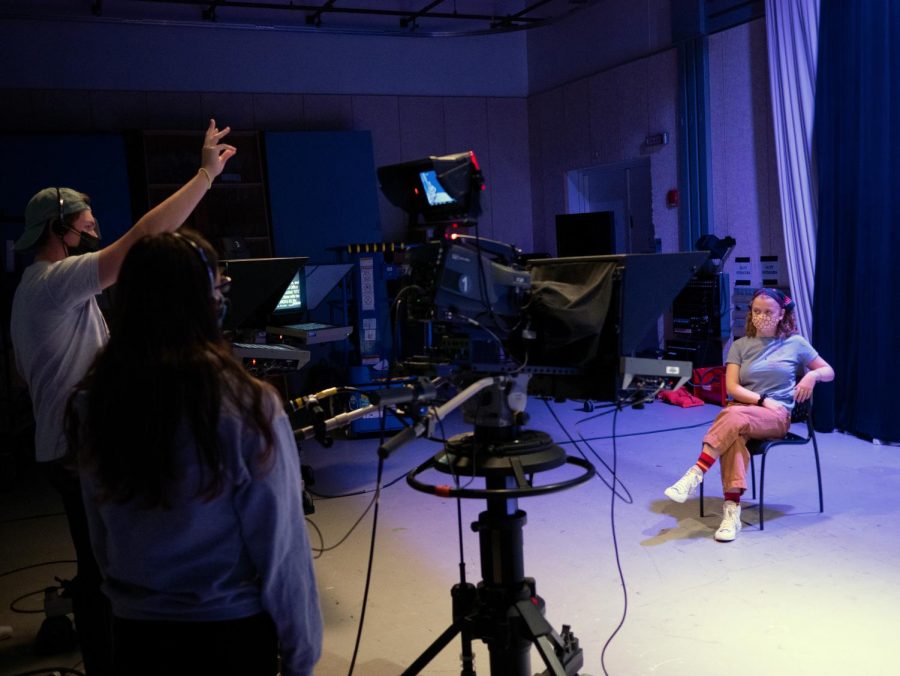


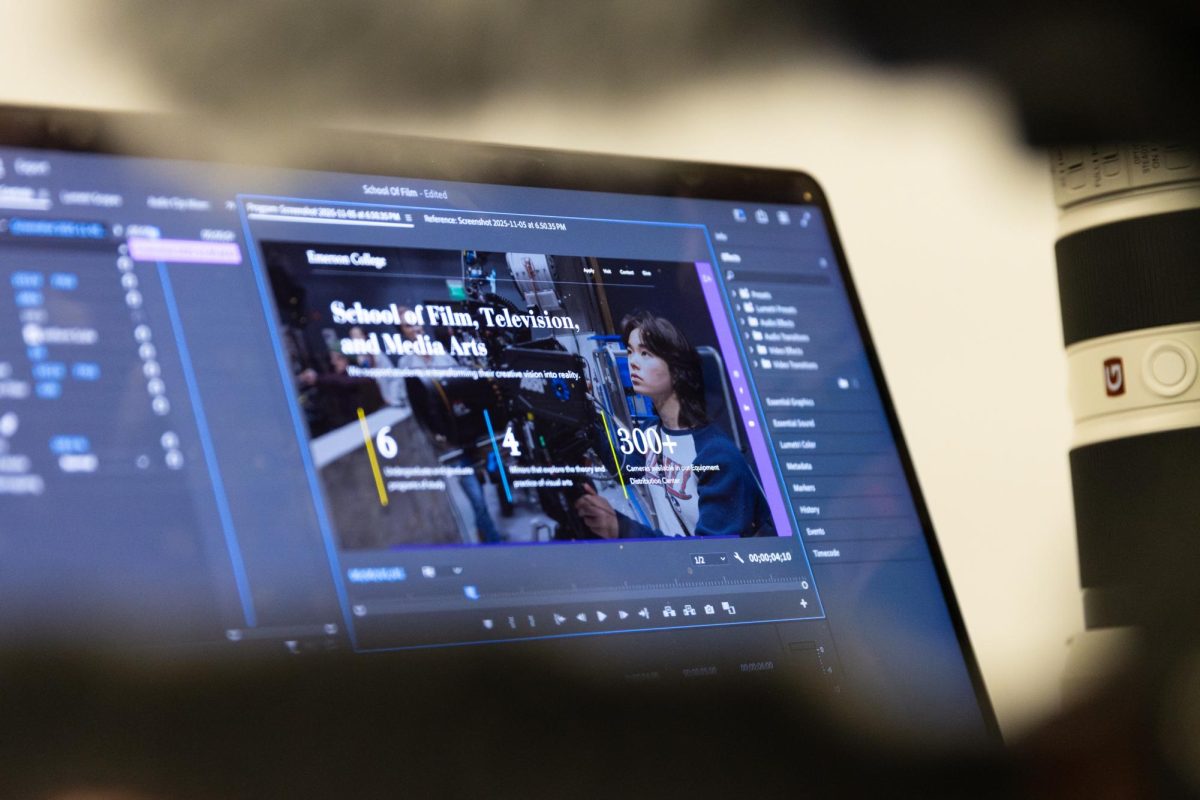
When the inaugural class of Emerson’s School of Film stepped back onto campus this fall, little appeared to be different to the naked eye. But behind the scenes, faculty had been working all summer to revamp the program.
Such was the impression on Diya Garg, a junior media arts and production major, who didn’t notice many changes to her studies. However, the excitement about the name change has made her excited about the future.
“I feel like the School of Film just makes it more official,” she said. “Given that Emerson is largely a film school, it’s good to have that appreciation; that tag that I’m from a school of film.”
After years of being housed as The Department of Visual and Media Arts, Emerson’s renowned film program entered its next act with a new name: the School of Film, Television, and Media Arts. Emerson’s first film classes began in 1984, and the program has since become Emerson’s most populated department, with nearly 1,605 students.
The change was announced in an email to the SOF community over the summer. The updates are focused on increasing opportunities for students by adding new courses and more technology. The former chair of VMA, Shaun Clarke, now the interim dean of the School of Film, said it was “a college-wide effort” to make the changes.
“[The changes] happened for a number of reasons,” Clarke said. “The success of the VMA program, the size of the VMA program, the ability for the program to kind of flourish in its new configuration of the school, were all considered as factors when it came to making the change.”
Less than two weeks after the initial announcement in July, The Hollywood Reporter named Emerson the 6th best film school in the U.S. for 2025.
Garg expressed her satisfaction in the programming the college already offers and said they are indicative of the elite ranking the SOF received.
“I’m proud…we have all the resources that a lot of good schools don’t, and we’re very privileged in that sense,” Garg said. “To some extent, we do deserve the title.”
Along with the name change, the updates to the SOF will include evaluating co-curriculars and continuing to add courses and resources. A student advisory council was created to ensure the program is meeting expectations, Clarke said. The council is made up of 15 students and meets weekly to discuss the next direction of the SOF.
Carlson Jones, a senior media arts production major, was chosen by faculty to be on the council because of her status as the senator of SOF in Emerson’s Student Government, formerly the senator of VMA. Jones hopes that the creation of the council will improve the relationship between the administration and students in the program.
“My biggest hope is that conversations can be started, and that we can continue to build trust between administrators and students,” Jones said. Mia Staiti, a sophomore media arts production major on the council, says a crucial aspect of the recent changes is that students are able to hone in on topics they’re more interested in, rather than take classes on broader topics, something she thinks will benefit everyone.
“I think it’s especially promising for people whose interests right now aren’t necessarily covered by the VMA department,” Staiti said.
Harlan Bosmajian, a professor for the SOF, is also excited by the development of the curriculum, particularly about new screenwriting and directing classes.
“I’m hoping the result of this kind of transfer formative process will be a greater integration of curriculum across the different areas of filmmaking and art,” Bosmajian said.
Courses that have already been added for next semester include Immersive Media in the AI Era, Music Video Production, Visual Programming for Games, and Forms of Resistance. Students will also have access to new virtual and game production studios, as well as ARRI certification, a training program for use of ARRI technology and workflows.
Concerning the increase in classes focusing on AI, Clarke said he has considered the creative and ethical concerns of AI and film. He said that courses centered on emerging technologies are crucial for SOF students, and the use of AI will remain an ongoing discussion.
“It’s hard to avoid those conversations nowadays, inside the classroom and outside the classroom,” said Clarke.
The administration has restructured some staffing in the SOF by creating new leadership positions and creating a faculty committee, though no significant changes were made in terms of faculty or staff numbers within the school. For the future, Clarke says the committee is consistently making sure curriculum and resources evolve to reflect the needs of students.
“[We] want to make sure that students have pathways towards careers that they want to pursue beyond Emerson College,” Clarke said.
The student council, which will be meeting until the end of the semester, is mostly focused on how the SOF can further develop to support students beyond this year.
“I feel really hopeful about future classes and my friends who are sophomores and younger, and just hopeful for the school overall,” said Jones.
Bosmajian, referencing The Hollywood Reporter rankings for 2025, sees the continued expansion of film at Emerson as both a time for celebration and a mandate for further improvement.
“Let’s get to fifth next year,” he said.