


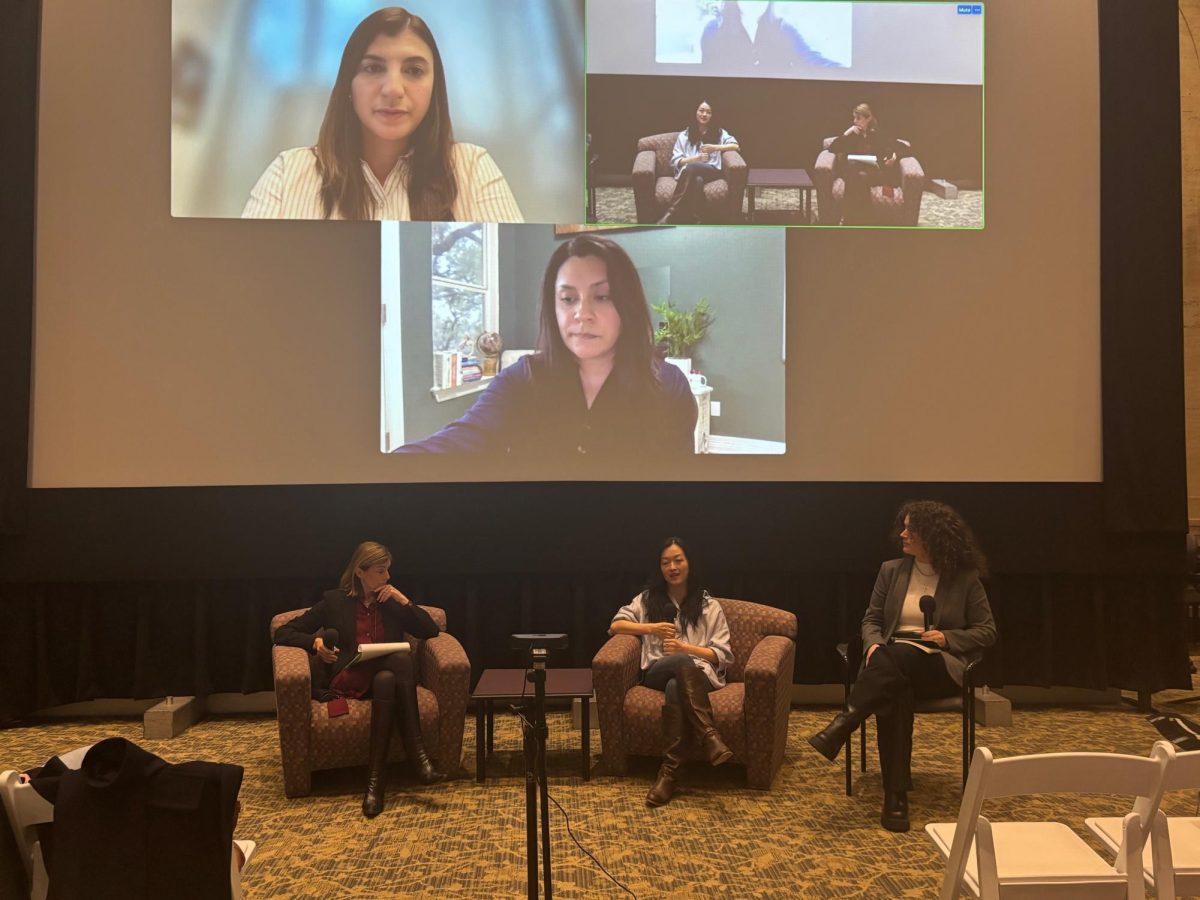
On Wednesday evening in the Bill Bordy Theater, four award-winning journalists spoke with enthusiasm about a subject that many students at Emerson College are vehemently against: the use of AI.
As the panelists, half of whom appeared in person and half through Zoom, and senior journalism major and moderator Anastasia Petridis began the discussion, around 35 faculty and students filed into the room. Some were chattering curiously about what the evening would entail, and others were skeptical that their opinion on AI could be changed at all.
“I have a lot of hesitation to use AI just because I feel like in the past I didn’t need it, so why should I need it now?” said senior journalism major M.J. Membreño.
Lisa Pierpont, a professor of broadcast journalism at Emerson and a Boston Magazine columnist, opened the lecture by emphasizing that AI in journalism is not a conversation about a hypothetical future, but something that is already being used in newsrooms. She noted that many in broadcast, including journalists at CBS News Boston, use AI to transcribe audio, and WCVB Channel 5 uses a tool called LegalLense to summarize legal documents.
“I can go down the whole list, but everybody [is] using [AI] in different ways,” Pierpont said, discussing how AI can help journalists streamline tedious processes.
For Upasna Gautam, a partner in strategy and innovation at The Texas Tribune who appeared as a panelist on Zoom, the question isn’t how AI should or shouldn’t be used. Instead, it is how it can solve problems and increase workforce productivity through a product mindset, where AI delivers value in helping solve customer problems.
“That product mindset trains you not just to build things with AI, but rather to build the right things that solve the most critical problems for the right reasons, with minimal risk and unintended harm,” she explained.
Although Gautam said that AI is not the answer to every problem, she believes AI in newsrooms is an aid rather than a hindrance, and having a product-led mindset adds value to newsrooms’ audience, purpose, and business goals.
Marisa DeCandido, another panelist on Zoom and director of Magid, a company that uses AI-powered tools to help businesses in their market strategy, agreed. In her role, she is responsible for helping newsrooms across the country gain insights and streamline workflows through the use of AI.
“A lot of [the work] is trying to help [newsrooms] determine exactly what they need to solve for and where these tools can fit seamlessly into their workflow process,” DeCandido said.
When posed the question of where journalists should draw the line on the usage of AI, Chi-Chi Zhang, the senior director of product at Yahoo! News, encouraged a shift in its perception. She tied it back to using AI as a product that helps the journalist focus on reporting and creating important stories instead of spending thousands of hours looking over notes and recordings.
“The ultimate goal is…understanding how your story is going to impact and resonate with the audience,” Zhang said. “And understanding that using AI, using a product mindset, in a lot of ways, is the most successful way to go about it.”
Paul Niwa, an award-winning associate professor of journalism at Emerson and former reporter for NBC and CNBC, joined his AI Collaborative students in organizing the panel. The program guides students in teaching them how to use AI ethically in their work. Niwa said that teaching up-and-coming student journalists to be more empathetic and to see AI as a helper instead of just a tool is integral to ethical uses of AI in newsrooms.
“The key to ethical use of AI is more courses in the humanities,” Niwa told The Beacon. “You’re learning about economics, learning about sociology, becoming more empathetic … learning from examples of others.”
At the end of the panel discussion, students remained split on the future of AI in the media. While some said they had their opinions changed and were hopeful about the future integration of AI in newsrooms, others left with skepticism about its ethics.
“The fact that it’s being used on the more procedural things is good to know, and it makes me feel a little more secure, but I’m also not fully convinced that’s all it’s ever going to be used for,” said Sydney Guida, a freshman journalism major.
One of the many reasons Guida and several other Emerson students said they are against the use of AI is because of its harm to the environment. When asked about the environmental impacts of Magid, DeCandido replied that the company was too small to cause as much environmental damage as larger language learning models, such as OpenAI’s ChatGPT.
Guida had a hard time accepting the answer, noting that, despite the small size of Magid, Magid’s use of AI still had at least some impact on the environment, as AI is powered by data centers that often demand a large amount of electricity and water for cooling, which can disrupt local ecosystems.
“It’s not big like ChatGPT, but there’s so many little aspects of AI that build into something as significant as ChatGPT,” she said.
Membreño said she was split down the middle on the panel discussion.
“It gave me a different perspective, something that I hadn’t really considered that much with AI in journalism,” Membreño said. “I do think while it had answered some questions, I’m definitely left with other questions.”
Pierpont acknowledged that she knew several students, especially at Emerson, would be apprehensive about using AI in their daily lives, and even more so in their journalistic careers. However, similar to Zhang and Niwa, she encouraged students to see these changes as an assistive technology that will help students be better journalists and more employable in the field.
“People are scared, and they are threatened, and it’s understandable why people would feel that way,” Pierpont said. “So it’s not that AI is going to replace journalists, but a journalist…who is equipped with AI skills will replace a journalist who is not.”