

Bob Odenkirk is continuing his career shift from comedy to action with the help of writer Derek Kolstad, creator of the “John Wick” movies, combining the two genres in his upcoming independent film “Normal” (2026).
As a now award-winning actor, writer, and producer, Odenkirk’s roots are deeply buried in the world of comedy. He started off his career in the ‘80s and ‘90s writing for Saturday Night Live and co-creating “Mr. Show” (1995–1998) with Emerson dropout David Cross, but began a shift towards dramatic television in 2009, appearing in “Breaking Bad” (2008–2013) and garnering the attention of millions in the hit series “Better Call Saul” (2015-2022).
In a student press roundtable, Odenkirk and Kolstad detailed the ebb and flow of their collaboration process, comparing and contrasting their backgrounds in the film industry. They worked together on “Nobody” (2021) and its sequel, “Nobody 2” (2025), and “Normal” is a continuation of their give-and-take dynamic, where humor, graphic violence, and an archetypal hero’s journey all fight for the spotlight.
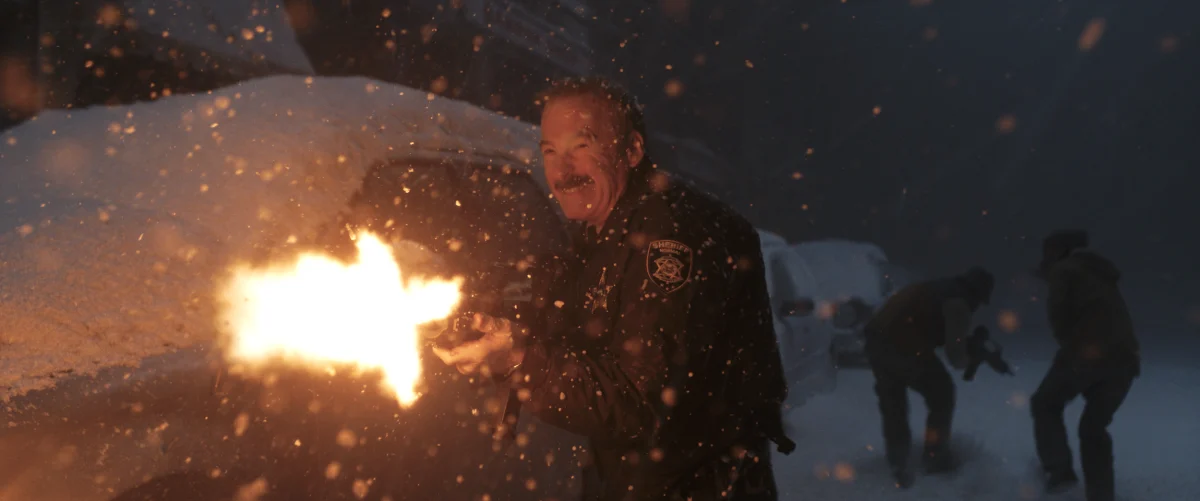
The film’s setting is similar to the towns the two grew up in — Odenkirk in Naperville, Ill., and Kolstad in Madison, Wis. — in a seemingly, but not so “normal” town, Normal, Minn. Exploring the meaning of normalcy by employing various versions of it as plot devices, the film follows a temporary sheriff named Ulysses, played by Odenkirk.
Emerson graduation speaker Henry Winkler ‘67 also makes a quick but unforgettable appearance.
For Odenkirk, the build up, rhythm, and algorithm of an action sequence is akin to comedy. The journey is like a comedy sketch, he said; there’s clever parts, turns, and ideally, a big moment at the end. Similarly, Kolstad said that he writes scenes in a three-act structure, starting out detailed, becoming a bit murky in the middle, then ending with a “staccato beat.”
In “Normal,” invention and innovation are vital to many of the fight scenes, just like in sketch comedy. During the roundtable, Kolstad offered an example, pointing to a circle shaped light in the room.
“If we were having a fight here, I would say, ‘That looks like a frisbee. Could we make it a frisbee? Could I tear it down and throw it to hit someone?’” said Kolstad.
This is where Odenkirk’s origin in improv bleeds through. “The other thing with [Odenkirk] is, if you want to make a movie, especially an independent movie, you leave the ego at the door,” said Kolstad.
For the filming process of “Normal,” no ego meant having open dialogue about the interpretation of the story on set, Kolstad explained. The director, Ben Wheatley, and one of the producing partners, Marc Provissiero, would suggest ideas, and Odenkirk would sometimes give Kolstad notes 15 minutes before shooting.
“None of us want to be locked into our role, we want to make sure that what we’re making is the best,” said Kolstad.
This balancing act between comedy and action is a delicate thing. Paying attention to when tension should swell and when it should release becomes a crucial aspect of maintaining the audience’s investment in the narrative.
“Oftentimes, with comedy, you’re building tension to poke fun at it and pop it. But in these films you have to be careful,” said Odenkirk. “If you want the final fights to matter, for people to stick around for them, and feel some type of reward from them, then you have to preserve that tension and that earnest connection to the material.”
Odenkirk added that you can’t make fun of this tension in a film like “Normal,” even though he often feels the urge to. When that urge starts to build, he acknowledges that he should take a step back, sensing that he’s on the “edge” of bursting the bubble the story needs to work.
Here, each genre displays its unique characteristics, which Odenkirk has become aware of through working with Kolstad.
Odenkirk said that when he works with Kolstad on a movie script, he often lets Kolstad take the reins, since the action genre is more of Kolstad’s wheelhouse. This became even more clear to Odenkirk through witnessing Wheatley — who also comes from the action genre — and Kolstad interact.
“It’s hilarious to see them together,” Odenkirk remarked. “The reference level is so deep, things that I’ve never heard of.”
Another balancing act the team had to pull off was considering the audience binary their film would be facing. Before its upcoming theatrical release on April 17, the film screened at the Boston Underground Film Festival on March 18. At the Toronto International Film Festival last year, The Hollywood Reporter called the film a “jaw-droppingly excessive blast of a crime caper.”
Those who attend film festivals, Odenkirk noted, tend to be viewers who cling to every detail and subtle plot suggestion; in other words, they don’t need a guiding hand through the narrative. Opposingly, audiences who might be watching the movie at home while cooking or doing other daily chores need you to “put your arm around them” to lead them to the minutiae worth picking up on.
“You hopefully want to engage them [the audience] on a level where they feel they did a part of the work,” said Kolstad.
A less obvious challenge the crew faced was figuring out how to portray a recurring moose in the film, which Kolstad characterized as an “oracle,” always lurking in the background. At first, Kolstad thought finding a trained moose in Canada — where the film was shot — would be easy. He was wrong. Instead, the crew ended up using a large stuffed moose they stumbled across in the lobby of a Cabela’s mixed with CGI.
When Kolstad first showed Odenkirk a short synopsis of “Normal,” Odenkirk was reminded of Lake Wobegon, a mythical town in Minnesota created by author Garrison Keillor for his radio show “A Prairie Home Companion.” In the radio show, the town is described to be a “little town that time forgot and decades could not improve.”
He was also reminded of the song “Harper Valley PTA,” a country song written by Tom T. Hall in 1968. In the song, a widowed wife receives a note from her daughter’s school’s Parents Teacher Association, claiming that she is a bad example for her daughter, “wearin’ your dresses way too high” and “drinking and a-running ‘round with men and goin’ wild.” In response, she shows up to a PTA meeting and calls out the members for their own conventionally inappropriate behavior.
While these two referrals may seem like simple personal attributions, they actually give a lot of insight into what “Normal” might be trying to tell its viewers: The concept “normal” doesn’t really exist, and if you think it does, it’s probably not the exact type of “normal” you were expecting.
Then again, Odenkirk’s tendency to deviate to freedom of interpretation leaves it up to the audience.
“I think a really good movie or a good piece of creativity doesn’t tell you what to think, or it doesn’t land in the most solid, parable-like, ethical lesson,” he said.
On April 9, “Normal” will be screened in the Bright Family Screening room for Emerson community members only as a part of Cinema Emerson.