

This article includes spoilers for “The Drama.”
“The Drama” released two weeks ago, and even if you haven’t seen it, you’ve felt its mystique: The Boston-based black comedy hinges on a massive capital-S spoiler. But unlike the talk-of-the-town movies of yore, the hype surrounding its big twist isn’t for some bombshell ending; instead, the film gatekeeps its very premise.
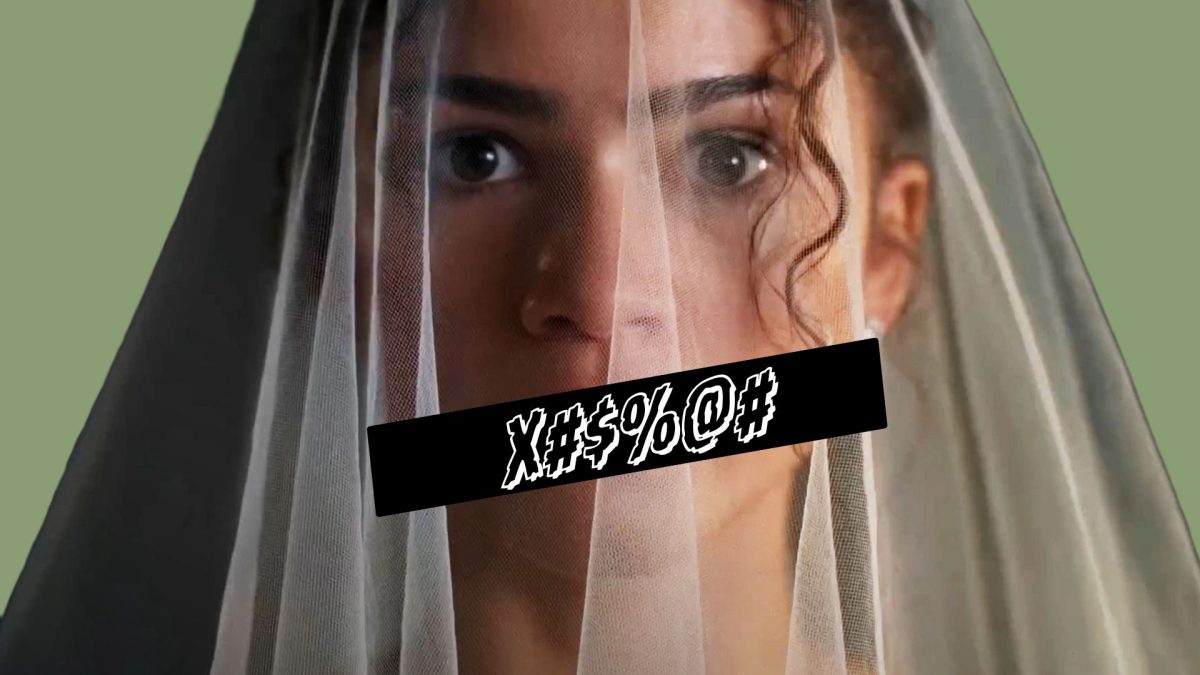
Robert Pattinson and Zendaya star as Charlie and Emma, a couple who — days before they’re set to be married — play a game with friends where they have to reveal the worst thing they’ve ever done. The bride-to-be spills a secret so disturbing that the trailers have to cut around it, and so sensational that you have to see this movie.
Depending on the viewer, the revelation is either an “oh, SHIT” or an “oh, no.” But besides the questionable ethics of concealing a very sensitive theme as a marketing ploy, my issues with the film neither start nor stop with this reveal: As “The Drama” evolves, it becomes apparent that it’s more concerned with being buzzy discourse bait than it is with exploring its ideas.
Because it’s impossible to examine the film without revealing this crucial element, allow me to be your spoiler: The worst thing Emma ever did was aspiring to be a school shooter in middle school. It wasn’t just a one-off impulse thought, but a whole phase; she recorded manifestos and even mapped out the entire sequence, and the only reason she didn’t go through with the plan was to not be a copycat, since another shooting had happened nearby.
There are a lot of philosophically rich questions conjured by such a premise. Questions like, should we judge people for a crime they didn’t commit? Is it fair to judge someone based on the worst version of themselves? And, can you ever fully know someone else? But the film stops short at deeply exploring any of these angles, and always cashes in introspective moments for laughs.
After the revelation, Charlie begins to wrestle with his engagement, imagining himself with both current-day Emma and 14-year-old Emma (played by Jordyn Curet), and tries to play the kind fiancé to hear her out, but can’t help being paranoid that she may be a psychopath.
But even though the couple met two years prior — and despite strong chemistry from the two A-listers — we never get a sense of why they actually love each other. This becomes a joke early in the film, when Charlie drafts his wedding speech with his best friend Mike (Mamoudou Athie) but can’t conjure more than pleasantries about how he likes her laugh.
I’d be similarly stumped trying to describe Charlie. His lack of characterization reads intentional at first, but ends up landing as an oversight: When asked the worst thing he’s ever done, he hastily mentions that he once cyberbullied someone, an answer so conspicuously dull that we’re primed to expect some deep, dark secret about his past. Yet nothing comes out of this.
And while Charlie is undeveloped, the way Mike’s wife Rachel (Alana Haim) is written is downright insidious. Rachel is the most vocal about her distrust of Emma, but what she reveals as the worst thing she’s ever done — as numerous think pieces have picked up — is arguably worse: As a child, she locked her “slow” neighbor in a closet in an abandoned RV, leaving him to potentially die. Viewers would be right to call her out on her hypocrisy, but with this ridiculously evil backstory, Rachel feels engineered to attract hate from a valid discussion about how bad intentions should be forgiven.
The film’s unbearably cringeworthy third-act wedding sequence, in which Charlie gives a wedding speech worthy of an “Impractical Jokers” punishment, trades nuance for cheap catharsis. In his drunken tirade, he spills Emma’s beans in front of their friends and family and all hell lets loose, providing a chaotic out instead of sitting with the uncomfortable questions posed by the premise. (The saving grace of this final leg is its very last scene, which is so brilliantly succinct that it makes you wish the first 100 minutes were much stronger.)
Perhaps the closest analogue to the film’s progression is an “SNL” sketch, because it starts with a great premise, has a lot of funny moments, and bungles the ending — but you’re engaged because you like the actors.
For this exact crime, director Kristoffer Borgli is a second-time offender. His previous film, “Dream Scenario,” started with a similarly dreamy scenario: Nicolas Cage plays a mild-mannered professor who inexplicably appears in people’s dreams, which he becomes a celebrity for. But when people’s dreams turn to nightmares and he becomes globally hated, the film flops into a third act that half-heartedly tries to be a dissertation on cancel culture.
Despite my issues with the film, “The Drama” is a healthy bowel movement for cinema. It neatly belongs to a recent trend of politically tapped-in movies that keep film discourse alive, and the film’s $65 million box office gross is no minor feat — even though the only other movie releasing April 3 was “Pizza Movie.” Zendaya remains a proven star while Pattinson further commits to being a total weirdo — both on- and off-screen — marking the first of their three big collaborations this year.
But just because “The Drama” is a black comedy doesn’t mean it can’t be an effective character study: It’s possible to be laugh-out-loud funny and write characters with nuance. Maybe Emma’s advice, which she gives to Charlie, was meant to apply for viewers, too:
“You have to stop thinking about it.”