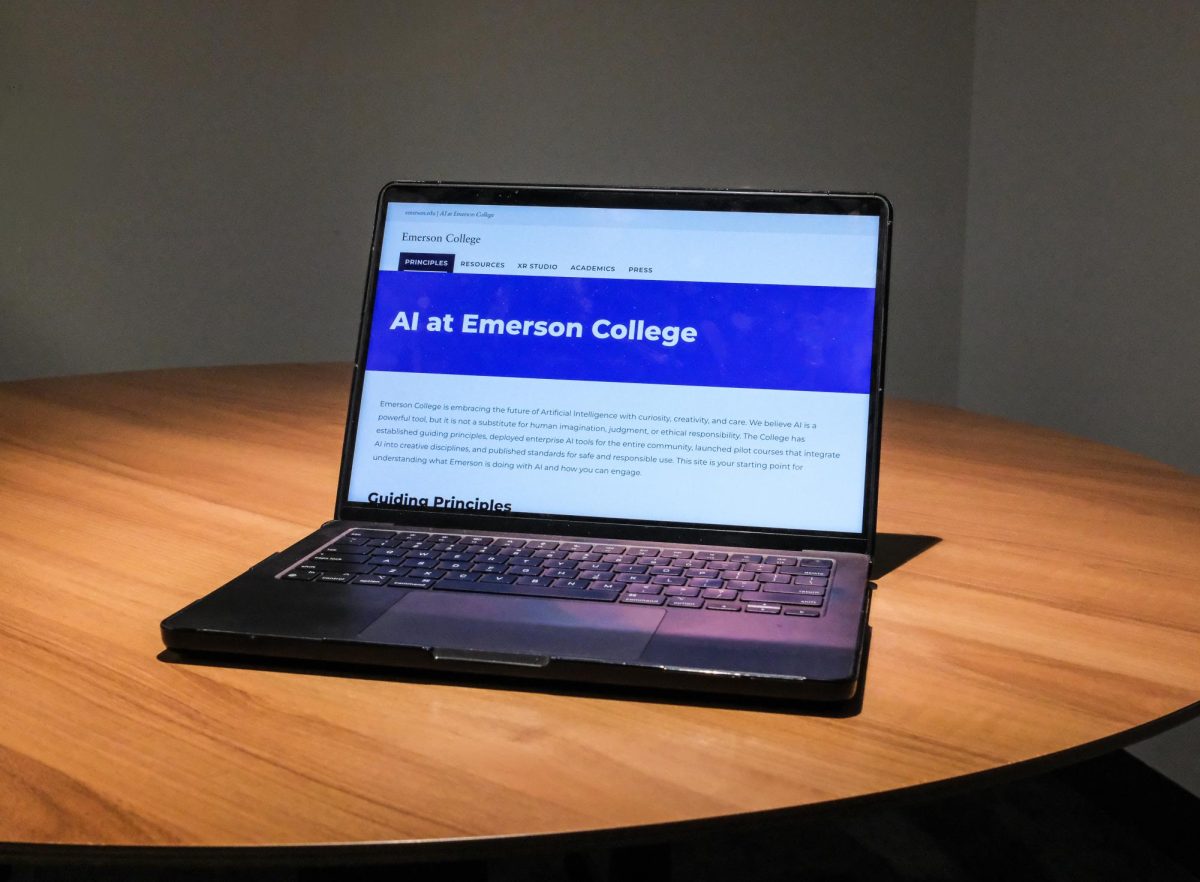



Over a year has passed since Emerson College’s first generative AI course, AI and the Future of Filmmaking, was launched last fall at Emerson Los Angeles.
The course at ELA was one of the first in the country to specifically teach generative AI filmmaking, according to professor Stuart Acher, who created and teaches the class. Other film programs, including at Chapman University, Loyola Marymount University, and New York University, also offer generative AI courses. A similar class at Emerson’s Boston campus, AI Tools in Media Production, was launched at the beginning of this semester.
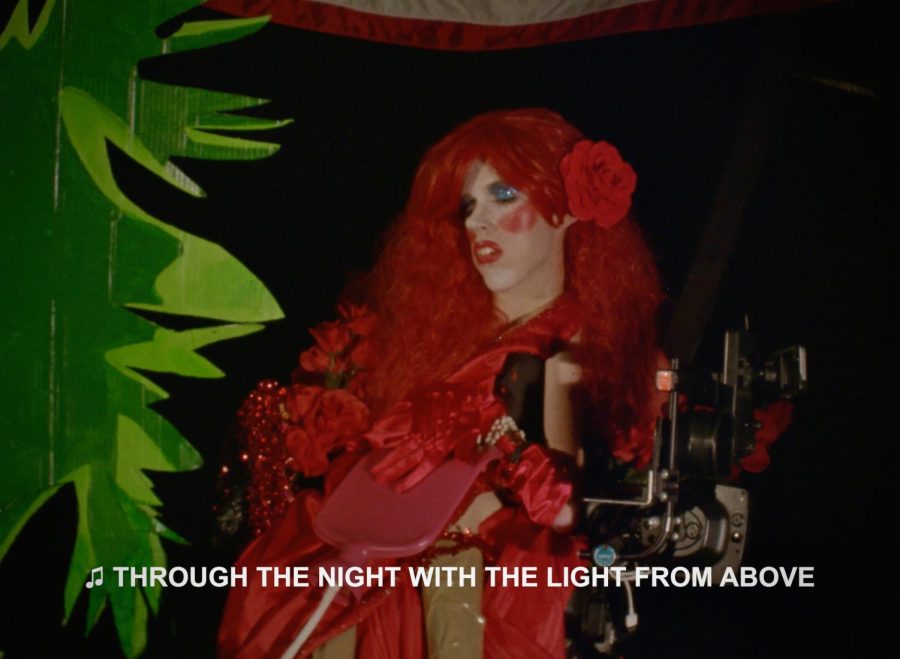
On Tuesday, the five students in the course screened their final projects, short films created with the help of generative AI, at an end-of-semester showcase. Acher invited filmmakers and other industry professionals to the showcases, and used it as an opportunity for professionals to see work from young filmmakers. After last semester’s showcase, two students were offered jobs from industry guests in the audience, he said.
“They’re eagerly looking for people with AI experience,” Acher told The Beacon. “If you want a job in the field today — especially if you’re graduating in the next five years — if you don’t know AI, you’re dead in the water.”
Acher says being an early adopter of generative AI has helped his own career as a filmmaker. He became interested when the first stable diffusion model, an early image generation model, was released in late 2022, but only seriously became committed to learning the technology in 2024. He was hired by Emerson after a Board of Trustees member watched “Next Stop Paris,” an AI-generated short film he wrote and directed.
The course curriculum teaches students a wide variety of programs. Students begin by training large language models, such as ChatGPT or Google Gemini, to create prompts to use in other programs. Students then use image-generating software to create start frames — the first frames of a shot — which are put together into storyboards. Shot generation programs use start frames to create videos, then students create iterations of shots to shape their final film.
Because generative AI is a currently evolving field, Acher has to evolve the syllabus in real time.
However, Acher stressed that when working with generative AI tools, creativity should still come from the human side; when generative AI tools are given sole creative control, they’re often not very good.
“I don’t think you should use it to write … because the truth is, [it’ll be] junk,” Acher said. “It’s a tool to help, but it’s not going to write your film. I mean, it will, but I don’t think it should be made.”
Acher says he appreciates that students join his class for various reasons. Some come in with various degrees of skepticism, though most students have little experience with generative AI.
“There are definitely some that are like, ‘I have no idea what this is, but I know I need to learn it,’” Acher said. “Then there have been others who come in openly, [saying], ‘I don’t know if I agree with this, but I want to at least understand it,’ which I think is great.”
Navarin Pirachai, a senior visual and media arts student in the class, was initially curious when it appeared in the course listing. She heard skepticism from her peers, which made her interested to check it out.
“It was very much like a ‘why not’ mentality,” Pirachai said. “I’m kind of prone to new things, and also controversial things, so I wanted to go in and explore it. When people are really against one thing, I want to know the perspective of the thing.”
Another student in the class presented their final project at the showcase under a pseudonym. They spoke to The Beacon on the condition of anonymity, in order to not be associated with the class.
The student said they enrolled thinking it would be a discussion about AI in the film industry, instead of a production class teaching generative AI tools. They said they missed the window to drop classes.
“I was hoping out of a 400-level course, we would have more discussions about why are people saying these things about AI? Why are these things going on? Why is it controversial? And we barely talked about the current events with it,” they said.
The student noted that Acher was good at discouraging students from using celebrity likenesses and copyrighted intellectual property, but felt that he was “extremely pro-AI” with “no neutrality at all on the issue.”
“I think the hands-on-ness of the course was really good,” the student said. “I think it’s something that could benefit the people in the class, to just understand how stuff like ChatGPT and other programs can be utilized, but it just was so one-sided.”
Both students have felt a stigma on campus around the course, and noticed that flyers advertising the showcase would disappear. On one occasion, sticky notes that read “Happy Earth Day/AI is killing our planet” and “Do you care about the environment?” were placed on the flyer, referencing studies about the high energy use of generative AI.
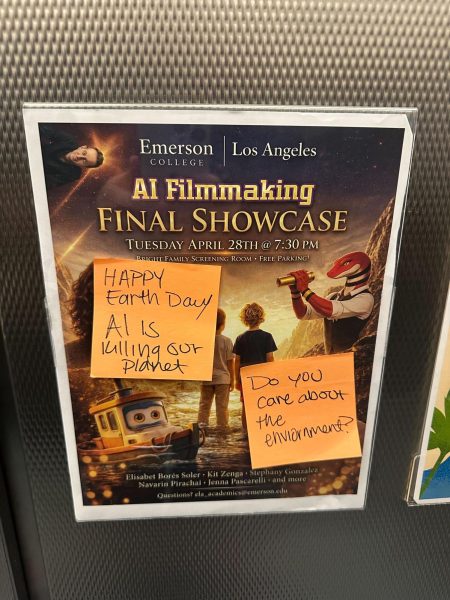
“I don’t think that the class should receive as much ridicule as it does,” the student added. “In typical Emerson fashion, it wasn’t very confrontational in any way. It was very passive, just taking the posters down, and someone writing a sticky note.”
“I would invite all those people to come [to a showcase] and be able to learn something,” Acher said. “Behind every one of these AI films is a human person who put their heart and soul into it, just like any other film.”
As the professor of Emerson’s first class to teach generative AI tools, Acher described his students as “unicorns” entering a competitive film industry — though he says luck is essential to landing a job, students should capitalize on learning any skills to stand out.
“Mostly adults are telling me, ‘Yeah, everyone is doing it and you just have to know it’ … When you apply for new jobs, they’re going to ask you if you know AI,” Pirachai said. “Then from my generation, people are like, ‘Yeah, fuck AI, I’m never doing that,’ and I think things will probably change when they actually graduate.”
Despite differing viewpoints, all agree that generative AI — in the industry, and in the classroom — is here to stay. Acher plans to continue teaching the class next fall.
“I can understand completely the fear that so many people in the college have,” the student said. “But I think a lot of them need to actually get involved with how AI works and where the future is going, instead of being just blatantly against it and being fully anti-AI in every situation.”
“I had a great experience,” Pirachai said. “This is my favorite class I’ve taken this semester, and probably one of my favorite classes I’ve ever taken at Emerson, and a lot of it was honestly because of Stuart.”