


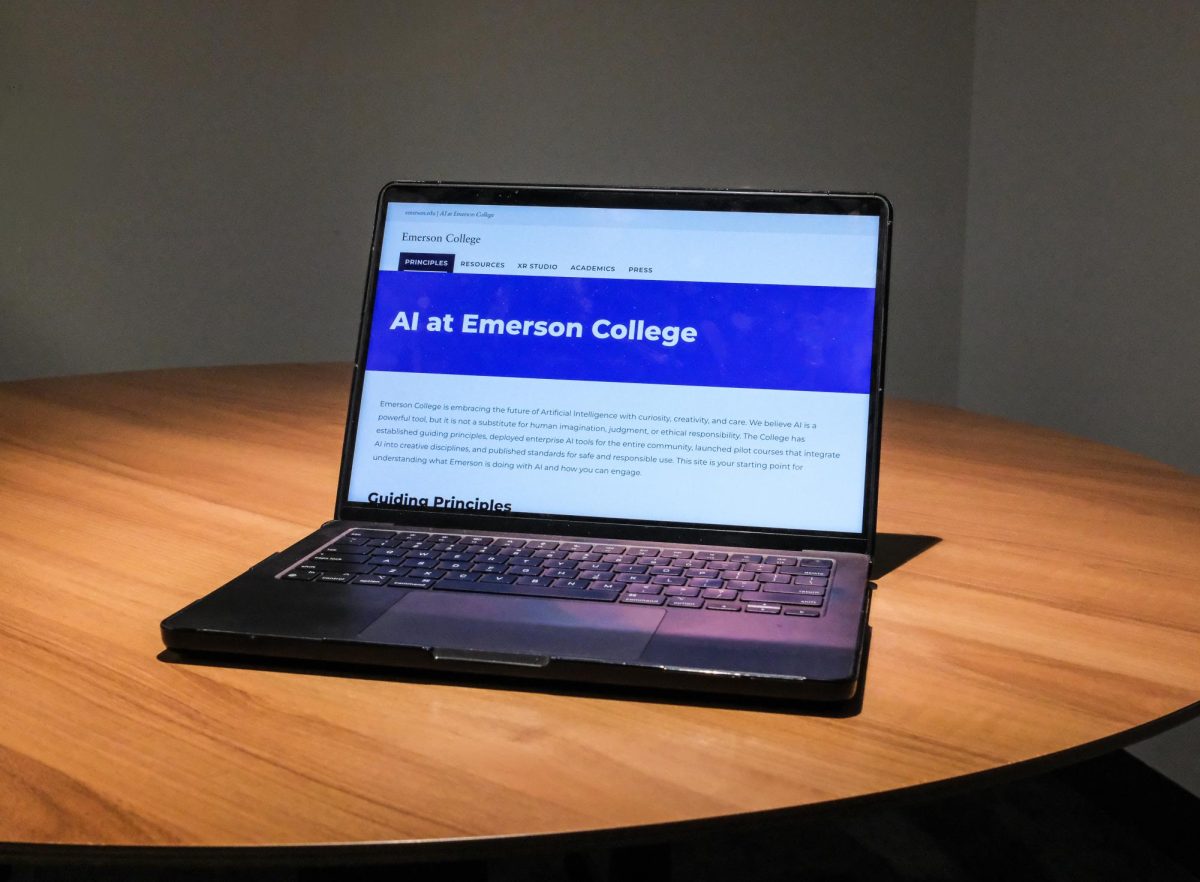
Emerson College doubled down on rapidly growing artificial intelligence technology and released official guiding principles on how AI should be used on campus.
The college launched a new website that aims to serve as “a living resource” for the Emerson community, President Jay Bernhardt announced in a community-wide email. The website lists a set of guidelines, AI tools, and AI-related announcements.
“Of all the opportunities and challenges we face, none may ultimately prove as transformational to our work and lives as artificial intelligence,” the email read.
Frankie Frain, the assistant vice president of IT security and infrastructure and a member of Emerson’s AI Task Force, a group that helped draft the guidelines, said that the college has always been focused on career readiness, which includes students gaining familiarity with emerging technologies.
“AI happens to be the current emerging technology, but that’s a philosophy that we have always had and will always keep to,” Frain said.
Bernhardt’s email echoed these sentiments, stating that the college is balancing the commitment “to the power of human imagination and creative expression,” and to help students navigate “a rapidly changing professional landscape.”
According to the email, the college will coordinate its AI efforts through the Emerson AI Initiative, a new initiative co-led by Academic Affairs and industry leaders. The office will work closely with the administration, faculty, staff, students, and the Emerging Technology Initiative. The Technology Initiative is a cross-disciplinary faculty and staff group that discusses AI and other emerging technologies. These initiatives fall under “Priority A: Academic Innovation to Shape the Future of Arts and Communication,” within the college’s Extraordinary Emerson 2030 Strategic Plan.
The college released five guiding principles regarding AI on the website:
Story Comes First
The use of AI tools should be to “advance the human creator’s vision,” and that decision-making power is in the hands of — and the responsibility of — the creator.
Career Readiness
Use and study of AI tools should align with students’ professional aspirations in their respective fields.
Transparency and Integrity
Users of AI technology should be transparent and label their work as such.
Critical Engagement
The website says that “high-value AI use requires skepticism and rigor: verifying sources, questioning biases, addressing ethical concerns, and refining output that is otherwise generic or incorrect.” The school aims to provide students with context to engage in discussions around AI use.
Protect Privacy
The college prohibits “the input of sensitive, confidential, or proprietary College data into public or unauthorized AI systems.”
“These principles and related initiatives will enable Emerson to set the standard for creative, innovative, responsible, ethical, and critical AI study and application,” the email read.
Frain said the website will answer the question of “What is Emerson doing with AI?” Beyond outlining the kinds of tools the college uses — including Google Gemini, NotebookLM, Adobe Firefly, and Zoom AI Companion — the website aims to bring clarity to the college’s principles in using the technology. However, Frain noted the core principles can always change.
“It’s also not the last word on where we stand with AI. This is emerging and developing,” he said.
Over the past year, students at Emerson have expressed mixed and often skeptical opinions about AI on campus. Some have said they feel uncertain or resistant about the push toward AI integration.
“It is inescapable and it’s already being implemented in so many aspects of our daily lives and in society and so many different industries,” said Nicole Coleman, a senior theatre education major at Emerson. “But I don’t think that we have to adapt to it in the sense that, [because] it’s everywhere, we have to use it.”
Faculty and students are not required to use AI, according to the website. Instead, the college calls for AI literacy while acknowledging that it affects different disciplines differently. Individual faculty will define the acceptability of AI-generated coursework. While the college guidelines establish that transparency is necessary, the website states that what is considered “legitimate versus illegitimate” AI-assisted work is up to individual departments.
Coleman said that AI has not been integrated into most of her classes. In her syllabi, she said many of her professors are negative toward the use of AI in student work.
“Especially since so many majors at Emerson are very creative, and using AI to complete assignments for a lot of classes completely destroys the point of why you’re here and what you’re studying,” Coleman said.
A key criticism of AI, both at Emerson and beyond, has been its environmental impact. Generative AI tools like Gemini and OpenAI’s ChatGPT have raised significant environmental concerns. Training large AI models requires vast computational power, often relying on energy-intensive data centers that consume substantial electricity and water for cooling. This demand can also contribute to increased carbon emissions, especially in regions dependent on fossil fuels.
Coleman said that she does not think AI is worth the impact on the environment for what it provides.
“There’s not a real benefit to using it besides convenience, and it’s definitely damaging our environment,” she said.
On its AI website, the college said it recognizes that the “infrastructure behind AI technologies carries real environmental and social costs,” and urges students to be aware of these costs as a part of their AI education and literacy.
“Several faculty members are engaged in research and teaching that directly addresses the political economies and externalities of emerging technologies,” the website reads. “This is an active area of discussion within the Emerson community and is part of why Critical Engagement is a principle.”
According to Frain, the website and new principles were shaped by feedback from a number of stakeholders, including the Provost’s Council, the Emerging Tech Initiative, representative faculty, and Dean of the Faculty and Associate Provost Brooke Knight, and himself.
“Our philosophy was determined through that governance process in authoring the five principles that you see on the new website, of ‘Story Comes First,’ ‘Career Readiness,’” said Frain. “We put those two at the top because we feel that ‘Story Comes First’ really represents the Emerson ethos.”
Another principle that Frain highlighted was that of critical engagement. He said that it is important for the college and students to continue to wrestle with questions surrounding AI, such as environmental impact, artistic integrity, and protection of privacy and copyright.
The college continues to accept feedback on its AI guidelines. Feedback can be forwarded to a new email address at [email protected].
“I would encourage our community to remain flexible, to provide feedback, to continue to engage with the principals on the principals page,” said Frain. “We also ask for critical rigor and critical analysis as we move through this, because the answers are not obvious.”
Sage Jezierski and Ava Velez contributed to the reporting of this story










“According to Frain, the website and new principles were shaped by feedback from a number of stakeholders, including the Provost’s Council, the Emerging Tech Initiative, representative faculty, and Dean of the Faculty and Associate Provost Brooke Knight, and himself.“
Glad so many perspectives were included 🙄 (sarcasm)