

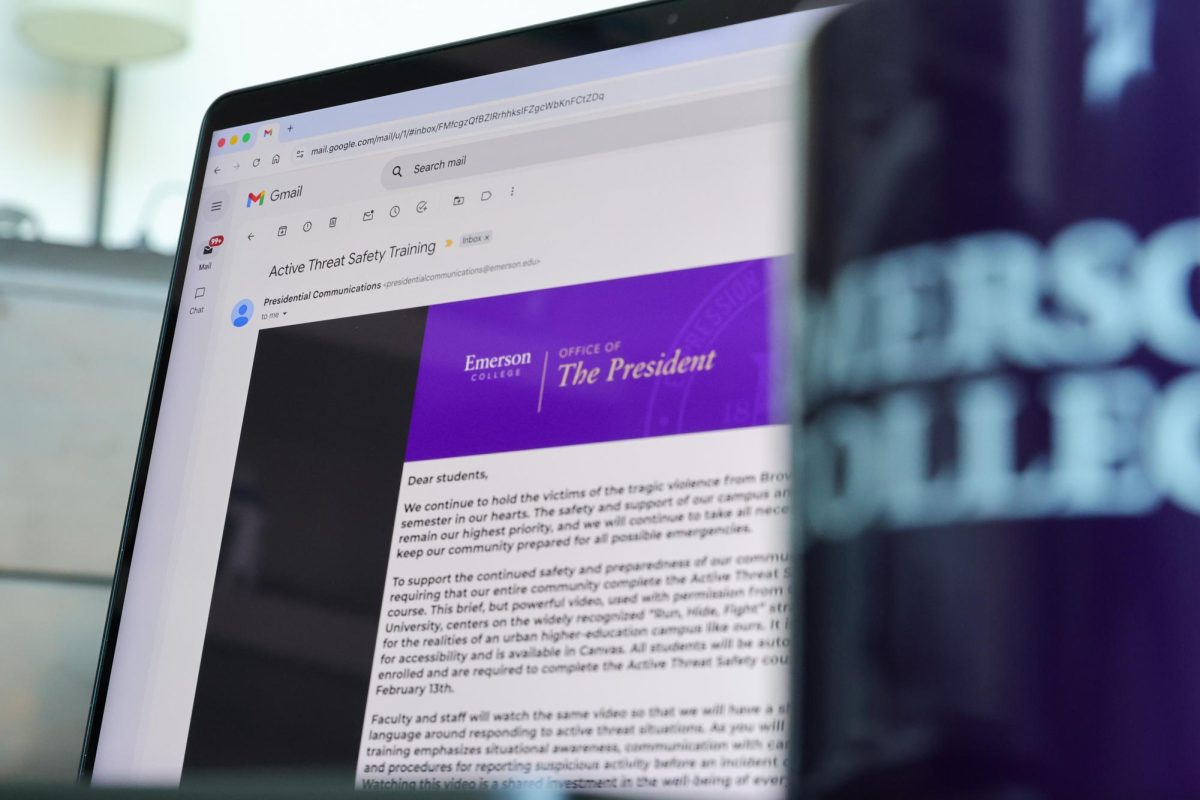
On Jan. 29, six weeks after the shooting at Brown University in Providence and the killing of an MIT professor, Emerson College President Jay Bernhardt’s office announced it was enrolling all students in a mandatory Active Threat Safety Training course.
The course includes one eight-minute video and a short questionnaire with a single checkbox for students to acknowledge that they have watched the video.
The Brown shooting on Dec. 13, 2025, left two students dead and nine others injured. Two days later, the suspect, Claudio Manuel Neves Valente, shot and killed MIT Professor Nuno Loureiro in Brookline, Mass. After a six-day manhunt, the suspect was found dead with a self-inflicted gunshot wound. The community-wide email cited these connected incidents as the reason for the mandated course.
“We continue to hold the victims of the tragic violence from Brown and MIT last semester in our hearts,” the email from Bernhardt and Emerson Vice President of Student Affairs Christie Anglade read. “The safety and support of our campus and community remain our highest priority, and we will continue to take all necessary steps to keep our community prepared for all possible emergencies.”
According to the email, the course features the “brief, but powerful” video from California State University, titled, “Run, Hide, Fight,” The video has cartoon-style characters encountering an active shooter threat, and attempts to teach viewers the proper steps to keep themselves safe. The video asks students to remain hypervigilant, but does not mention what part the college’s administration would have in handling such a threat.
Emerson currently has a website describing all the emergency protocols they have in place, where they detail the different procedures students need to follow during these emergency situations. Additionally, Emerson has a LiveSafe, a safety app, where students can report tips and safely walk in the city.
Jia Tahiliani, a freshman visual media arts major, said she wondered if the video was indeed the best way the university could educate its students on active shooters.
“I think it is definitely doable and a lot easier for the university to run an actual drill. So, I don’t know about the eight-minute video,” she said.
Kaia Castro-Dara, a freshman theatre and performance major, echoed that sentiment.
“I feel like, to a certain extent, how much can a safety course teach you?” Castro-Dara said.
Ella Hamilton, a freshman political communications major, disagreed.
“I think it is important to reinstate that safety protocol. And since we do live in a big part of the city…I think it’s important to make it known that it could happen,” Hamilton said.
Tahiliani also reflected on the timing of the new course.
“I think there definitely was an expectation for the [college] and the president to have to say something, especially because this all was affected within our area. It would have been really disingenuous if they didn’t,” she said. “That doesn’t necessarily mean that they didn’t have good intentions in doing it, but I definitely think that some external pressures were pushing them to send the message out quickly.”