




When asked what advice he’d give himself if he could travel back in time, to when he first started his job, Jay Bernhardt considered the question for a moment, and after a pause, said he’d buy a better coat.
“And better gloves, maybe,” he added.
This kind of dry humor isn’t out of character for the New Jersey-born president of Emerson College, who moved from Texas to take the job in 2023. However, he did come to a serious answer about his advice, despite saying he wasn’t initially sure if he had any.
“Don’t take for granted how hard it is to build relationships and meet different people,” he said.
His comments came during the first day of my conversations with Bernhardt, which took place in the form of three interviews over the course of two months. As a condition of these interviews taking place, administration requested the ability to review quotes for approval before the article’s publication. Given the strict confines under which these interviews took place, and The Beacon’s commitment of transparency to its readers, I felt some level of self-insertion and feature-style editorializing was warranted.
Some quotes have been edited for brevity, clarity, and grammar. Because Bernhardt has not spoken to The Beacon since March 2024, I was willing to negotiate an agreement with the administration for the sake of telling what I, as Editor-in-Chief, believe to be a newsworthy story.
Since assuming his role as president, Bernhardt has appeared elusive, even reticent, to some Emerson students, particularly during the last year and a half of student unrest and widespread criticism.
As he was sworn in as the college’s 13th president, 13 protesters were arrested outside the Cutler Majestic Theater; his first academic year in the role would end with the arrests of over one hundred pro-Palestine protesters in the Boylston Place Alley.
Since then, more fissures in the fabric of the campus community have emerged, from news of RA firings to criticism of discipline against student protesters arrested this October. Some community members criticized Bernhardt for isolating himself from students and faculty, and others have repeatedly called for more transparency in administrative decision-making.
However, he’s been seen more often this semester—like at SGA meetings and alumni events—in a move his office said marks a concerted attempt to further engage the community.
Bernhardt also expressed a personal aspect to his newly increased presence on campus, saying it stems from a genuine desire to connect with the community he leads. He spoke about how much he misses teaching and how he’d love to teach at Emerson someday.
I asked if he feels he was born to be a teacher; he answered, “There are things that, when you try them, and it feels right, you know to pursue them.”
Similarly, he reminisced about overseeing the Daily Texan, the student newspaper of the University of Texas at Austin, where he served as dean of the Moody College of Communication, his last job before Emerson. Moody is a school within the large public university that he said was not all that different from Emerson, specifically in its topical purview.
The school houses different forms of media and communications, from communication sciences and disorders to film. Despite being in a city with a vastly different culture, weather, and landscape from Boston, Bernhardt said the change wasn’t that stark for him; in fact, he described moving to Emerson as a homecoming.
Originally from Princeton, NJ, Bernhardt called the northeast home through college at Rutgers University in northern New Jersey, until moving south post-grad to teach at schools in Georgia, Florida, and eventually Texas. When the opening for Emerson’s presidency was put on his radar, he remembered knowing that Emerson represented fields he felt were important and cared about.
“What I really always loved about Emerson is, [that] is all we do,” he said, referring to the college’s focus on communication, arts, and media.
Bernhardt came to Emerson with goals to engage with students more, work towards carbon neutrality, and keep up with advancing technology. These priorities culminated in the multi-phase Extraordinary Emerson 2030 strategic plan, which he unveiled last year.
Part of this plan is the overhaul of the Department of Visual Media Arts, which departed the School of Arts over the summer and became the School of Film, Television, and Media Arts.
This change may have come as a surprise to formerly VMA, now SOF students, but Bernhardt said the plan has been in talks for nearly two decades. The decision was an attempt to reflect the way the film industry is evolving in a more interdisciplinary direction.
One much-discussed addition to the film curriculum is the new AI elective that the college will host next semester. Students have had mixed feelings, from enrolling in it to ripping down posters advertising the class. While Bernhardt acknowledged that students might have varying reactions to AI integration in major curricula, he declined to disclose his personal stance on the technology.
“We can’t bury our heads in the sand and hope it’s not going to happen, because it’s happening right now,” he said. “Instead, we need to go in eyes wide open and make smart decisions.”
Many senior leaders in higher education are facing a number of unprecedented challenges beyond emerging technologies, including pressures from President Donald Trump’s administration. These pressures have come in the form of crackdowns on DEI, investigations of antisemitism, visa revocations, and slashes to federal funding. Emerson students have testified to seeing possible reflections of these pressures in on-campus changes, such as the renaming of departments and titles of positions.
Moreover, the school has dealt with low enrollment for two years in a row, resulting in layoffs of staff across departments in both 2024 and 2025. This summer, 30 members of staff were laid off, and faculty were offered an incentive program to encourage them to voluntarily leave the college for benefits, including a lump sum payment. Last year, declining enrollment was attributed to “negative press and social media generated from the [April] demonstrations and arrests.” This year, many faculty, Bernhardt among them, have pointed to a “demographic cliff” as the reason for the drop.
“I’m not the type of person who’s going to feel sorry for myself or our leadership team. Our job is to navigate through the great positive things that occur, and opportunities, and to manage through challenges,” Bernhardt said.
He said he believes there’s an antidote for any obstacles presented by the heightened political climate: sticking together.
“If you’re fighting each other or disagreeing with each other or focused on your differences, it’s going to be much harder to navigate through those times,” he said.
But since the series of arrests on campus in 2024, Emerson’s community and campus have faced deep fractures. These events garnered floods of criticism in the form of dissenting stickers on the Ansin building, scathing letters to the editor, and a vote of no confidence from SGA in the aftermath of the April arrests. Students and faculty have spoken out against Bernhardt’s handling of the encampment, expressing discontent over his lack of presence on the ground.
In August 2024, the Board of Trustees put in place an institutional neutrality policy, restricting the college from taking stances on complex geopolitical issues, such as the Israel-Palestine conflict. College protest policies were also updated to more explicitly restrict where, when, and how students could protest on campus. The neutrality and protest policies have garnered intense criticism, with many feeling they suppress free speech.
Bernhardt said he doesn’t see these challenges as out of character for the college, or any college.
“I’ve been at multiple other places where I hear and see people criticizing the president, mostly not knowing the president, and mostly not interacting much with them, but nonetheless being critical,” he said. “And that’s certainly true at Emerson as well… I don’t take it personally. I think we can differ on policy and differ on direction. When people disagree with me, I’m interested to hear why, but it doesn’t bother me.”
He reiterated several times that, in his opinion, his daily interactions with members of the Emerson community, from alumni to students and faculty, are positive.
“Sometimes people make it very personal. Sometimes, some of the attacks or some of the Instagram posts can sometimes be very personal. And I do my best to not take it personally.”
Criticisms of Bernhardt started after the Cutler Majestic arrests, but significantly increased after the police sweep of the encampment. Graphics with his face circulated on Instagram, featuring derogatory caricatures. He said such posts were inevitable, given his role, as well as the sometimes-contentious push and pull of power between college administrators and students, faculty, and staff.
He also said that April 2024, which saw hundreds of encampment-style protests across universities nationwide, was a challenging time for every school, not just Emerson. But he did note that there’s one thing about Emerson that sets it apart from other schools.
“We don’t own any grass. We don’t have a quad, we don’t have a field, we don’t have a square, whatever you want to call it,” he said.
Many encampments, formed around the same time as Emerson’s across the country, utilized campus green spaces for their demonstrations. Arrests were widespread: Over 100 students were arrested at Columbia University a little over a week before the arrests at Emerson. Students across Boston, from Harvard to Northeastern, faced discipline ranging from suspension to arrests for setting up encampments on campus property in Spring 2024. Emerson is unique in that Boylston Place Alley, where tents were set up, is not solely owned by Emerson.
“From the moment the encampment was set up, we tried very hard to communicate to the students that [the alley] was not a good place [to protest], and that there was real risk,” Bernhardt said. “We also immediately heard from the city that day that the city would not tolerate tents in a public right of way. The city has very clear laws and rules around encampments.”
The Boylston Place alley, which provides access to several campus locations, is partially privately owned by Emerson and falls under the jurisdiction of Boston Police as a “fire alley.” Bernhardt maintains that the decision of whether or not to clear the alley and make arrests was entirely the municipal government and law enforcement’s responsibility.
At this point in the conversation, the energy in the room changed. Bernhardt’s voice grew more hushed, and he chose his words carefully. It was clear that it was not easy for him to talk about the encampment. When he walked me through that week, his communication with the government and police, as well as the students, I could see the events of the night unfold before his eyes as he recounted their sequence.
I explained to him that I was seeking to understand the events as he experienced them. Did he watch it happen on an Instagram livestream, like I and many other students did? Why wasn’t he in the alley that night?
“My staff was present, they were communicating back to me in real time how things were happening,” he said. “I was not present because I was advised by our police and our safety team to not be present because I might become a distraction, given the volatility of the situation.”
He reiterated, “We continued to communicate that we weren’t seeking to punish, we were seeking to protect, and that as long as they had tents set up in the public right of way, there was a risk.”
He continued, “We encouraged the police right up until the very last minute to allow students to leave without being arrested. But we were not able to control how they managed the situation.”
At this point, I wanted to know how Bernhardt would have felt about the results of that night if he weren’t in the position of a college president. How would he have felt if he were dean of a school within Emerson, like he was in Texas? Or a teacher, like he was in Georgia and Florida?
“I understand how strong everybody’s feelings were, but it was my job to manage a crisis. It wasn’t my job to have feelings on one side or another,” he said. “It was to help protect our students, protect our community, protect our college, and we did the best we [could] to try to meet the goal.”
Amid all the backlash and negative comments, he said there is one thing he would’ve done differently that week in April of 2024.
“Even more communication to the community, both before and after the arrests,” he said in a way that suggested he’s thought of this before. “I think there was so much misinformation that was shared, and so many sort of false accusations made in all different directions that [were] really troubling.”
In addition to that lesson, a more holistic one emerged for him, too: the dire need for community in times of choppy waters.
“The best case scenario for our college or any college, wherever possible, is to solve our differences through civil discourse and dialogue,” he said.
According to The Beacon’s reporting from April 2024, Boylston Students for Justice in Palestine representatives met with Bernhardt on the second day of the encampment to discuss negotiations and exchange information.
In a conversation with The Beacon at the time, a former college staff member who was present in the meeting shared that the college told students the city could forcibly remove tents. They also shared that Bernhardt said arrests were a possibility, which he could not control, and that he offered alternate places they could move their tents. The staff member said Bernhardt did not commit to any of the demands the students made in the meeting.
“My preference is, I’d rather meet at a table and talk about our differences and see where we can find common ground than meet on the street in a confrontation that involves law enforcement,” Bernhardt told me in our recent interview.
Despite the many challenges of the job, Bernhardt said he considers himself “very lucky” to be here.
“I believe in my core that these fields [arts, communication, and media] are among the most important,” he said. “I’m here because I believe in the mission and the vision of Emerson.”
That vision, the same one he mapped out in the form of the strategic plan, is one he truly believes will take the college to new heights, put the institution on the national map, and grow Emerson’s prestige.
“I think we’ll be stronger than we’ve ever been in all of our different disciplines,” he said. “I think we’ll be seen as a really important college.”
Looking forward, Bernhardt said he hopes to continue engaging with the community more.
“I’m not trying to change Emerson from what makes it great,” he said. “I’m just trying to strengthen Emerson … to help the rest of the world know how great Emerson is.”
Bernhardt, who is often the first on his staff awake, is also one of the last to leave the office, working nights and weekends. It is clear that there is something tying him to this job, despite challenges.
When trying to answer what it is, one memory in particular sticks out to me: a signed autobiography of Bruce Springsteen. Tucked in its pages, a heartfelt thank you card from a student of his at the University of Texas, Austin, who waited in line for hours to get the book signed by Springsteen because he knew how much Bernhardt loved the singer.
This is one piece of the Bernhardt puzzle. There’s also the framed painting from an Emerson alumnus of the swan boats in the Public Garden. And then there’s his first job out of college, working to educate his peers about sexual health and violence in the Student Health Center at Rutgers.
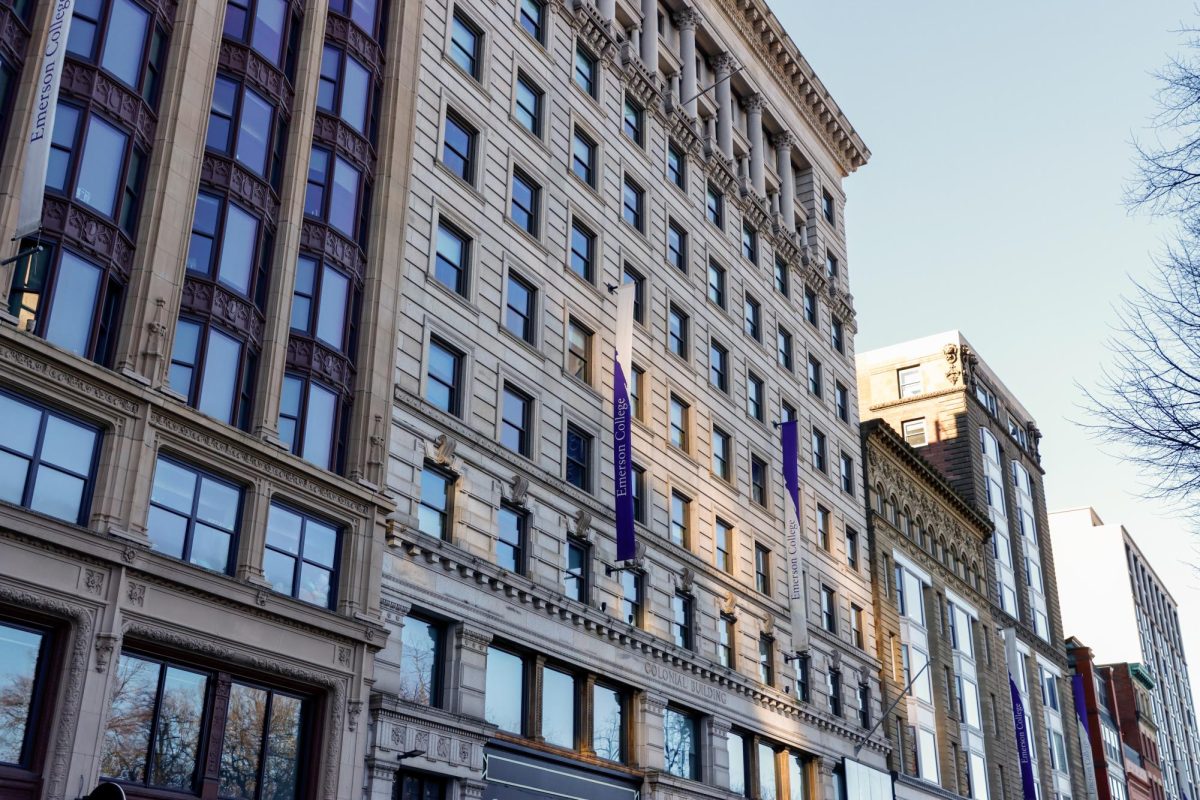
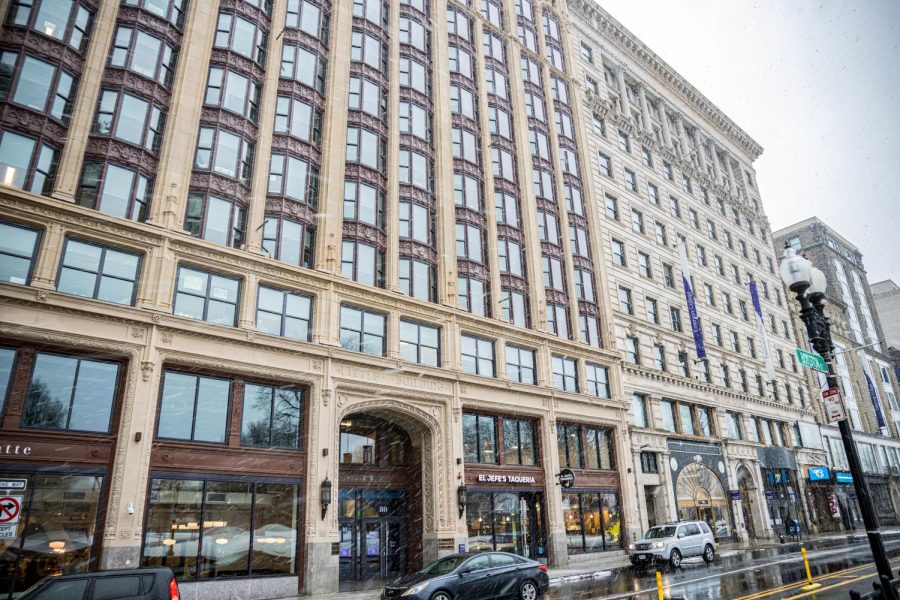
Still, there are some crucial puzzle pieces that we won’t get from a couple of formal conversations. Those bits, perhaps, only reveal themselves when the day ends and his office’s light is the only one seen on the 14th floor of the Ansin building, which only a few can access.


Smart timing on Jay’s part to do this interview right before he fired the entire Student Success Office.
If only the Editor-in-Chief had spent more time discussing the President’s strategic plan, the threat (and opportunities) of AI, and the “demographic cliff” facing higher education and Emerson in particular–you know, things that the Emerson community actually cares about–rather than once again re-hashing the nearly two-year-old protests and arrests.