


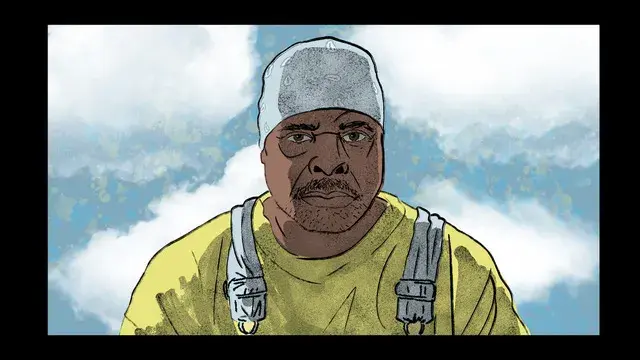
When asked about the artistic merit of his new documentary film “Holding Up the Sky” (2025), Emerson College associated faculty member and documentary filmmaker Bob Nesson declared his film to be “a project with implications beyond pure art,” setting high stakes before a Cinema Emerson screening this past Tuesday.
The documentary follows two men, business owner Ed Jordan and his apprentice Jimmy Costello, working in the ironworker industry, both on parole from their respective life sentences. After portraying the specific incidents and events that led to the imprisonment of both men, the film delves into the challenges faced amid their respective sentences, and displays the stability they were eventually able to discover after their releases.
Through Jordan and Costello’s stories, the film challenges the efficacy of lifetime imprisonment and parole, and considers the faults within the system’s lack of support for released persons. While both men were able to form stable careers and relationships upon reentry, their experiences getting there shines a light on the high volumes of individuals who do not find success after their sentences are lifted.
The film’s creation was made possible by the awarding of a $5,000 grant from the Massachusetts Cultural Council. Nesson was one of six Emerson faculty and staff, and at least 10 Marlboro Institute alumni within Emerson are set to receive the award to support their creative projects.
“The award I was given is one given to artists on both the intent and value of their art,” Nesson said in an interview with The Beacon. “It was awarded to my film, as it is a project with implications beyond just art. It’s a film about justice and injustice.”
Since its completion, the film has also been screened at the Massachusetts State House for a crowd of legislators, and is currently on a screening tour across New England-area schools. It calls for legislative and social action to benefit formerly incarcerated persons.
Audience members at a screening of the documentary in Emerson’s Paramount Center last week said that Nesson’s “Holding Up the Sky” is capable of acutely promoting empathy and understanding for the injustices incarcerated persons face after release to quite an effective degree.
One individual in attendance said the film was “undoubtedly a tool in the political and legislative toolbox [for prison reform].”
Nesson said that he was inspired in part by a short film directed by Emerson alumni Ryan Egan ’13, Christine Maroon ’13, Megan McLoughlin ’13, and Gina Varamo ’13. The students’ film came from Documentary Filmmaking for Social Action, a class in which Nesson served as an instructor in 2012. There, he assigned these four students to contact a local nonprofit and work alongside the organization to produce an advertisement and public service announcement-style video to bring awareness to a cause or concern addressed by the charity.
The students selected Haley House Bakery Caf, a Boston-based nonprofit that acts as a “house of hospitality” according to its website, offering a soup kitchen, food pantry, permanent and affordable housing, farming spaces, and cooking lessons. “Re-Enter: My New Community,” (2012) a short film centered around the nonprofit’s goal “to hire and train formerly incarcerated people to be bakers, delivery workers, and management, while promoting belonging and fulfillment,” Nesson said.
After screening the student’s documentary in his class, Nesson realized he wanted to do more on the subject and build off of the film. He spent several years workshopping a project investigating the livelihoods of formerly incarcerated people after serving time in prison.
“My students’ film made me aware of all the barriers to reentry [such as recidivism rates],” Nesson said. “I realized the whole system is designed to swallow you up.”
Many in attendance at Tuesday’s screening — Emerson community members, Boston-based educators, various colleagues of Nesson, and multiple professionals in prison-based education — articulated how precisely Nesson and his subjects portrayed challenges, such as the restrictiveness of lifetime parole, poor quality of life in prison, and high recidivism rates for released persons.
One woman in attendance questioned Nesson during the postscreening Q&A session on how the Emerson community — students and faculty alike — can become involved in advocating for legislative change alongside the film’s distribution. Nesson urged for individuals to call their legislators and make them aware of the injustices highlighted by his project. He hopes Emerson’s students engage with the film and its call to action.
“You have got to be persistent; you have got to stick with it,” Nesson said. “It may take years until you see change, but change will eventually come.”







Bob Nesson is doing more than making a film—he’s putting real faces to a system most people never see. By telling stories like Ed and Jimmy’s, he builds empathy and challenges assumptions about incarceration and reentry. The fact that he’s bringing this directly to legislators and students makes it feel actionable, not just informative. Work like this is what actually moves conversations—and eventually policy—forward.