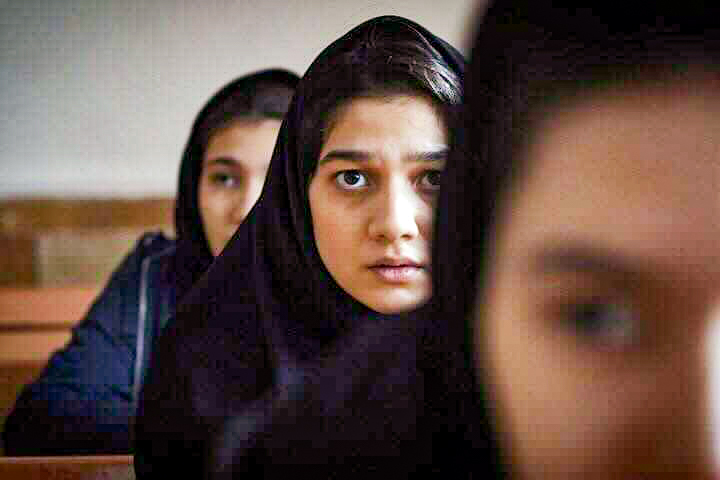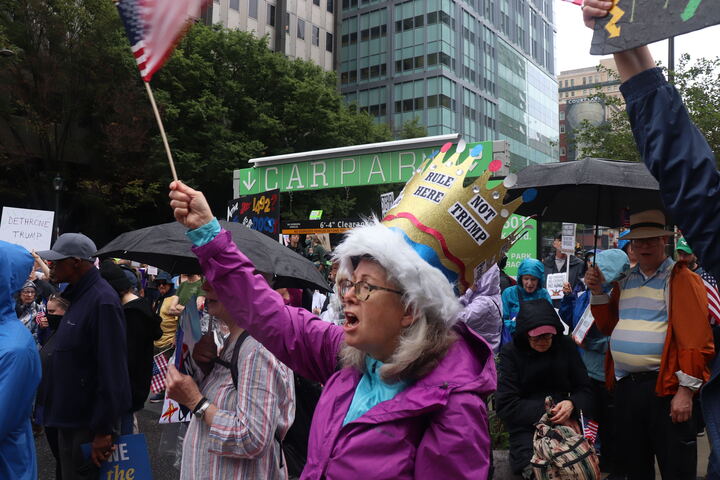



Crowds of thousands of people have taken to the streets of Iran in recent months over economic hardship and political grievances. Protesters were met with lethal force and a sweeping internet blackout by the Islamic Revolutionary Guard Corps, although the official death toll is still unknown. In Boston and cities around the country, Iranian-Americans are questioning the lack of media coverage and international attention.
“There’s more than 20,000 people who got killed during this uprising, and the coverage of that from the media is zero, the way I look at it,” Saeed Shafiyan-Rad, president of the Iranian Association of Boston (IAB) said.
In Iran, the protests that began in late December 2025 have spread nationwide and evolved into widespread anti-government demonstrations. State security forces have responded with an extremely violent crackdown, using live ammunition and physical force, resulting in mass arrests, and a near total internet blackout intended to suppress information and coordination among protesters.
The total death toll is not yet confirmed. While the Iranian government’s official figure reports about 3,117 deaths, rights groups and independent monitors suggest a significantly higher number. Some activist networks have confirmed over 6,000 deaths, with others estimating that the total could be tens of thousands.
“I hate to say that Jeffrey Epstein has got more coverage than anyone when it comes to the news coverage,” said Shafiyan-Rad.“I understand that there is no internet connection, there is no information coming out, but at the same time, you still would be able to get information from folks who are leaving that country.”
Iranians are calling for an end to authoritarian rule, greater political and personal freedoms, and accountability for state violence. What began as protests over economic hardship has grown into broader demands for human rights, the release of detainees, and systemic political change, with many demonstrators openly challenging the current governing system.
In the United States, solidarity protests have taken place in several cities in support of Iranians. Participants have held rallies near the U.S. Capitol and the White House, waving an Iranian flag from the days of the Shah, who ruled the country before the Islamic revolution of 1979. Protesters also honored those killed in Iran and urged U.S. policymakers to back democratic reforms and human rights in Iran.

Jazzy Compton, a sophomore political communication major, said the risk of not talking about what is happening in Iran and other parts of the Middle East is that the efforts of those resisting oppression could go to waste.
Compton, a first-generation American who is Kurdish — an ethnic group indigenous to the Middle East and primarily living across parts of Iran, Iraq, Syria, and Turkey — said she has spent her life watching resistance movements in the region go largely unnoticed. She added that she recently lost her grandfather, who fought for Kurdish independence in the 1980s and 1990s.
“When my grandfather was dying, I kept wondering if he knew that everything he fought for might go to waste because we’re not talking about this,” Compton said. “After all these years, we’re still fighting, and that’s all our future seems to hold.”
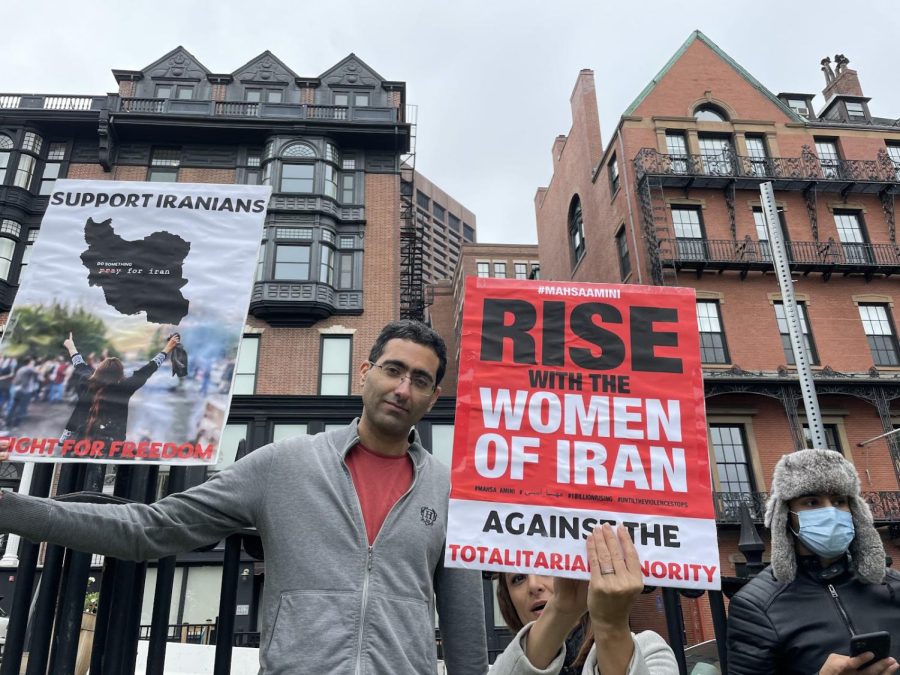
In Boston, protests have continuously taken place every Saturday at noon in front of the Boston Public Library. On Jan. 30, a crowd of more than 300 braved the 2-degree wind chill.
Navid Aghasadeghi, one of the organizers at the protest, said that the turnout has been consistent thus far.
Chants of “SOS for Iran” and “President Trump Act Now” echoed across the square as protesters gathered to call for a free Iran and mourn those lost in the unrest. Echoing the calls in Iran, protesters also called for the institution of Reza Pahlavi, the exiled son of deposed Iranian Shah Mohammad Reza Pahlavi, in place of the current regime.
Aghasadeghi said protesting is especially critical now because little information is coming out of Iran following the internet and communications blackout.
“It’s even more important for us to be the voice of the people,” said Aghasadeghi. “We’ve seen this recipe where the government shuts down the internet completely and starts massacring people.”
Shafiyan-Rad said the lack of information about the country has taken a toll on Iranian- Americans. He said that as president of the IAB, he receives a lot of questions from members about what is happening in Iran. He said members of the community are turning to each other with unanswered questions.
Some Iranian-Americans are also disappointed in public officials for not speaking out about the conflict.
“I’m heartbroken. I am deeply heartbroken,” said Zara, one of the protesters on Sunday who declined the use of her full name for safety reasons. “I expected at least a post from Barack Obama, from Kamala Harris, from so many people from the UN.”
Aghasadeghi said that he sees this lack of speaking out to be the result of politicization. He said that he thinks politicians, public officials, and the general population are not speaking out because they would then be in agreement with President Donald Trump.
Trump has gone back and forth between showing support for Iranian protesters and threatening to attack the country. Tensions in the region have escalated. As of Wednesday, U.S. military forces are positioned in the region for possible strikes.
Compton, however, said she does not want to see Trump get involved in the region. She pointed to Trump’s order to military forces to withdraw from Syria in 2019, a move that left U.S.-backed Kurdish forces without protection against ISIS. Compton said she is worried that Trump will “take it out of the 2019 playbook.”
“It’s the same colonial cycle,” Compton said. “Western powers decide what happens to people who aren’t theirs.”
“A lot of things unfortunately become politicized,” Aghasadeghi said. He continued, saying that he is disappointed that things have become more about politics than human interests.
“When a government is blacking out the internet and massacring the people, there’s really no other side to take besides the side of the people.”
Even when coverage of Iran occurs, those from the region argue that often pieces leave out important details. Compton said that growing up in the U.S., she has witnessed the media leaving out crucial information or not covering events entirely.
“If you don’t have the right algorithm and you’re not seeing both sides, it just looks like unperpetuated violence,” said Compton. “It doesn’t matter what region of the Middle East you come from — Western media has already painted us in such a negative light.”
Aghasadeghi said that consistent media coverage is crucial for understanding the conflict in Iran, as it is more expansive than singular event coverage portrays. He explained that it is important to continue to focus on the consistent struggle that protesters in Iran are facing.
“This is obviously a constant struggle, so the continuous media coverage really matters a lot,” said Aghasadeghi. “This is an issue of humanity, this is an issue of justice.”