


Emerson College is known for its historic focus on communications and the arts, but for much of its history, it lacked a formal curriculum designed to communicate with the Deaf or hard-of-hearing community. Today, Emerson’s American Sign Language Club is a hub for students to obtain tools for communication and connection-building with people who are deaf.
The first efforts toward studying differences in communications began in 1953, when Emerson introduced The Robbins Center, formerly The Robbins Speech, Language, and Hearing Clinic. The clinic provides services for a variety of communication differences, including speech and fluency, language delays, autism spectrum disorder, and hearing and deafness. 40 years later, they hired their first deaf professor.
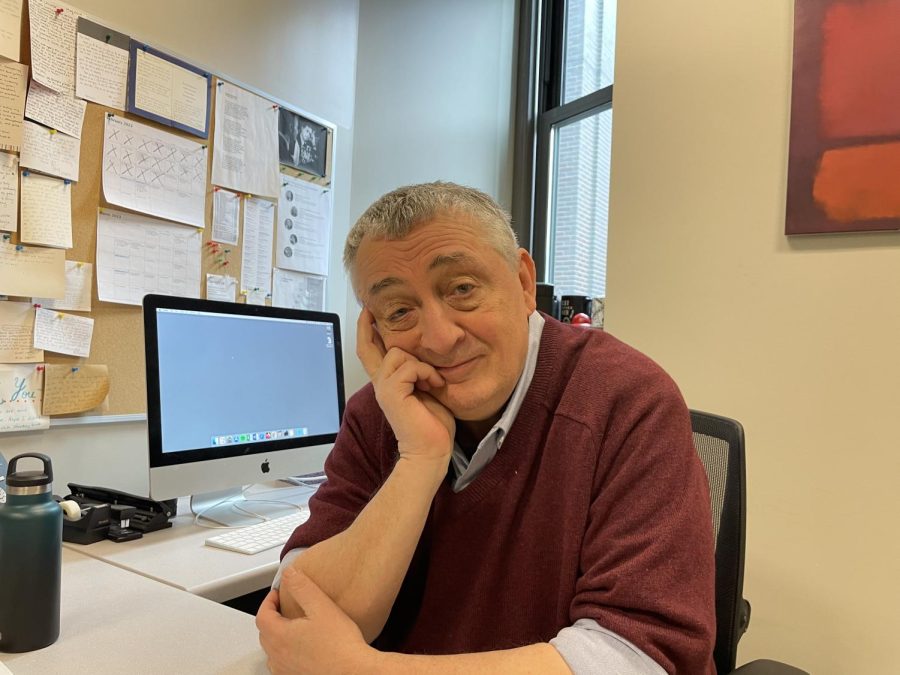
Nancy Vincent-Meotti began at Emerson in 1993 and currently teaches two sections of ASL. Now, she is among five deaf teachers who collectively teach a total of nine classes. In an email to The Beacon, Vincent-Meotti said her experience has been “very rewarding” and that she enjoys working with students and “seeing their confidence in ASL grow.”
To Vincent-Meotti, the ASL Club serves as a space for students at Emerson to not only practice ASL, but to build a community and increase awareness of Deaf culture. They do this through events, such as the recent Deaf Comedy Night featuring comedian Andrew Fisher, Vincent-Meotti’s son.
“I was so proud of ASL Club officers to host a Deaf Comedy,” she wrote. “It was a big event at Emerson that most students from ASL classes and Deaf community attended.”
ASL Club President and senior acting major Peter Kolodziej has been leading for the whole year, coming in just after the club became officially affiliated with Emerson last spring. Kolodziej presided over the club when it launched and throughout this semester. The ASL Club was one of the few organizations to receive an increase in funding from SGA. Now that they are an official Emerson organization, they can use funding to bring in special guests, like Fisher.
“I think that the comedy show was a big step in the right direction of making the ASL program a lot more prominent here,” Kolodziej said.
At the show, Fisher revealed he conferred with the ASL teachers, who came up with a name sign for Kolodziej — a high honor and sign of respect for a hearing person who “makes an effort to make themselves a part of the deaf community,” said Kolodziej. Name signs can only be given by deaf people.
Kolodziej’s name sign combines the sign for “scarf,” which entails the dominant hand motioning as if wrapping a scarf around one’s neck with fingers together and slightly bent, due to Kolodziej’s frequent donning of scarves, and the sign for “P,” Kolodziej’s first initial.
To Kolodziej, to be named after something “so feminine,” feels like a “reminder of self,” as well as a meaningful gift from the people who introduced them to ASL in the first place.
“It was really special,” they said. “I felt insanely emotional that night.”
According to Kolodziej, Emerson does not have any “culturally Deaf students,” which means people who are deaf, use sign language, and identify as part of the Deaf community. There are, however, students who are hard of hearing and deaf.
It is partially for that reason that the ASL Club aims to be a community center. It holds regular events, from game nights and movie nights, to hand painting, which invites attendees to paint objects on their hands to resemble a certain sign they like — for example, painting the back of a hand purple with pink dots to resemble a butterfly, which is signed by flipping the palms of the hands inwards, laying the dominant hand over the non-dominant, and flapping the hands like a butterfly’s wings.
Looking ahead, Kolodziej would like to see more curricular support for ASL at Emerson, beyond just signing classes — such as classes on Deaf history or other topics discussed in “immersive” ASL classes offered at Emerson. The ASL Club’s efforts in this have not been futile, as next semester, Emerson will be offering an online class on Deaf culture, CD-245, for the first time.
Kolodziej also said they would like to see more people “make the choice” to engage with the Deaf community at large. They said that by doing so, Emerson could be put on the map as an institutional giant in Deaf education, helping to create a larger community of students who take ASL at schools around Boston.
“I just want to see people make the choice … to be a part of the community,” Kolodziej said. “Make our professors proud.”
While it can be intimidating to learn a new language, Kolodziej said, there’s no better way to learn than jumping right in and immersing yourself in the community — the main goal of the ASL Club.
“I just encourage people to stumble and fall and make mistakes and try their best,” they said. “You just have to kind of do it. That’s the best way to learn a language.”
Hallie Munsat, a junior media and Deaf studies major and the incoming president of ASL Club, aims to increase the presence of the organization on campus next year. She became involved with the club for the first time this year, and is hoping to do more to engage with the Deaf community next semester, like Deaf Coffee Meetups in Downtown.
“We were having more of a turnout towards the end of the year,” Munsat said. “I think that next year there is certainly going to be an uptick in people attending our events.”
Coming from Washington, D.C. — home to one of the nation’s largest deaf communities of over 20,000, on account of the deaf college Gallaudet University in the Northeast district — Munsat chose Emerson in part because of the ASL classes it offers. However, for a school that offers a hearing and deafness minor, Munsat said she would like to see more deafness-related classes outside of ASL, though she is enrolled in the Deaf Culture class next Fall.
Looking forward, she hopes to get the club involved with other college ASL Clubs in the area, as well as seeing more hearing students show up and show enthusiasm for learning ASL.
Munsat added that it was “so cool” to hear people at the Deaf Comedy night talk about their interest in learning sign language. She said that most of the ASL Club’s events, such as showing movies related to deaf culture like “Deaf President Now,” are beginner-friendly, with no prior signing experience required to show up and get involved.
“We want to make it more accessible and [foster] a space where people can feel comfortable signing and asking questions about deaf culture and practice sign [without] throwing people into the deep end,” she said.