

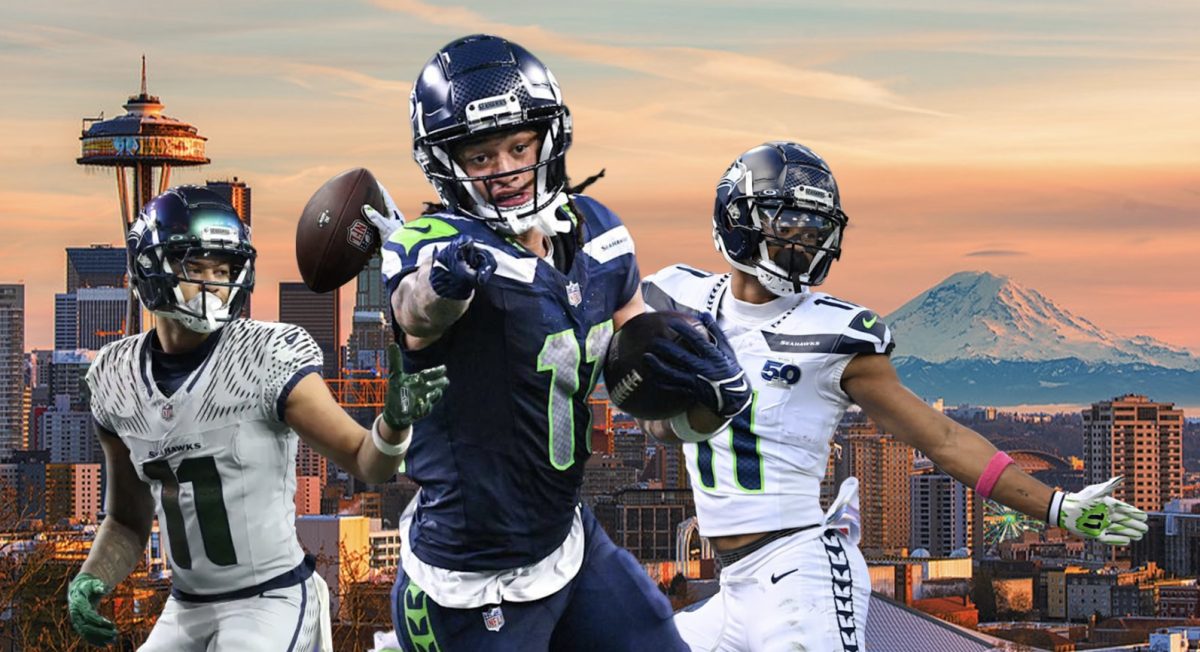
Seattle Seahawks wide receiver Jaxson Smith-Njigba doesn’t have the frame or athleticism for the typical elite receiver. He stands at six feet tall and ran his 40-yard dash in 4.48 seconds, both below average for his position.
For the first two years of his career, Smith-Njigba was touted by experts as nothing more than a number two option. But this season, Smith-Njigba is annihilating NFL defenses, leading the league with 1,793 receiving yards, and spearheading his Seahawks to their first Super Bowl since the 2014 season. Smith-Njigba, known to many by his initials, JSN, is reinventing what it means to be the best pass catcher in the league. He doesn’t need significant physical advantages — like Jameson Williams’ super speed or Mike Evans’ massive build — to attack defenses. It’s the intricate, almost unquantifiable parts of the game that JSN excels at.
Why is JSN’s unorthodox play so important to the league? Simply put, it is working, and it’s indicative of a larger shift in how the NFL views wide receivers.
With his unique abilities and extreme versatility, JSN has been unprecedentedly dominant. With a 36% target share (making him first in the league), he is a major reason the Seahawks have dramatically outperformed expectations.
The Beacon spoke with online creator and sports journalist Anthony Lawson, who recently published a video essay exploring a modern era of athletes less limited by physical traits. Lawson highlighted the differences in modern defenses that young receivers face compared to the last generation.
“I think it’s just the natural progression to want to be as unpredictable as possible … to be impossible to read,” he said. “Defenses have become more flexible, unpredictable, and less static in terms of zone or man.”
In 2025, the average NFL defense used man-to-man coverage in just 30.5% of snaps, while zone defense took up a whopping 69.5% of snaps. Just going back to 2022, teams were running man-to-man 41.7% of snaps, and zone 58.3%.
This shift can be attributed to combating large, physical receivers like DeAndre Hopkins and Keenan Allen, who have seen success against close man coverage throughout their careers. Allen’s division opponents, the Denver Broncos and Kansas City Chiefs, ran man coverage at two of the highest rates in the league in 2016, one of many factors that led to Allen’s success in that decade. But now with the changes to defensive coverages, newer physical receivers aren’t finding the same success.
The two high-safeties scheme is running the modern NFL and capping deep threat receivers from making big plays. Second-year receivers Marvin Harrison Jr. and Keon Coleman, who are 6’3″ and 6’4” respectively, have been struggling to translate their college success into an equal NFL impact.
Through two seasons, they have shown a clear inability to break out for deep passes against zone coverages despite their height and speed, an issue that has gotten Coleman benched and caused commotion in the Buffalo Bills front office repeatedly this season.
“It makes absolute sense that the receivers who flourish in this era are the ones who can outsmart the defense, or out-leverage them, or just find the holes,” Lawson said. For him, what makes this new era of players like JSN different is their mental game attacking a defense.
These receivers can accurately read and identify their opponent’s defensive scheme, meaning they do not need to outrun a defensive back if they know exactly where he will be. This is enhanced by elite route meshing, a technique perfected by receivers like JSN, which hides the route from the defensive back until it is too late.
Former Seahawks receiver Bryan Walters analyzed JSN’s unique abilities on “Wyman and Bob: Seattle Sports Talk & Analysis” earlier this season.
“A lot of receivers will stand up briefly if they’re about to break down or they’ll run harder if they go ball as opposed to a dig,” Walters said.“JSN’s speed is the same, so that makes him dangerous. As a [defensive back], you can’t tell what route he is running; he’s meshing all routes off of each other.”
“I do think that there has been a very big shift in the most statistically dominant [receivers],” Lawson said. He added that many modern receivers are not delegated to a specific spot on the field, such as slot or outside, and therefore are less confined by labels. “They’re thrown in motion a lot. Motion rates are something that have really been in this era,” he said.
JSN shows this unique ability to be successful in any part of the field. When former Seahawks starting receiver DK Metcalf was traded away last offseason, JSN was forced to make the transition from aligning in the slot to aligning outside the formation. He has proven he can do both, leading the league in slot receiving last season with 956 yards and in outside-aligned receiving this season with 1,378 yards.
Seahawks offensive coordinator Klint Kubiak, who was hired last offseason, has been widely praised for unlocking JSN’s potential and using him creatively in the offense.
Lawson said that the shift in wide receiver strategy we have seen in recent years is also about coaching talent like Kubiak, which he believes is equally as important as player ability.
“Jerry Rice had these exact traits that we’re praising now as the new meta,” Lawson said. “To some extent, receivers have always had this. [Coaches] have just gotten better at capitalizing on the traits, at least more than in previous eras.”As the league has shifted towards the passing attack in recent decades, it is only natural for there to be an evolution in the archetypes of wide receivers. But what matters most is how defenses — and defensive coordinators specifically — will respond to modern, unique playmakers such as JSN.