

This article includes discussion of sexual assault.
“The Prince Charming Theory,” a short film by junior media arts production major Sophia Horowitz, follows a girl named Clara as she moves through the stages of processing her experience of sexual assault. However, the essence of the film has nothing to do with assault itself.
Focusing on girlhood, how women support women, autonomy, and addressing how young girls are taught to perceive possible partners, the film aims to challenge how sexual assault is typically portrayed in media. Directed, written, and produced by women, the work environment that emerged served as a juxtaposition against the working norms female crew members said they have experienced on film sets at Emerson College.
The inspiration for the short film came to Horowitz during her freshman year at Emerson. Multiple women spoke with her about their experiences with sexual assault, and she started to notice similarities between their accounts.
“It was that thing of like ‘why is nobody talking about this?’ and I got really frustrated, like why is the same thing happening to so many women?” she said. “So I decided to sit down and write about it.”
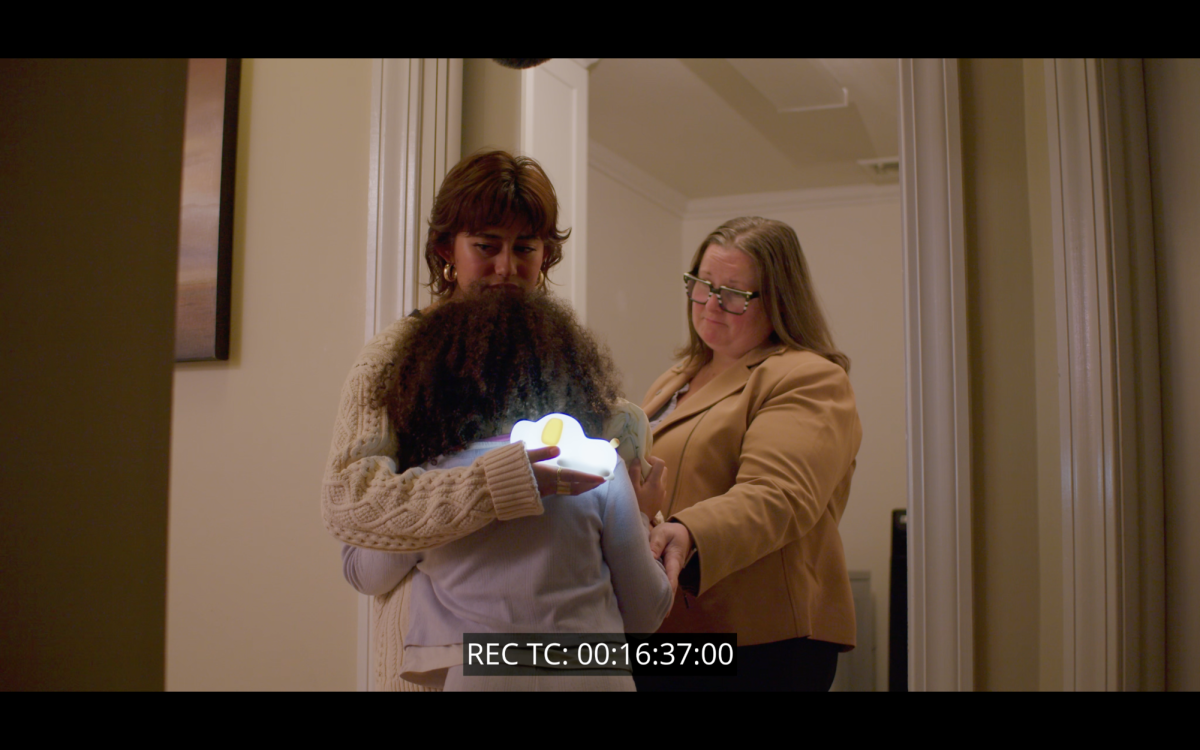
The story, which Horowitz described as a “tapestry” of women’s experiences with sexual assault, starts the day after the main character goes on a date with her boyfriend. She goes to babysit a five-year-old girl named Olive, and to entertain her, she starts telling a fantasy-esque story involving an archetypal “prince charming” character. As she tells the story to Olive, she starts to think back on her date, reflecting on her boyfriend’s behavior, contrasting it with the idyllic character she has developed for Olive.
“Little girls are brought up to look for [their] prince charming,” Horowitz said, adding that when you start seeing someone, it’s easy to look over warning signs and red flags in order to convince yourself that the person is your prince charming.
“This man could be your prince charming, but on a theoretical level, are there cracks in the surface? Are there things that need to be studied more? Because is there ever a truly perfect person?” she said. These are the questions “The Prince Charming Theory” asks.
During Clara’s internal flashbacks and reflections on her boyfriend’s behavior, it is revealed that she experienced sexual assault.
The event is purposefully shown as a quick glimpse and nothing more. When Horowitz was writing the film and deciding how she would approach the depiction of the assault, she knew she didn’t want the film to focus on the actual event. Instead, she wanted to show everything that comes after.
“That first step towards acknowledging — finding health, getting healing — that is the bread and butter of it, essentially,” she said.
The main character is shown transitioning from a state of discomfort and an inability to vocalize what she needs, to slowly coming to terms with her situation and receiving guidance from an older woman mentor figure.
The relationship between Clara and this mentor figure was inspired by a scene in the Netflix series “Sex Education.” In the scene, one of the show’s main characters, Maeve, has a tender conversation with an older woman while they are in a recovery room after undergoing medical abortions.
“Both of these women are going through a hard time; their emotions are high, and things are going on, yet they’re very calm, and they’re talking about it very subtextually,” Horowitz said.
That subtext, Horowitz said, the sometimes unspoken yet emotionally heavy words exchanged between women about something only they can understand, is the point of “The Prince Charming Theory.”
“This is a story that is about women, not even their struggles, it’s just about women,” said Nora Beirne, a junior media arts production major, one of the film’s producers. “I think that it’s really easy to assume when you hear [about the film] that it’s about sexual assault, and yes, it is about sexual assault, but it’s actually not.”
“We see the aftermath, and we see the healing process, which a lot of other films don’t tackle as much,” she added.
Clara De Luca, a junior media arts production major and the lead editor of the film, said this comes through clearly in how the film was shot, with not a single scene occurring where only the boyfriend is framed.
“There was so much care and thoughtfulness put into not putting in anything unnecessary, not putting in anything for the spectacle of it or for the male gaze. You can tell that this was written by a woman,” she said.
This type of story is not common in short films at Emerson, according to Beirne and De Luca. When Beirne first read the script, she said it immediately stood out to her as something unique and never done before on Emerson’s campus. She cited this as the main motivation for her wanting to take on a role in the film.
“Out of all the stories I could choose [to work on] here, this is something I could actually stand by in 20 years and be like ‘I’m so glad I helped make that,’” she said. “I think it was really moving, and that’s a really good feeling.”
During the hiring process, Horowitz sought out an all-woman producing team, saying, “I didn’t want to have to translate that experience and vision to someone.”
Even though she did interview men while seeking out crew members, she noted that some interactions made her feel like she had to explain why the story was important to tell, something that didn’t occur when interviewing women. Beirne noted that women applicants were more eager to understand the story, asking what the name of the film meant and what the driving force was behind the project.
“I had never really experienced that before because I hadn’t really worked on anything where the story was the reason why people wanted to work on it,” she said.
“The Prince Charming Theory” also set itself apart from other film sets on campus in terms of its work environment. Both Beirne and De Luca noted that most film sets they’ve been a part of at Emerson had a male majority, and on them, they felt like they were not trusted with their given roles simply because they are women.
“I’ve talked with my friends, and they’re just like, ‘Yeah, I feel like a secretary,’ and I’m like, good God, what is this, the 1950s?” said Beirne.
On the set of “The Prince Charming Theory,” this wasn’t an issue. “[Horowitz] really trusted me, and I feel like that’s what’s lacking when I work with a lot of men on short films here at Emerson,” said De Luca.
During the production process, Horowitz was also deliberate in choosing specific companies to partner with.
Having worked with a nonprofit theatre group over the summer, she knew how to network with companies to raise funding for “The Prince Charming Theory.” Collaborating with the film’s public relations and marketing team, they compiled a list of women-owned companies that shared the same values as she and the film’s crew.
For their second round of fundraising, it was decided that part of their donations would go to the Boston Area Rape Crisis Center. Partnering with BARCC had been a factor in the production process that Horowitz had been adamant about since the beginning of the project.
“[BARCC] was pushing us along. It was also what was pushing Horowitz along, like, ‘I’m doing this for a reason; there is a concrete reason behind this,’” Beirne said.
That reason — the intrinsic incentive of making a difference — doesn’t have to be on a large scale for Horowitz. For her, it comes down to creating a piece of media that exemplifies the authenticity of girlhood and the reality of what women have to grapple with.
For survivors, she said, “Sexual assault is something that so many women can relate to, but that doesn’t mean they want to shout it from the rooftops, and that’s kind of what the film is for.”
She said for those who don’t directly relate to the experience in the film, “I want people to be able to know how to communicate with survivors. I want them to know how to care for them and hold space for them.”
The first official screening of “The Prince Charming Theory” will take place on April 17 at 5 p.m. on the Berklee College of Music’s campus as a part of the college’s Women’s Film Initiative. The event is a combined screening and talk, focusing on female filmmakers.