


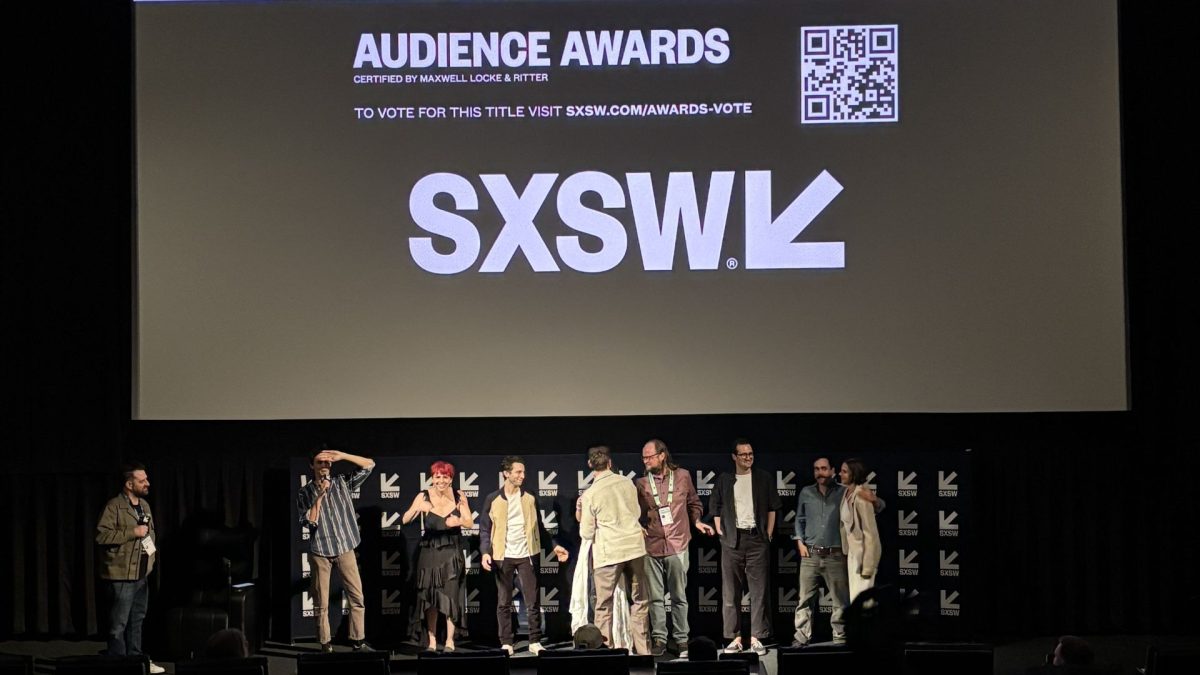
Austin, Texas — It’s just past 11:30 p.m. at the Alamo Drafthouse Cinema South Lamar, a time of night when the last bus downtown is too timid to come out of hiding. Under the cover of a dark movie theater, director Danny Madden ‘09 is in his element, premiering his brand new film, “Downbeat”, in South by Southwest’s (SXSW) Film & TV Festival Narrative Feature competition.
For most filmmakers without household names, a primetime slot at SXSW — where indie luminaries from Sean Baker to Greta Gerwig to Barry Jenkins picked up steam on their trip toward eternal critical glory — would be a resounding ‘big break.’
But for Madden, “Downbeat,” which follows the financially and emotionally stunted bucket drummer Mauro (Daniel Rashid) as he crashes at his sister Isa’s (Addie Weyrich) apartment in Boston, is just the latest addition to a growing portfolio. Along with his 2020 feature-length debut “Beast Beast,” (2020) and an animation credit on the Daniels’ “Everything Everywhere All at Once” (2022), he recalled how SXSW took a chance and programmed the first short film he made after finishing school.
“It’s called ‘(Notes on) Biology.’ It’s a little animated thing, a kid going through his notebook. Just a fun little movie,” Madden said in an interview with The Beacon. “I didn’t even come [to SXSW]. I was, like, 23, 24. I didn’t realize it was a big deal.”
All of these films were produced on shoestring budgets, typical of SXSW’s scrappy artistic ranks, though none of them yet belonged to the “American broke wave,” the new genre of zero budget filmmaking Madden and frequent collaborator Pete Ohs half-jokingly founded in January. Along with Ohs’ “Erupcja” (2025) — which also played at this year’s SXSW — “Downbeat” represents ground zero for the movement, and therefore stands as its purest, most personal form.
“The idea of choosing an artist’s life, or whatever we want to call it, [is] stepping out all the time,” Madden said. “You’re gambling and taking risks and whatever. And at this particular season in my life, I had kind of lost the last bet, you know?”
Upon graduation, Madden was stuck with the all-too-familiar film student curse: applying for jobs in Boston restaurants. To make matters trickier, he was 26 years old and didn’t have a solid address at the time.
Then came one fateful Fourth of July. As swarms of suburban families descended on the Charles River Esplanade with ice cream hangovers and fireworks scorched into their retinas, Madden emerged from his little brother’s “shitty college apartment” and, racked with nerves, took up bucket drumming as his new summer internship.
That is the same DIY stubbornness behind the “broke wave,” which seeks to correct a “broken” filmmaking industry currently prioritizing mergers, machines, and money over creation.
“Let me just do the cinematic equivalent of pulling buckets out of a dumpster and get a camcorder and then go with my friends into the streets and see what happens,” said Madden.
Yet, if “Downbeat” is Madden gathering scraps, it’s also him taking his craft more seriously than ever. Throughout the film’s rapid development process, he served as editor, sound designer, cinematographer, and “hustler-in-chief,” leading a motley crew around the streets of Boston with only a used $900 Sony Handycam and a $22 lens from Walmart.
When it came time to film scenes on the Esplanade, or at the Boston Aquarium, Madden eschewed all permits and paperwork, employing a run-and-gun system that felt akin to a steroidal student film in its oscillating shades of excitement and danger.
“‘Downbeat’ was a different process because we were [having to pivot],” said Madden. “We were going to shoot this scene near the pavilion in the Common, and then we’d show up that day and there’s a music festival and a giant stage set up … ‘All right, I guess we’re changing the direction of all the shooting.’”
That level of realism is “broke wave”’s biggest middle finger to the mainstream. Inspired by Ohs’ penchant for on-the-fly scripting tactics, Madden and his actors developed the story of “Downbeat” as a semi-improvised, 45-page outline, creating something closer to a home movie than a rehearsed family drama.
Rashid spent months bucket drumming to prepare for his performance, and would earn real cash by busking during breaks in filming. As he and co-stars Weyrich and Arkira Chantaratananond, who plays Isa’s roommate Mallory, launched into a pivotal argument in the film’s climax, crew members like producer Benjamin Wiessner ‘08 — an old classmate of Madden’s from Kasteel Well — fed them fresh insults from just off screen.
“I know a lot of this will be shaped in editing, but I just wanted them to have ownership of their roles in this,” said Madden. “They were doing their own wardrobe, hair, and makeup, so they got to sort of craft the characters in that way.”
This is the sort of quick thinking magic that “Downbeat” and its genre’s inglorious aesthetics traffics in, from its first frame to its soulful, gently redemptive conclusion. To reveal the intimate details of the movie’s characters isn’t to spoil a major plot point, but to cheapen the sobering impact of Madden’s vision, which, regardless of the way its credits look, is more of a communal achievement in overcoming severe limitations than a frantic solo work.
After all, he claims that beyond his summer as a bucket drummer, the majority of the film is just “shit we made up.”
Still, it’s impossible not to see Mauro as an avatar for Emersonians populating film sets and classrooms: stuffed into cheap duds, flailing, nervous, and copping any work they can get while simultaneously reading reports about Hollywood cutting 42,000 jobs from 2023 to 2024.
“I feel like I can just go out and do it if it takes long enough that nobody’s giving me permission,” said Madden. “So if I’m going another 10 months, and nobody’s biting on as far as financing goes, I’m gonna go out and do another one of these.”