

Stories came off the page in Copley Square on Saturday, Oct. 25 as authors and presenters from across the globe came together for the Boston Book Festival. Authors of all types and genres connected with readers, spoke about their work, and celebrated literature and the rich history the city carries.
The cloudy sky contrasted the warm environment as adults and children mingled together, where families could read together in an activity called “Story Stroll”. There was a place for people of all ages with a program solely dedicated to kids that incorporated activities such as face painting and balloon animals, as well as holding interactive workshops, literary sessions, and an outdoor streetfair.
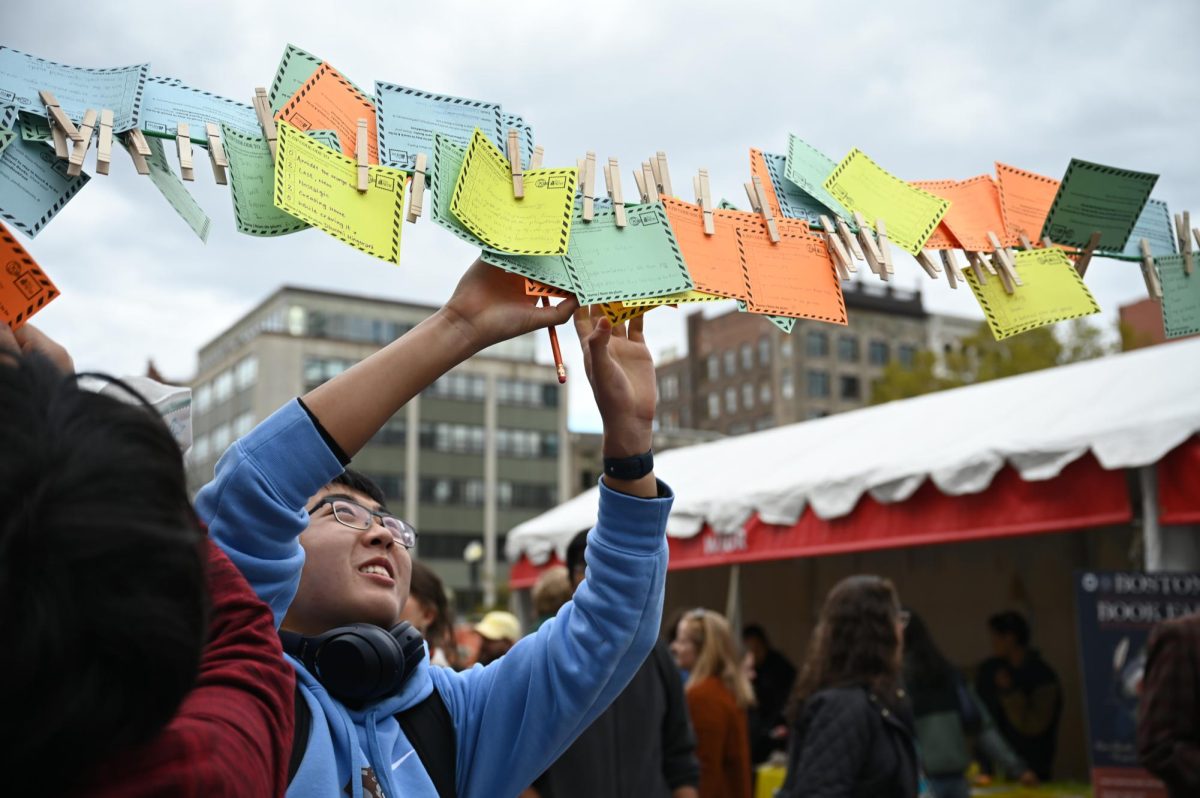
Festival attendees were given the chance to tell their own stories as well, scribbling tiny poems in a booth on colorful postcards referred to as “zip code odes.” The cards were strung up, adorning the pathways, with live music provided by Berklee Music Stage. Latin jazz and strums of guitar were not the only sound heard. was also the surrounding conversation, flipping of pages, and bustling from booth to booth.
The annual book festival returned for its 16th year, hosting over 200 authors and presenters, including household names such as the “Bridgerton” series author Julia Quinn and award-winning screenwriter Shonda Rhimes, to name a few. While notable press outlets such as The Boston Globe and GBH were present, the festival simultaneously allowed smaller businesses to be represented, such as Belmont Books and Wondermore, Inc. were also given space to showcase their work
Known for its accessibility, the festival was held near one of the city’s iconic institutions, the Boston Public Library, symbolizing public access to knowledge and free education. According to outdoor captain Rachel Partington, this year had expanded to make the festival more diverse in all aspects, including genres, demographics, and a wider range of presses.
“People might be more incentivized to sign up for a library card, which is near and dear to my heart. I think everyone should have a library card,” Partington said. “I think that it’s really nice to be able to expose people to different facets, where they can get access to different books if that’s something that they’re struggling with.”
The director of operations, Leandra Sharron, described the Boston Book Festival as a “book club on crack, times a million,” conveying that events interacting with one another in a similar space are the beginning steps to building a community. Observing book lovers stand in 10-foot-long lines in hopes of meeting their favorite author or seeing individuals experiencing shared love for a book series is her favorite part of the job.
“There is just something really special in the air about so many people coming together over a love of reading, especially when reading is usually something that’s very solitary,” Sharron said. “When you can come together with a community of other people who also enjoy it, that is really important.”
The facilitation of community can empower individuals to remain resilient through hardship as well. With Pen America detailing 6,870 instances of book banning this year alone, presenter Ron MacLean emphasized that this festival is “more important now than ever.” In light of the current administration, federal actions and school district policies have resulted in several books about race and LGBTQ+ issues being banned from schools and libraries nationwide, with the Department of Education dismissing 11 civil rights complaints against the book bans. MacLean expressed the importance of reading in building empathy, claiming that it is something the country is lacking in right now.
“They wouldn’t be banning it if they didn’t think that people might grow from reading our words. They’re threatened by what we’re presenting,” MacLean said. “You actually know that books and writers are making a difference when you see books start being banned, because they’re considered dangerous.”
Not only does this event create community among fellow book readers, but it also allows reunions for authors. When asked about her favorite part of the festival, presenter Lisa Borders jokingly responded, “each other,” explaining how events celebrating reading bring the writing community back together.
“I like it because I am comfortable in this community and it’s been my community for a long time, just trying to make sure to invite people in, find out if there’s anything I can do for them,” Borders said. “It’s what gives us strength in times like these—feeling like we’re not alone. Even just wandering around here outside in the square, it just feels great to see people celebrating the books and being happy to be around each other.”