

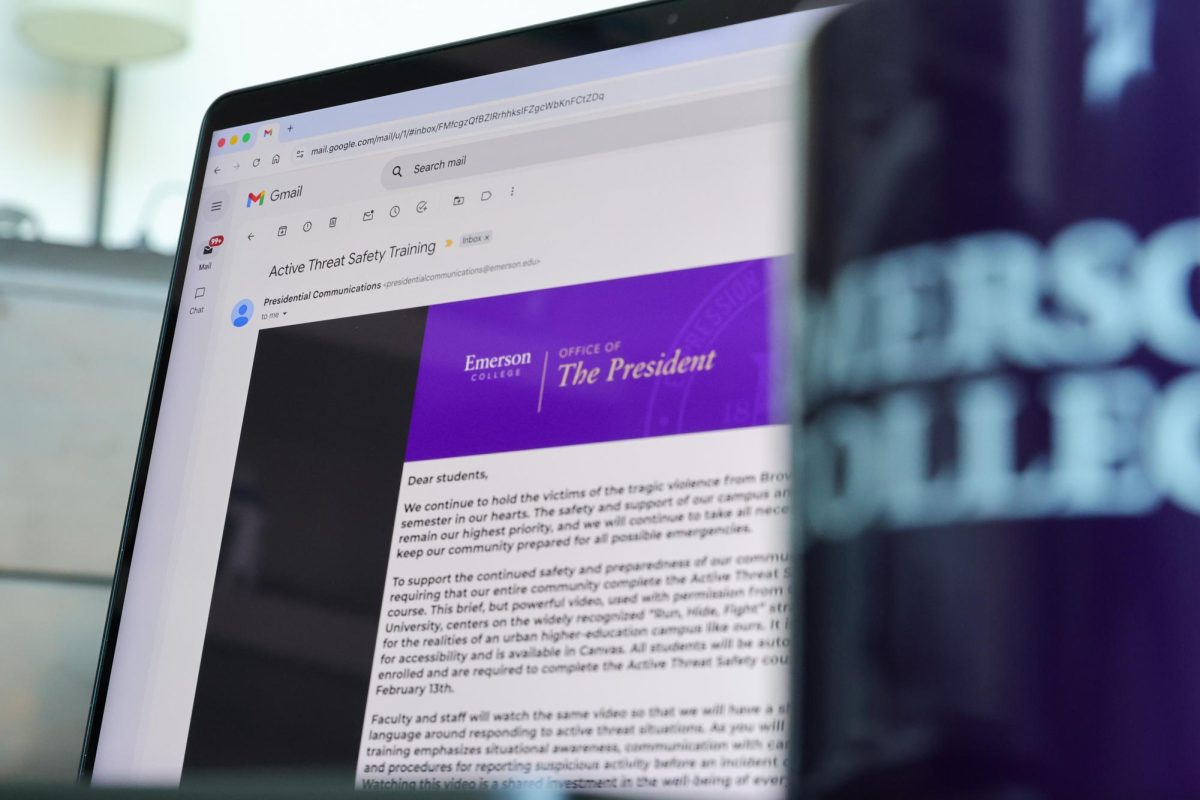
In a community-wide email sent last week, Emerson College President Jay Bernhardt announced a mandatory Active Threat Safety Training course, with the purpose of educating students on what to do in an active shooter scenario on campus.
The announcement came six weeks after the shooting at Brown University, when former student Claudio Neves Valente killed two students and wounded nine others on Dec.13. Two days later, Valente also shot and killed MIT Professor Nuno Loureiro in Brookline, Mass.
“While these types of training can be challenging and cause anxiety, we believe they are of vital importance,” the email from Bernhardt and Emerson Vice President of Student Affairs Christie Anglade read. “The goal here is empowerment and preparation for our community.”
The course, located on Emerson students’ Canvas, contains one eight-minute video created by California State University and a one-question verification quiz for students to acknowledge they watched the video. The course must be completed by Feb. 13, although it is not immediately clear what would happen if students fail to complete it by the due date.
The video, which features the “Run, Hide, Fight” strategy, is endorsed by the U.S. Department of Homeland Security and has been adopted by law enforcement agencies and colleges nationwide.
The strategy suggests running when there is an active threat, hiding if escape is not possible, and fighting back as a last resort.
“While the likelihood of finding yourself in an active shooter incident is small, the risk is real, and these situations are happening with increasing frequency on college campuses and elsewhere,” the video stated. “Our objective is to help put you in control of the outcome.”
Matt Matheis, the director of emergency management at Emerson, conducted a needs assessment around the college’s preparedness last semester.
“As part of that effort, we looked at a number of options to get this awareness training in front of the Emerson community,” Matheis said in a statement to The Beacon. “We selected this training because it was an established curriculum developed by one of the largest university systems in the country and shared with other institutions for use over the years.”
Matheis said that Emerson’s plans are “regularly evaluated” for the possibility of an active shooter threat arising on campus.
Last November, senior leadership and stakeholders across the college participated in “a tabletop exercise” to test their plans, according to Matheis, in order to ensure that administrators and staff are prepared to respond to safety incidents.
The active shooter training we shared with the college community last week is intended to inform students, faculty and staff for that same purpose,” Matheis wrote. “To build resilience across all segments of the college by informing each member what to do in the event of an active threat.”
The college’s website outlines all emergency protocols, including the various steps that students should take in the event of an emergency. Additionally, Emerson offers a safety app called LiveSafe that allows students to report tips and navigate the city safely. Emerson Alerts is an emergency notification system that sends messages to students, faculty, and staff in the event of an emergency.
While the school says the course “is a shared investment in the well-being of every member of the Emerson community,” some students have raised questions about how helpful it will be.
The issue was discussed at length during this week’s Student Government Association meeting, with some students calling the announcement “impersonal” and “deeply unsettling.” Several council members felt that the email from Bernhardt should have conveyed more information, or a direct address from the president.
Christian Carapucci, a junior journalism major, shared his doubts about the efficacy of the training course, having grown up at a time when lockdown drills were routine throughout high school.
“I feel like during the video, they’d be lucky if half the people are paying attention, and they’d be lucky if half of those people remember what they watched afterwards,” he said.
Justine Cox, a freshman bachelor of fine arts in theater major, echoed the statement, saying that her K-12 education prepared her for an active shooter threat. She wishes that the training provided a better way to “check if people actually watch the video.”
“It’s so easy to just click ‘yes, I watched it,’ even if you didn’t,” she said. “The concept is good, but the execution is kind of pointless.”
Despite administrators’ efforts, Carapucci said he doubts Emerson is fully prepared for an active shooter threat.
“Just a simple video during a mass shooting doesn’t give me much faith that they know what they’re doing,” he said.