


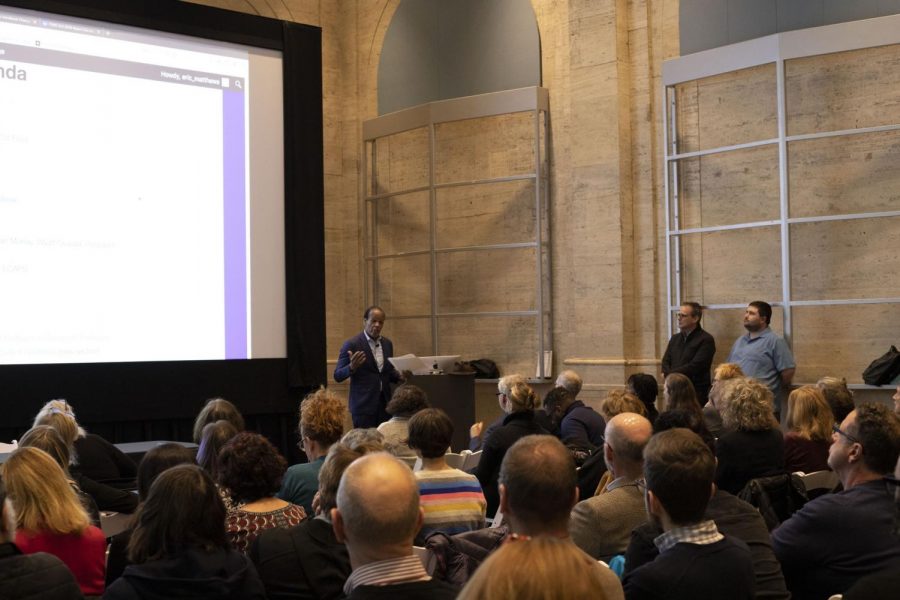
Emerson faculty overwhelmingly voted in favor of a resolution affirming “the value of diversity in faculty hires in all academic endeavors” at the monthly Faculty Assembly meeting on Tuesday, in which they discussed governance, representation, and institutional policy.
The resolution was a preemptive response to a proposal, which has not yet passed, to change language in the Faculty Handbook — a document outlining the policies, procedures, rights, and responsibilities governing faculty employment — to remove mentions of diversity, equity, and inclusion (DEI).
The handbook language has not yet been finalized, as it was tabled in both semesters meetings for future discussion. In the proposed changes to the handbook, which were reviewed by The Beacon, one sentence that contained the verbiage “individuals with a variety of perspectives and expertise and with a commitment to diversity and inclusion” would be replaced with “individuals with a variety of perspectives, backgrounds, and areas of expertise.”
While the resolution is symbolic, some faculty argued that it was important to have the statement in writing to show they are not being “silent on the issue.”
In the past year, the Trump administration has made moves to dismantle federal DEI programs by closing offices, cutting grants, and ending affirmative action requirements for contractors to instead prioritize merit-based policies. This pressure extends to higher education, where Department of Education investigations into DEI practices have prompted many universities to scale back programs to protect their federal funding.
Emerson College has restructured some of its DEI framework, including renaming offices and roles. While leadership says it maintains a commitment to an inclusive campus, the shift in vocabulary and structure has met with mixed reactions from the community.
Yasser Munif, an associate professor in the Marlboro Institute for Liberal Arts & Interdisciplinary Studies, said that he is concerned about the “ambient politics of fear at Emerson.”
“Many of our colleagues have the same worries, but they won’t share [them] with the leadership to avoid retaliation,” Munif said. “I think that more of our white and tenured colleagues need to speak up.”
Munif said that the proposed language changes would erase diversity at Emerson, and he rejected what he saw as a capitulation to the Trump administration.
“Today we are told that we need to make changes on inclusive language,” said Munif. “The argument is that there is a fascist government full of Epstein friends that suggested the language, and therefore, we need to abide and do as they wish.”
In a statement to The Beacon, the college said that the Faculty Handbook remains under the authority of the assembly. This means that when the changes go to a vote, the faculty can vote it down.
“The Faculty Handbook and its contents are the purview of the faculty,” the statement read. “However, the College has an obligation to ensure all of its policies and handbooks are legally compliant, which is why the College provided potential handbook revisions for the Faculty Assembly to consider.”
The resolution passed with 86% in favor. The handbook proposal has been tabled to be addressed at a later meeting.
Two other handbook language proposals were also discussed in the meeting. The first is a resolution that will be voted on in the March meeting, which would replace all references to “he” or “she” in the handbook with “they” in order to standardize language. Another, which passed with a majority of 93%, alters the language that describes how a faculty member is promoted, to match what is written in the faculty union’s Collective Bargaining Agreement. The move was made to avoid confusion, ensuring the two use the same language.
The assembly also discussed growing concerns regarding a lack of interaction between faculty representatives and Emerson College’s Board of Trustees. Senior Distinguished Artist-in-Residence P. Carl, who acts as the current faculty representative to the board, said that he feels his ability to communicate with the board is limited. In light of this, he questioned the purpose of his role, and asked the faculty for suggestions that he could share in his next report to the board.
Several faculty members who previously served as Board of Trustees representatives also spoke on their experiences in the role. Deion Hawkins, an associate professor in the communication studies department, said that he was “floored” by the infrequency of meetings with the board during his time in the role, and said that it was “impossible to have any deep-dive discussions.”
The problem, he said, is differing definitions of the role’s purpose between the faculty and the board.
“From the board’s perspective, the job is to observe and report back to the faculty about what was happening,” Hawkins said. “Whereas we saw it as meaningful involvement to contribute to the discussions being had and the outcomes that would come from that process.”
In the discussion, several faculty members said that changing the structure of the role and clarifying its purpose is necessary and should be a priority.
“If we’re going to advocate for a change, I do think that the structure, like frequency of meetings, has to change if we believe this position actually should contribute to meaningful involvement,” Hawkins said. “Without there being a change of the structure, I don’t know if we will ever get a change of what the role looks like.”
There are three faculty members who engage with the Board of Trustees; this includes one representative to the full board and two representatives to board committees. In a statement to The Beacon, the college said that the roles have continued to remain the same.
“These roles and processes have been in place for years and are fairly typical for private higher education institutions,” the statement read.
Carl said this is why he is especially interested in ensuring that the role of the trustees’s representative will be addressed.
“I’ve never wanted to be more involved in shared governance, because this is the time — nothing risked, nothing gained,” he said.
The next Faculty Assembly will take place on Tuesday, March 31.




If the administration had been retaliatory, you all activist faculty would have been let go two years ago, when you rallied up the students, taught in the encampment, and then ran away when the police came. You are responsible for ruining the students’ future. You should have been investigated at a federal level, well beyond Emerson College. Yet, you are all still here.