


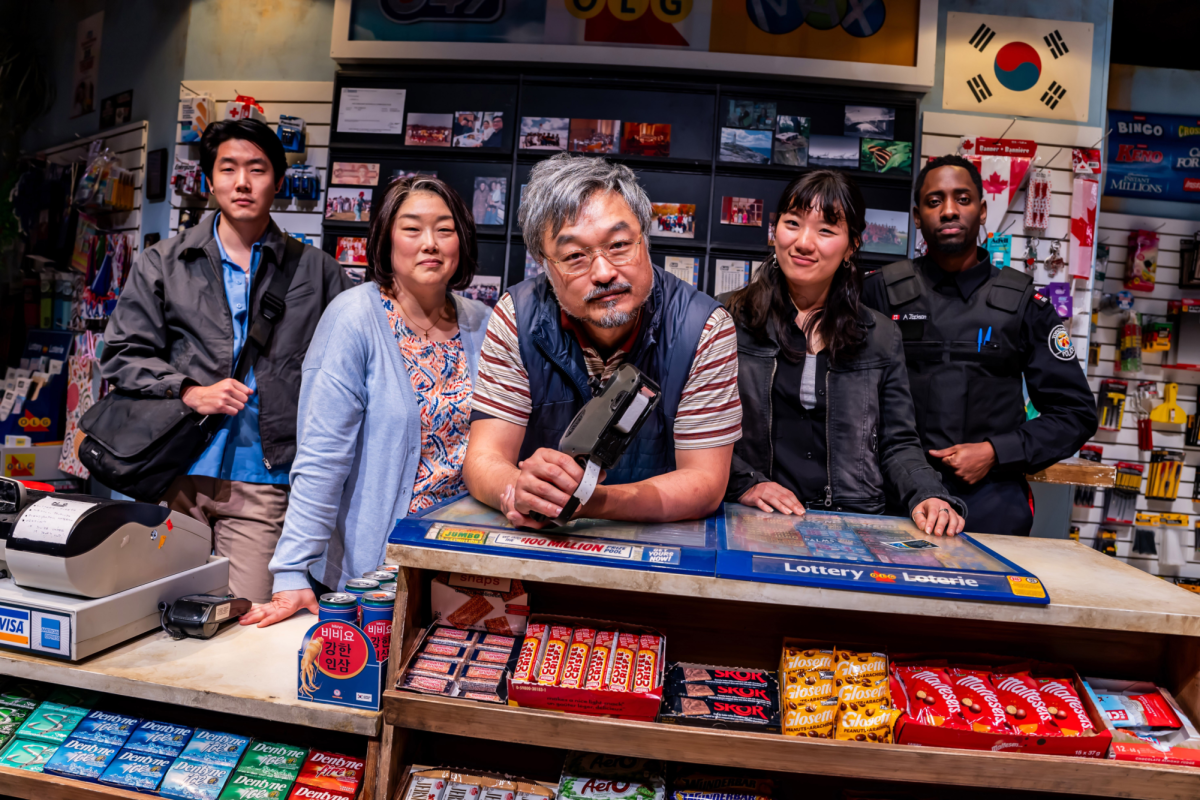
Local businesses make up the heart of a community and the livelihoods of those who run them. In “Kim’s Convenience,” a business becomes a harbinger of family reconnection and a way to give people in that family purpose when they feel lost in a messy world.
Adam Blanshay Productions presents Soulpepper Theatre Company’s “Kim’s Convenience,” the heartwarming comedy play turned TV show, returning to its original theater format at The Huntington’s Calderwood Pavilion from Nov. 6–30. It stars the playwright, Ins Choi, as Mr Kim, or Appa, Esther Chung as Mrs. Kim, or Umma, Ryan Jinn as Jung, Kelly J. Seo as Janet, and Brandon McKnight as Alex, among other small characters that appear only once in the play.
Weyni Mengesha, the artistic director of Soulpepper Theatre in Toronto, serves as the director of this show as well. She has long collaborated with Choi, directing the original play as well as its off Broadway run in 2017. “Kim’s Convenience” premiered in 2011 at the Toronto Fringe Festival, making its way to Soulpepper Theatre Company in 2012.
In 2016, the play was adapted into a Canadian TV show that ran for five seasons, now available on Netflix. It starred “Barbie” (2023) actor Simu Liu in the role of Jung. The show spends longer unraveling the interpersonal issues between the characters than the play does, with Jung and Appa not reconnecting until season two of the show.
Choi once played Jung in the show’s infancy, but joked in a Boston Globe interview that he “got old,” allowing him to now play Mr. Kim..
The intimate 90-minute play centers around the Kim family’s feelings surrounding the fate of their family business, which is at risk of being bought up and turned into condos due to increasing gentrification in Toronto.
Appa’s children, Janet and Jung, offer differing perspectives to the first-generation immigrant experience. Kelly J. Seo brings vivacity and humor to Janet, particularly while acting out relatable experiences for children of immigrants, such as attempting to translate nuances of a foreign language to parents who are not native English speakers.
Throughout the show, they experience the forming of new relationships, the mending of old ones, and the reimagining of the family dynamic, all within one convenience store on the brink of extinction.
The show takes place on a singular set: the convenience store that Mr. Kim owns and runs with his family. This staging demonstrates how the shop serves as the center of both external and internal conflict. The convenience store setting is rendered in immense detail, complete with shelves stocked full of products, a radio and tea kettle behind the register, and newly imported Korean energy drinks that Appa offers to his customers throughout the show.
Mr. Kim, also called Appa, Korean for “father”, gets into fights with his children in the store but wars with himself in quieter moments of solitude, where he is forced to reckon with its possible future in the face of displacement.
A touching and pointed moment in the show starts as a rip-roaringly funny sequence. After Alex, an old friend of Jung’s, goes on a date with Janet, Appa holds Alex (Brandon McKnight) by his arm, demanding (benevolently) to know if he likes Janet. He had earlier lamented, in another example of a relatable immigrant parent experience, that Janet was still single at 30.
Janet then flips the tactic on Appa, not releasing him until he thanks her for the years she spent working in the store and for staying when her brother left. This touchstone issue allows Janet to release her resentment against her parents by getting the affirmation from her father that she has long craved, and take a step into her new life with Alex.
Jung, however, hangs over the show as an unanswered question—the son who, in a moment of retaliation against the life he was born into, left home at 16 and has not been back since. He comes on stage more than halfway through the play, reconnecting with his mother at church, where he shows her a photo of his son. When she tells him that the store may be sold, Jung chooses to return to the store and face his father.
The gentrification question isn’t fully answered by the end of the play. There isn’t an easy answer to that question that the audience is given. Instead, we are left to hope that with Jung’s implied resolution to carry on the legacy of the store, they can avoid it being closed forever.
The audience is left with the final image of Jung behind the cash register in the same spot Appa stood at the start of the play. This reflection implies that Jung will take over the store and continue what his father started while Janet follows her dreams of becoming a photographer. Both children are left with the potential for fulfilling lives, one within the original family circle and one outside of it.
The play is a longstanding, seminal work about the immigrant experience. It presents the audience with multiple perspectives that don’t add up to an easy answer about how the characters should live their lives and reckon with their multifaceted identities.
Appa said many times in the show that “my story is you,” referring to how the family’s immigration was for the betterment of his children’s lives. While undeniably rooted in Korean culture, “Kim’s Convenience” could be the story of any immigrant family and how they relate to one another amidst the cultural differences between parents and children that come with living in a new country.
In the play, the store is a convenient way to represent the heart of a family and a way to keep heritage alive.