

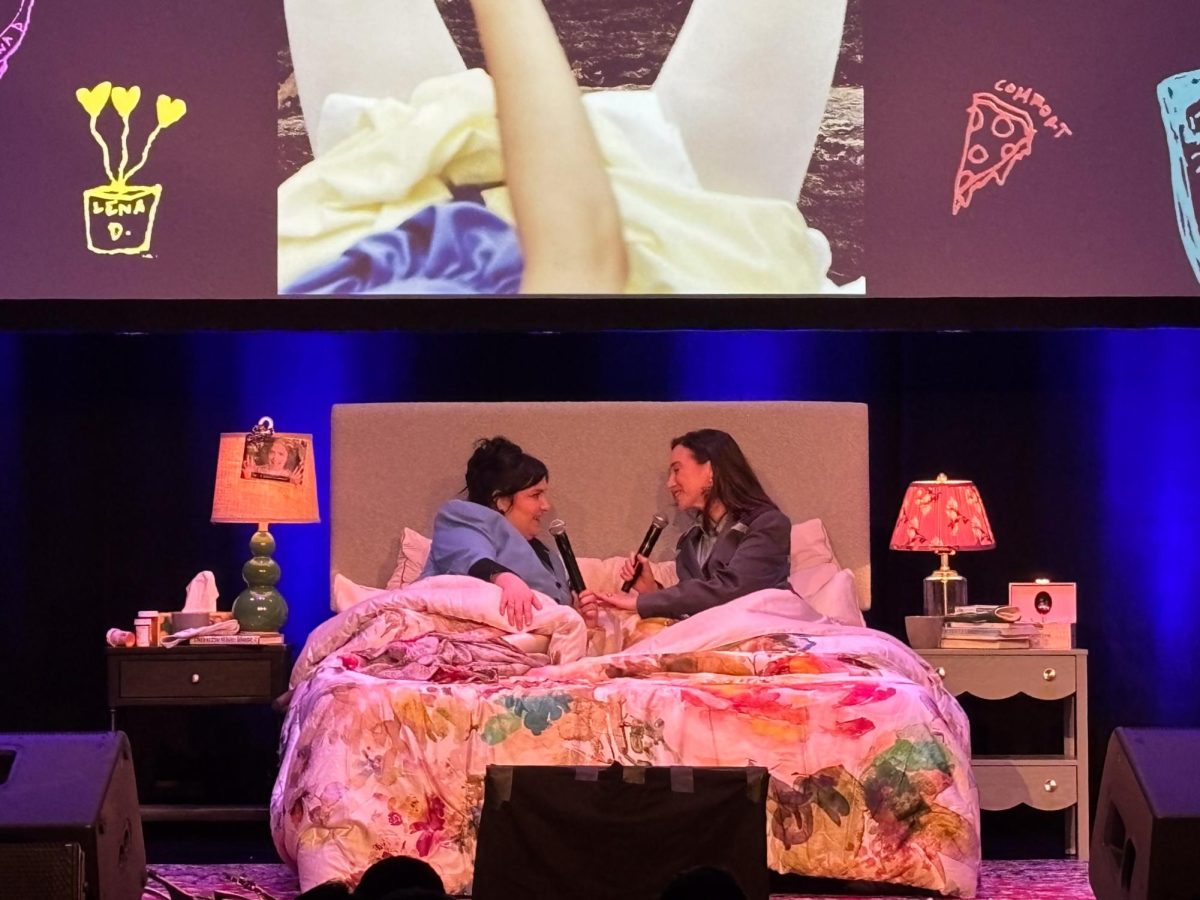
“It’s like you’re all in bed with me.” The voice of a generation, though not necessarily her own, Lena Dunham graced the Wilbur Theatre Thursday night with a sleepover-pajama party style event to celebrate the release of her second memoir, “Famesick.”
Often criticized for being the face of white zillennial feminism, writer-actress-director trifecta Dunham is certainly a product of her time. But, as evidenced by the resurgence of millennial optimism and a Gen Z audience who seeks authenticity, Dunham provides the blessing necessary for my generation to abandon perfunctory inclinations.
Dunham greeted her crowd warmly: “I love Boston,” she declared. She referred to the city as “Ben Affleck’s pussy buffet,” adding that Boston holds a place in her heart for headquartering her personal specialized gynecologist.
“Famesick” captures Dunham’s private life during a particularly fraught period of maturing fame following the release of HBO’s 6-season show, “Girls”(2012-2017), which she wrote, directed, and starred in. Over the near decade it took to write the book, Dunham said she spent a lot of time in bed over the last ten years.
Amid Emmy campaigns and Met Gala attendances, Dunham privately dealt with endometriosis, obsessive compulsive disorder diagnoses, family deaths, a public relationship and breakup with musician Jack Antonoff, and scandal. Dunham’s seemingly innocuous political activity, usually related to a crass comment or semi-religious devotion to then-presidential candidate Hillary Clinton, always escalated online to acts perceived to be on par with terrorism.
Surrounded by physical and mental discomfort, cozy became her favorite word.
To cope with constant threats and online harassment concerning her weight and her chronic pain, Dunham’s bedroom was her place of respite. For the book tour, she reconstructed what her room looked like at the time to conceptualize its theme: disclosure. The floral bedspread, scallop-edged Pottery Barn-ish nightstand, and pink lamps were reminders of who young Dunham really was during the period “Famesick” takes place.
“The book has a lot of heavy themes,” Dunham said prior to reading an excerpt from the memoir. “But there’s a levity. Some of the funniest stuff that happens to us is also some of the most painful … We just need like five to 10 minutes to recoup and turn it into a joke.”
“Famesick” earned press buzz for revealing Antonoff’s closeness with a budding popstar, allegedly Lorde, detailing the “verbally aggressive” psychosexual relationship she had with co-star Adam Driver, and disclosing her hysterectomy to treat endometriosis.
However, the true feat of the memoir, which is captured in the playful sleepover nature of the tour stop — two sexy male lackeys escorted equally sexy audience members to join Dunham on stage to play “fuck, marry, kill” and “would you rather” — is Dunham’s ability to be completely herself and remain compelling.
To keep a live crowd and/or readership simultaneously laughing, turned on, and emotionally invested ad nauseum invites audience burnout. But Dunham’s adaptability and loyalty to being herself makes her the exception to this rule. She captures what it feels like to be a vivacious, promising twenty-something who feels “cursed,” as Dunham writes in the book.
“But going through hard things actually makes life feel a lot less scary,” Dunham said. “Because there’s something about getting through a really hard experience and knowing … you can do it.”
From the mouth of Dunham, the lesson of the memoir is all about recognizing that “you’re a person that’s capable of enduring great challenges,” famous or not. Dunham said she did not always handle her struggles with grace, if she cared to handle them at all.
Adding a younger voice to the mix, journalist and writer of Feed Me Substack Emily Sundberg climbed into bed with Dunham halfway through the evening to talk coming of age. Despite the tour’s theme and Dunham’s initial dismay, Sundberg gave advice for healing and moving forward: “You have to get out of bed,” she said. “You have to talk to people and take in the world.”
The memoir isn’t a self-aggrandizing attempt to solidify herself into cultural history; the purpose of disclosing her chronic illness and personal turmoil is to discourage suffering in silence.
“The things that had been painful but suppressed, uncomfortable but tightly managed, were suddenly overpowering me,” Dunham wrote in her book, describing life after “Girls” wrapped.
Before the show began, audience members were encouraged to submit audio recordings through a QR code relating to topics we needed advice on. An audience member named Ella asked for advice about coping with anxiety, to which Dunham cited the Diamond Princess cruise ship passengers who were stranded during the pandemic getting a new lease on life when they were able to return home.
“[They] got back to [their] houses,” Dunham explained. “And [they’re] like ‘I love it here.’ I feel that way about my body, my life,” she said.
Dunham’s display of off-the-cuff wit while offering solicitous advice reminded me just how much of a genius she is in her own rite. She is deeply interested in the world around her and the human condition, particularly womanhood.
“I noticed that the enthusiasm for other people’s experiences seems to have diminished,” she said. “It’s like there’s a hunger for other kinds of information, but not actually like a hunger for connection.”
Dunham turns 40 in May. And although she is statistically halfway through her life, she feels “sharp and alive.” She’s now sober, married, a mother to several farm animals in London, and just as creatively successful as she was in her twenties.
Dunham led a mass meditation to conclude: “You have the chance to wake up tomorrow and start again,” she said. “The sun always rises, unless it doesn’t. We’ll find out.”
Two slideshows sandwiched the event. The first displaying stills from the “Girls” era to songs made popular by the show, like Robyn’s “Dancing On My Own,” that are culturally inextricable to the 2010s. They’re songs I now listen to in my twenties, dealing with the same artistic, metrosexual male avoidants that Dunham tackled in “Girls” over a decade since its debut.
The second slideshow was proof of life’s persistence. To Florence and the Machine’s “Dog Days are Over,” photos of Dunham’s life now show she’s at peace with her body and settled in her personhood.
“It’s amazing to realize,” said Dunham’s character in “Girls,” Hannah Horvath, “that my only limitation is my own mind.”