


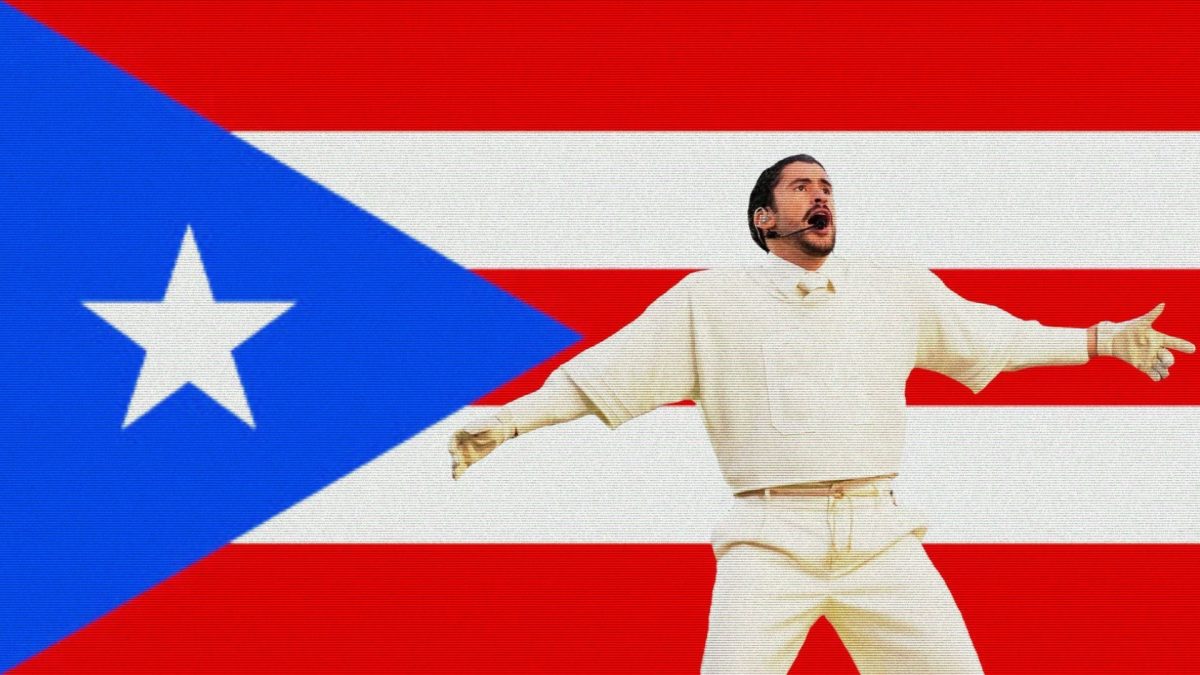
On Sunday night, Bad Bunny did not simply headline the most-watched stage in America. He reframed what we mean when we say “America.”
For 13 minutes, during the 60th Super Bowl halftime show, Bad Bunny transformed a football field into a living archive of Puerto Rican memory — and, more quietly, into a referendum on belonging. As a Boricua, watching that stage shift into something so unmistakably ours felt personal.
But the show was bigger than pride. In a political moment when immigrant communities are detained, deported, and used as campaign rhetoric, the performance served as a reminder that America has never belonged to one language, one race, or one version of itself.
The set unfolded like an archive in motion: Coco fríos and piraguas; older men slamming domino tiles on plastic tables, a rhythm as familiar as drums. In Puerto Rico, dominoes are more than just a pastime; they are ritual and debate, a space where politics, pride and family legacy are handed down across the Caribbean. A man sold joyas de oro — thick gold chains signaling pride and visible wealth across Latin America, especially in Puerto Rico, where adornment has long been both aesthetic and defiance.
Boxers squared up in the background, not the legends themselves but a nod to the legendary Puerto Rico-Mexico rivalries that once filled Caribbean living rooms. Félix “Tito” Trinidad. Oscar De La Hoya. Julio César Chávez. Miguel Cotto. Those fights were never just sport; they were national pride broadcast into diaspora households. On the field stood Puerto Rican rising star Xander Zayas and Mexican contender Emiliano Vargas — the next generation of that lineage. Their presence suggested inheritance rather than opposition, respect rather than spectacle.
Grounding the scene was a casita: the cement home built to withstand hurricane season and tropical storms. Cement because survival demands durability; cement because wind and empire both test foundations.
When the camera widened, the message expanded: Cardi B. Pedro Pascal. Karol G. Young Miko. Jessica Alba. A cross section of Latinos shaping American culture across music, film, and television stood visible on the nation’s largest stage. Latino influence, the performance suggested, is not peripheral to the United States. It is foundational to it.
I will admit that when I first saw Jessica Alba, a reflexive gatekeeping instinct surfaced. Alba never explicitly rejected her Latinidad, but she often sidestepped it. Coming up in the late ’90s and early 2000s, she built a career largely through roles written as white or racially ambiguous women, rarely portraying Latina characters, a choice that many in the Latino community found quietly painful. But who gets to claim Latinidad, and when? There is no better time to claim it than now, in a moment when ICE raids persist, when Latinos are detained and deported and when belonging is policed.
If claiming identity is an act of resistance, then showing it fully and unapologetically is an act of power. The dancers reflected every shade. At one point, two men perreando together appeared briefly — a small but quietly radical image. America,the real one, has always been multiracial, multilingual, and queer. The show did not argue that explicitly; it demonstrated it.
When the chords of the 2023 hit “Mónaco” rose, carried by violinists of color, Bad Bunny addressed the camera: “If I am here today, it’s because I never stopped believing in me. You should never stop believing in yourself.” The statement could have been read as generic motivation. Instead, it felt like affirmation. That this son of Vega Baja, rooted in Latin trap, reggaetón, salsa, and Puerto Rican identity, headlined the Super Bowl almost entirely in Spanish is monumental. He became the first primarily Spanish-language performer to command that stage, all without diluting his culture for translation.
When Lady Gaga appeared, singing in English over a salsa arrangement, the assumption that only one version of America deserves centrality was fiercely challenged.
This joyous mixture of symbolism sharpened during “NUEVAYoL.” After World War II, Puerto Ricans migrated in large numbers to New York as industrialization and Operation Bootstrap displaced workers on the island. What followed was reinvention. Diaspora Puerto Ricans built labor unions, founded political organizations like the Young Lords, advocated for bilingual education, and reshaped American culture. Salsa was codified in New York with a distinctly Nuyorican pulse. Puerto Ricans stood alongside Black communities during the birth of hip-hop. The Nuyorican Poets Café turned spoken word into political testimony.
When Bad Bunny dove into the crowd, it felt like acknowledgement — a return to the communities that carried Puerto Rico in their accents, kitchens, and protest chants. New York did not simply receive Puerto Ricans. Puerto Ricans reshaped New York, and in doing so reshaped Puerto Rico itself.
Then he brought Ricky Martin — a bridge between eras. From Menudo in the ’80s to the 1999 explosion of “Livin’ La Vida Loca,” Ricky helped crack open the Anglo mainstream during the so-called Latin Explosion. But that entry came with conditions. The rhythm could stay; the language had to assimilate. So when Martin stood there singing “Lo Que Le Pasó a Hawaii” in Spanish, he was invoking the 1893 U.S.-backed overthrow of Queen Liliʻuokalani and the annexation that followed. Colonization by force, then by law, then by narrative; Puerto Ricans understand that pattern intimately. For Ricky Martin to sing about land, displacement, and survival without translation on America’s biggest stage felt less like homage and more like history closing a loop. Ricky Martin walked so Bad Bunny could run.
And yet the transition into “El Apagón” grounded the show, shifting the tone from celebration to indictment. The song addresses Puerto Rico’s fragile infrastructure and the precarity that persists years after Hurricane Maria, which left thousands dead and exposed systemic neglect. After Hurricane Maria in 2017, some Puerto Rican communities spent nearly 11 months without power. Today, outages remain routine — lights cut off on clear days, interrupting work, school, and sleep. What began as disaster has hardened into daily life.
In 2021, the grid’s transmission and distribution were privatized and handed to LUMA Energy,a consortium between Houston-based Quanta Services and Canadian energy company ATCO, under a 15-year contract promising modernization. There is no alternative provider; residents cannot choose another utility, and Puerto Ricans pay some of the highest electricity rates in the United States for service that repeatedly fails.
So when Benito Martínez Ocasio, Bad Bunny, closed the Halftime show by proclaiming “God Bless America,” then began naming countries across the hemisphere — Grenada, Haiti, Jamaica, St. Kitts, and The Antilles — his performance insisted that America is not synonymous with the United States. America is Puerto Rico: a U.S. territory whose residents serve in the military yet cannot vote for president. It is Mexico. Brazil. Colombia. The Dominican Republic. Argentina. It’s all of us.
Since 1823, when the Monroe Doctrine framed the Western Hemisphere as a U.S. sphere of influence, “America” has often implied ownership: a logic used to justify intervention across Latin America and the Caribbean. To name the hemisphere aloud on that stage was to reclaim its independence. After all, as Boricuas, we grow up between flags. We learn to translate ourselves in classrooms, interviews, and airports. We learn how to be American without ever being fully treated as such.
On Sunday night, that split felt suspended. Puerto Rico wasn’t orbiting the moment. It was the center of gravity.
In a time when political leaders narrow who counts as American, that visibility was more than entertainment. It was a reminder.
We are here. We have always been here. And America has always been ours, too.