


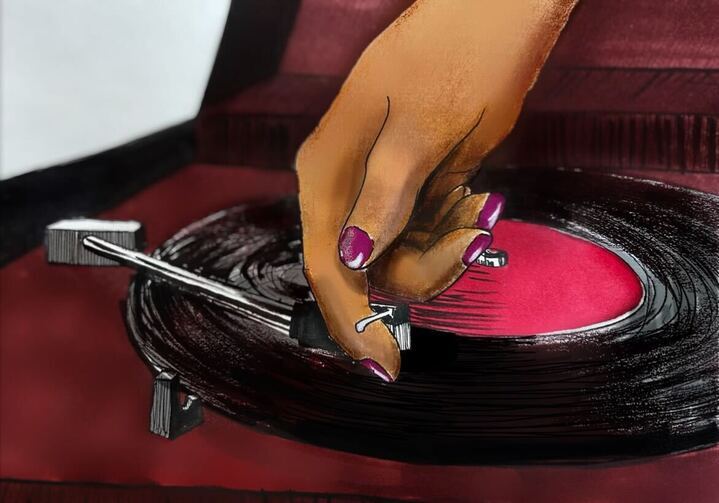
Consider the coffee shop. Not the one in your memory — the one with the hiss of an espresso machine and a door that swings open and shuts, carrying in cold air and someone else’s urgency — but the one you actually walk into now, in 2026. Within seconds, before your coat is off, you are already submerged. Something warm and textureless fills the room. A soft piano loop, a brushed snare at 75 beats per minute, a bassline that never resolves. The music isn’t asking anything of you. That’s the point. But that’s precisely the problem.
We are apparently afraid of pausing, which may explain why we’ve never stopped to examine why. The background music industry is now valued at $2 billion, driven in no small part by cafés, yoga studios, and co-working spaces that treat quiet as something to be remedied.
Before I wrote a word of this, I opened Spotify. I didn’t decide to. The laptop opened, the cursor blinked, and my hand moved to the trackpad the way it always does — find something to put on, then start. I caught myself halfway through and sat with the silence instead. It lasted about 40 seconds before it started to feel like a problem I needed to solve.
On YouTube, the channel Lofi Girl, a 24/7 live-streamed ambient music channel, has amassed 2.5 billion total views and 15.7 million subscribers — all of them actively choosing to fill their silence with something specifically designed to feel like nothing. There is a whole economy built on the sound of almost-nothing: music calibrated to be present but not demanding, audible but forgettable, the sonic equivalent of beige.
This is not an argument against ambient music. Musician and songwriter Brian Eno released “Ambient 1: Music for Airports” in 1979 and it remains one of the most genuinely beautiful things ever recorded. Eno famously wanted the album to be “as ignorable as it is interesting” — a description that has since been repurposed into a business model. The question isn’t whether music has value. The question is what does it mean that we need it constantly — that we have essentially prescribed around-the-clock music to ourselves as a treatment for the condition of being alone with our own minds.
What are we treating, exactly?
Maybe it’s not silence itself, but everything silence lets in. The unfinished assignment; the unanswered email; the low-grade awareness that everyone around you seems to be moving faster. On a campus, the ambient pressure is constant and structureless, which makes it especially hard to sit still with. Putting in earbuds is a coping strategy. The problem is that it works just well enough to keep us from noticing what we’re coping with.
A survey of more than 26,000 people across 21 countries found that the average American begins to feel uncomfortable after just 6.3 seconds of silence, roughly the time it takes to read a sentence. Those intervals used to simply exist: on a train, in a waiting room, in the 30 seconds between putting on a record and the needle finding the groove. Those intervals existed, and we moved through them, and they cost us nothing. They were the liminal spaces in the day, the rests in the score; and like those rests, they gave the other notes their meaning. Now we have the ability to paper over every gap, and we do.
This discomfort is not universal. In the Netherlands, the same survey found that nearly a third of people report no discomfort with silence at all. In Japan, the concept of “ma,” roughly translating to “the meaningful pause,” is built into the architecture of conversation itself. In these cultures, silence isn’t a failure of communication, which suggests our inability to sit in silence isn’t human nature — it’s a habit.
Watch anyone on a train platform. The moment the train is delayed, the moment there is nothing to do but stand and exist, the phone comes out, and with it the earbuds, and within seconds the silence has been dealt with. Nobody chose this, exactly. It happens the way flinching happens: faster than thought, below the level of decision.
Something is lost in all this: not the music, but the thing the music replaced. The capacity to tolerate an unanswered question and to be briefly, productively bored. To sit long enough in your own head that something unexpected surfaces.
That used to be called thinking. Now there’s a playlist for it.