

This article includes mentions of sexual harassment and drink spiking.
Studying abroad, I was prepared to be in a constant state of shock. As soon as I stepped foot in the Netherlands, I knew that everything — from the language, to the food, to the social etiquettes — would be vastly different from anything I was used to.
In a way, I signed up for this three-month-long cultural whiplash, and I was ready to embrace any shocks that came my way, no matter how strange. However, the most jarring shock wasn’t the different shaped outlets nor the fact that bikers won’t hesitate to run you over if you’re standing in their way, but the prevalence of catcalling and public harassment culture abroad — specifically, how widely accepted this behavior is, as if it were a normal part of the study abroad experience.
One of the first things I remember upon my arrival to Kasteel Well was the myriad of warnings presented by one of the program’s directors. It wasn’t anything we hadn’t been told before: don’t trust taxi companies outside of airports because they’re always trying to scam you; never carry your phone or wallet loose in your pocket because pickpocketers are extremely common. However, one piece of wisdom which stuck with me was the commonality of public harassment, specifically, its prevalence in nightlife culture in most major European cities.
Come to find out, it’s true.
A study conducted by the Journal of American College Health showed that sexual harassment and victimization is common among college students studying abroad. One-fifth of the participants from an array of American institutions reported experiencing some sort of sexual violence during their programs, with nearly half of these incidents perpetrated by local residents and disproportionately affecting women.
And yet, institutions rarely offer sexual violence prevention or awareness programs prior to the students’ arrival abroad, essentially leaving them to find out on their own. Even when the issue is acknowledged, it’s almost always treated as part of the study abroad “experience,” presented as one of the many hurdles one has to jump over while navigating a new city on their own.
Although I wasn’t completely naive to these conditions abroad, it was the way in which this topic was spoken about so brazenly by the Kasteel Well staff that truly caught me off guard.
During orientation weekend at the Castle, the topic was broached when speaking of culture shock, and even as these efforts to address such a daunting topic were noble, in the end, it wasn’t enough. Clearly, it would be an aspect of my study abroad life that I would have to learn how to navigate by simply living through it.
Sexual harassment and pickup culture were approached almost as intrinsic parts of going out in this continent, and therefore presented as guaranteed experiences. It made these behaviors sound normal and expected, as if the only thing we could do about it is ignore it.
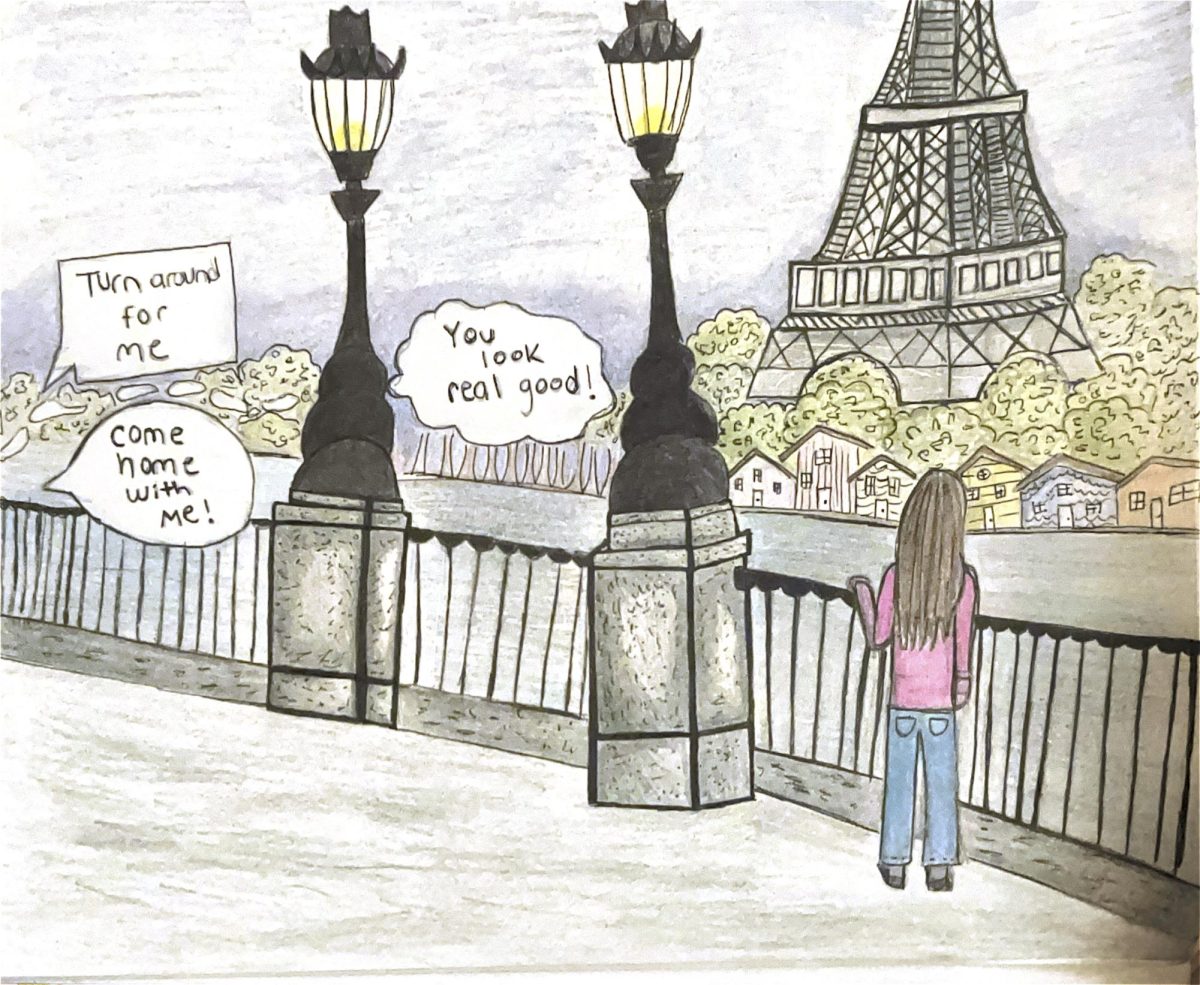
This mentality isn’t good. Catcalling and public harassment aren’t experiences one should come to terms with as part of their semester abroad. Sometimes it’s just not possible to ignore the lewd comments whispered in passing while walking the streets of Paris in search of the Eiffel Tower, while simultaneously trying not to get pickpocketed or lost.
It becomes extremely impossible at night outside of bars or clubs when, all of a sudden, you become aware of just how vulnerable you are in that moment — surrounded by intoxicated strangers with mixed intentions. All of a sudden, you second-guess that cute skirt you were so excited to wear, now convincing yourself that it’s entirely too short as you catch the lingering stares of men passing by. You feel uncomfortable in your own skin and also completely helpless because, really, there is no outfit change that will stop these strangers from persisting once you become their target.
Or so I’ve learned. I’ve encountered pickup culture and harassment in every place I’ve been to thus far, and, as much as it pains me to admit this, I started to view it as something I was meant to adapt to if I wanted to enjoy European nightlife. It seemed manageable at first; unwanted comments can be dismissed if one learns to power through them.
Visiting London for the first time, I was trying to get back to my aunt’s apartment on my own after a night out when a man came up to me and called me beautiful. I brushed his comments off as I always did, trudging forward to find my Uber in the endless sea of cars ahead of me, but he persisted. The man followed me, asked for my name, where I was going, and if he could help me get there with him. A feeling of dread and panic flooded me; the more I acted like a stone wall, the more this man wanted to talk. I felt completely vulnerable and powerless, and these feelings would only recur.
A man in Paris approached me in the middle of Champs-’Élysées calling me beautiful, then asking if I wanted to go home with him. Later that night, outside of one of the city’s most popular clubs, groups of men approached my friends and I trying to get to know us as we were trying to figure out a way to go home. When we rejected their efforts to convince us to talk to them, they became more and more defensive, resulting in insults we couldn’t understand for not wanting to entertain their unwanted comments.
But we carried on in Paris, in London, in Lisbon, in Amsterdam, in Barcelona, and seemingly everywhere we went. The thing about normalizing this sort of behavior is that at some point, it does become normal. It almost becomes part of the routine for going out in a new city, so you get used to the idea of catcalling and become increasingly more comfortable in your abilities to handle it. I thought with these experiences and the lessons they taught me, my survival would render me just fine everywhere else.
Then there was Madrid and a night I wish I could remember, but can’t and never will. Someone slipped something into my drink at a club because, in a completely rookie move, I left it unattended. I was lucky enough to be surrounded by friends who took care of me while I was unconscious, though this didn’t feel like luck anymore — it felt like naivety to its fullest extent for believing, even for one second, that one can will these situations away by simply ignoring them, as we’re advised to do.
The Castle’s directors who did everything they could to help me offered their unconditional support in the immediate aftermath. Although I cherish them dearly for it, they also encouraged me to move forward with my life, once again reiterating that these things happen and worrying myself sick over memories I can’t get back is useless. While their words provided temporary comfort, they were also part of the broader issue at hand. My guard was down that night because I felt capable of protecting myself from the pickup culture I was used to battling, not considering the malicious intentions behind unwanted commentary or creepy persistence.
That night, I learned that I was indeed not prepared to hold my own against the culture of sexual harassment that accompanies visiting new cities, and that ignoring it doesn’t make anything go away. In fact, it only makes us blind to what’s truly out there. To normalize and even excuse this behavior, even if it is regarded as a “thing that just happens sometimes” at this point, only works in favor of the abusers, as the longer they go unchecked, the more people they can target. We’re only doing a disservice to ourselves by fooling each other into believing that any of this behavior is tolerable.
Studying abroad should be about expanding our horizons through travel, and though that does often come with many struggles, catcalling and harassment are far beyond simple culture shocks.