


WELL, Netherlands — For some students of color studying at Emerson College’s Kasteel Well Program, adjusting to life abroad means grappling with Europe’s complicated relationship with race.
“They handle race relations very differently here in Europe, and we’re learning that firsthand,” said Olivia Quiles, a sophomore journalism major with mixed Puerto Rican, Black, and white ancestry. “It’s a little bit of a culture shock because I didn’t expect that.”
According to the Migration Policy Institute, the Dutch make up 75.4% of all ethnic groups in the Netherlands as of 2021. Racial demographic statistics for the town of Well were not available.
Elijah Bowden, a sophomore creative writing major who identifies as African-American with Italian ancestry, said he saw multiple Well residents staring at him through their windows when he walked through town for the first time.
“It wasn’t the fact that they’ve never seen a Black person before. I know that they definitely have, but I don’t think they expected one to be so close,” he said.
A few days after his walk, Bowden visited the local bar with friends when a Dutch man used the n-word in conversation. The next time Bowden visited the bar, the man pulled him aside to apologize. Bowden described his conversation with the man, who said that his reasoning to use the word was that the Dutch don’t have the same relationship with it as Americans do. But, at the same time, he contradicted himself and denied having ever said it.
On the drive to the castle upon arrival, students observed houses decorated with light-up signs featuring Zwarte Piet, or Black Pete — a popular holiday character traditionally associated with Saint Nicholas, and often portrayed in blackface. As students interacted with the local community, they noted a slew of different relationships to race, from language use to festivities.
Sophomore Zahara Trent, a Black and Filipino visual media arts major, said she expected harmful stereotypes like Black Pete.
“I kinda knew that when you’re going to a place that’s not America, they act like they don’t know [what’s racist],” Trent said. “They know.”
One of the closest interactions students have with the people of Well during the spring semester happens during Carnaval, an annual celebration leading up to Ash Wednesday. Locals dress up in costumes and host a parade through town while Castle staff and students hand out hotdogs to people in the parade.
Carnaval traditions emphasize role reversal during its celebrations, where people dress as different genders, classes, and even races. Castle staff explained to students in sessions preparing them for the parade that some costumes may not be politically correct to the American perspective. In the sessions, they told students to dress appropriately and respect the culture.
“I’m glad that they had a little meeting beforehand where they gave an explanation about everything, but I thought it was funny that they were like, ‘Don’t dress in offensive costumes,’ but everyone in Well is dressing in offensive costumes,” said Trent. “I think we know better.”
As locals paraded through town in mid-February, students spotted two floats that featured racist imagery:
The first had people dressed as sheep with faces painted black, and the second had a Confederate flag flying from a float replica of the Castle.
“I didn’t even believe it was the Confederate flag at first because I was like, ‘There’s no way. Why would that even be something that they would show?’” said Quiles. “It wasn’t even really surprising. It more just solidified to me the culture of the people and kind of the lack of awareness [local residents] have.”
Bowden said he felt that the Castle staff’s warnings ahead of the parade are justifying the traditions.
“[The College] wants Americans to give Europeans grace when it comes to racism. They want to say that they’re not the same sort of society as us, and that they’re not going to understand the same things about race and racism that we do,” he said. “But I feel like it’s all a very cheap attempt.”
But a history of racism doesn’t only extend beyond the Castle’s gates, but inside them as well.
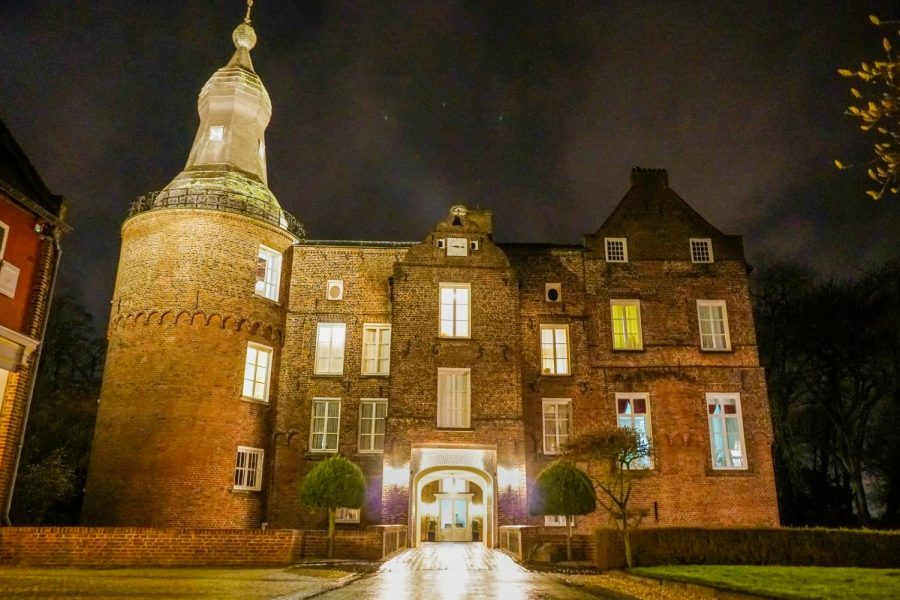
Hanging in a side room of the Main Castle is a portrait of Willem Liedel, a former owner of the Castle. According to the Well Archives, Liedel was responsible for major renovations to the Castle in the 1770s after he made his fortune by working as a merchant for the Dutch East India Company. The company, however, notoriously acquired its wealth and power through violent colonization and plantations.
Trent said that if there were more transparency about this connection, she probably wouldn’t have applied to the program. Bowden echoed Trent’s sentiment.
“Other people that I’ve brought it up to here have been, like, ‘You’re reclaiming the space,’ but how can I reclaim a space that I didn’t even know I had to take back in the first place?” Bowden said. “Now I feel weird being here because … this place wasn’t built for people like me.”
Trent and Bowden said they are grateful to be at the Castle, but wish Emerson had been more forthcoming about what their experiences as people of color would be like.
“They can’t do anything about the people of the community, but when it comes to things simply on campus, about the program itself, you need to tell people that these things are here,” said Bowden. “You’re coming to a conservative area, and you’re coming to an area that has a lot of really bad history when it comes to slavery and racism. You can’t just hide that in the terms and conditions.”
Still, Bowden said he doesn’t discourage students of color from applying to the Kasteel Well program, but would implore them to find support with other students and people of color abroad. “It’s not the village, it’s not the country, it’s not the kingdom. It’s the community.”