

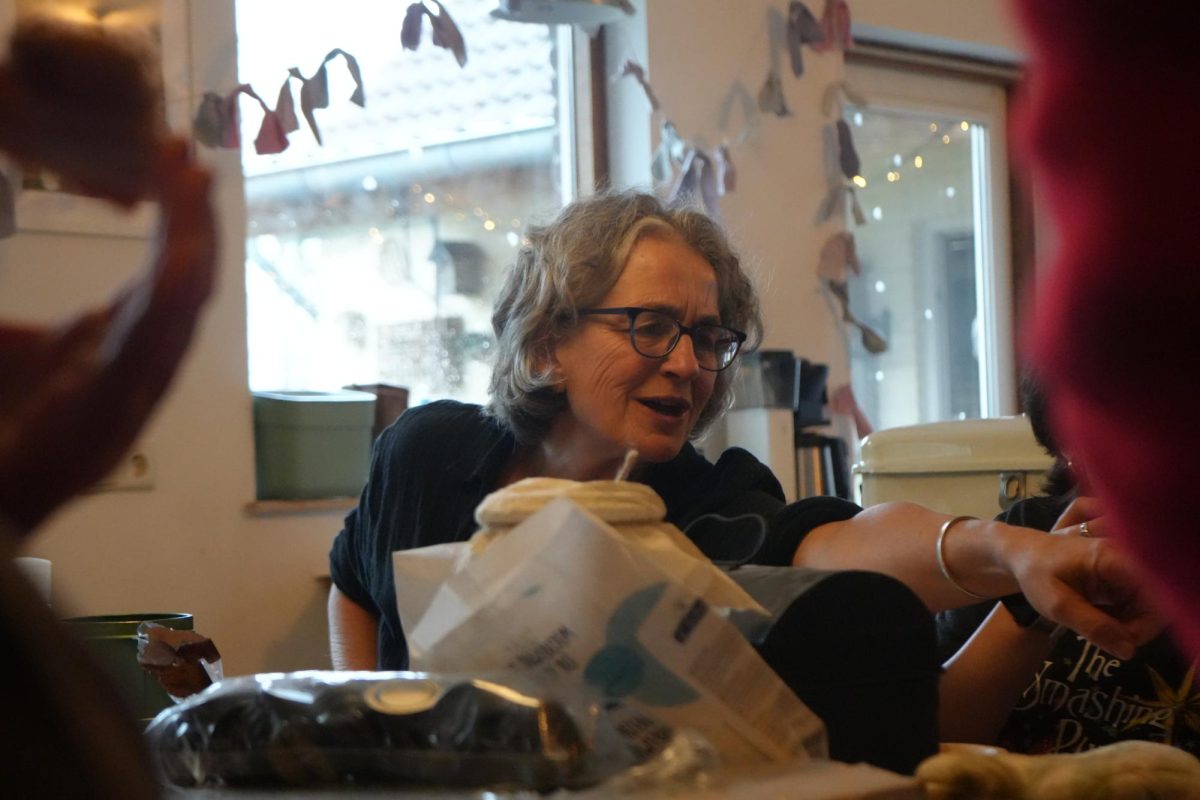
WELL, Netherlands — For nearly 90 Emerson College students who arrive at Kasteel Well each semester, one local, Corianne van der Horst, has made her home a haven for students to escape from the stress of studying abroad.
Each week, van der Horst invites students into her home, just a 10-minute walk from the Castle, to visit, eat stroopwafels, play with her farm animals, and create crafts in a program she calls Spelen Met Groen — a Dutch phrase meaning “playing with green.”
Van der Horst came to the Castle in 2023 to work as an on-call staff member, a position under the Office of Student Affairs requiring workers to be available during the afternoon and evening hours in case of emergencies.
During her first year at the Castle, van der Horst started the program out of her home, believing it would eventually move to its planned location at the student kitchen on Kasteel Well’s campus after its construction. But when the time arrived for the transition, van der Horst chose to keep it at her home, feeling that the welcoming environment was important for students who might feel homesick while studying abroad.
Now, numerous students find her quaint house and her dog Amke, cat Moef, pigs Karel and Cato, chickens Dolly and Sas, and rooster Ambrosius synonymous with the Spelen Met Groen experience.

Some students, such as sophomore theatre and performance major Zoë Wojnicki, consider Spelen Met Groen their home away from home.
“My favorite thing about [it] is the homeliness because you’re studying abroad,” Wojnicki said. “It’s really nice to have a homely feeling and a feeling of community.”
Though her picturesque brick house with a red-tiled roof may be small, van der Horst accommodates every student who walks through her door. She has a cluster of chairs in the sunroom for students to visit and drink tea together. When that room fills, students often spill into the kitchen, where they complete their crafts and make baked goods at her large kitchen table.
Anna Geisler, a sophomore political communication major, said that being in such an intimate setting with a Well resident helps students better understand Dutch culture. She also said it helps students relieve stress during a tumultuous time when they must balance being in another country, schoolwork, travel, and worries about current events happening at home.
“There is something really important about taking time to exist without having to do anything or be anywhere, and her house gives students at the Castle that space,” Geisler said.
Seeing van der Horst is something students like Geisler look forward to every week.
“It’s a very specific type of person who would open their home to a bunch of 19 and 20-year-olds they’ve never met and just give them full rein to exist in their space. It’s a very selfless thing to do,” Geisler said. “She is actually interested in every person, which is such a beautiful thing.”
In line with its name, Spelen Met Groen provides students with the opportunity to interact with nature in a rural environment, which some Emerson students may not be used to while living on Boston’s urban campus.
“Not a lot of people in America are connected with nature,” van der Horst said. “It’s a funny example, but I have students who don’t know how to crack a walnut, and they want me to teach them.”
During one of their first sessions, students made bird feeders from empty jars and tea cups to hang from the trees in the Castle’s courtyard, and brought back plants from van der Horst’s garden to put on their dorm windowsills. Last week, students made paintbrushes from plants and animal fur, and paints from elderberries.
Sophomore stage and production management major Amelia Lauren, who is from New York City, pointed to the contrast between life in Well and in the big cities she’s used to calling home.
“I’m used to the hustle and bustle of Boston and New York,” Lauren said. “Here, it’s another level of quiet. You can walk down the street, and people will say hi to you. It is different.”
While van der Horst initially focused on connecting students with nature, she said it has since developed into a time to share experiences and backgrounds through creation.
“I’ve always loved seedlings and cuttings, but I think the play is the most important,” she said, noting that it helps students connect and teaches them skills they can take with them back to Boston.
Part of what students create with van der Horst directly relates to the needs of those living in the Castle. During the last few weeks at her house, students have made anti-itch balm for eczema and extra pies, brownies, and bread catered to those with dietary restrictions.
Helping students in need comes naturally to van der Horst, who, prior to Kasteel Well, worked for 15 years in after-school programs. It was this exact calling that brought her to work at the Castle.
“If a student comes in cold, I give them a shawl. If they come in and their socks are wet, I give them my socks,” she said. “I’ve always been the type of person who enjoyed helping others.”
The students aren’t the only ones who benefit from this experience. van der Horst said that meeting students from different countries over the years and seeing their similarities has given her hope that people are not all that different and that there are good people in the world. She explained that she still connects with past students, and that taking care of and learning from them makes her happy.
“They make my world bigger,” she said.