

For many, it’s hard not to recall the final moments of the fifth installment of “Stranger Things,” the sci-fi horror series that premiered on Netflix in 2016 and wrapped up late last year. Set in the 1980s, the show initially centered on the supernatural disappearance of a young boy, Will Byers (Noah Schnapp), and his close-knit group of Dungeons & Dragons-obsessed friends known as “the Party.” Now, the original charm of a small town mystery has dissolved into a large mess of government conspiracies, complex monsters, and pointless subplots.
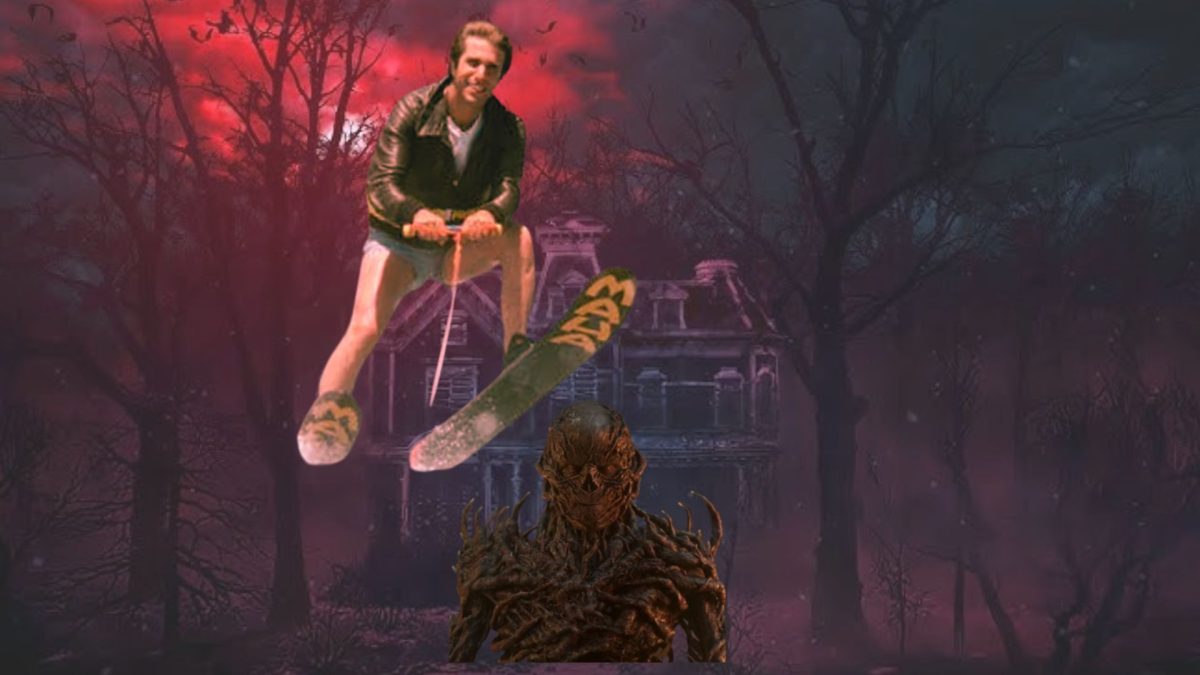
“Jumping the shark” refers to some multiseason television shows losing its original charm; ideas become exhausted, the audience wants something new, and the writers have to go to great lengths to create a new idea —most of the time with a plot point that will be hard to realistically wrap up in a finale.
The term comes from the 1974 sitcom, “Happy Days,” which featured the day-to-day life of a 1950s family. In the fifth season, the show’s breakout “bad boy” character, Arthur “Fonzie” Fonzarelli, attempts a stunt that included jumping a great white shark, gaining popularity at the time, but ultimately playing as a shameless gimmick for novelty and attention.
Many also point to recent shows quickly declining when they start to “lose the plot” and betray their hard-earned mythology. “Grey’s Anatomy” strayed from the original medical drama and included outrageously unrealistic plotlines like a large plane crash and a patient having sex with a ghost. “Riverdale” added a supernatural plotline to the once teen drama show. “The Office” ran for long enough that Michael Scott (Steve Carell) — the central driving force of the show — left.
I am quick to follow in the footsteps of pinning this trend on a show — even if it’s one I’m a fan of — by recognizing the shark-jumping present in the fictional town of Hawkins, Indiana. And I especially speak of this trend regarding the show’s recently released finale.
Across its first two seasons, the show explores threats including the Upside Down, as well as the Demogorgon and Mind Flayer, with Will being kidnapped and later possessed by the creatures. At the center of the mystery is Hawkins National Laboratory, a secretive government facility where a young girl known as Eleven (Millie Bobby Brown) was subjected to experiments that granted her telekinetic powers.
“The success of Season 1 freaked us out and then we knew we needed to build up this bigger world, that this was going to be ongoing,” said Ross Duffer, co-creator, showrunner, executive producer, writer, and director of “Stranger Things” in a Netflix interview.
I’m not the only one who holds the opinion that “Stranger Things” fell off somewhere along the way due to this pressure. A quick scroll through TikTok or Twitter proves it, with fans reminiscing on the nostalgia of what the show once was.
Season three is where cracks in the plot really started to show. The introduction of a Russian spy subplot arguably marks the beginning of the end. Adding a real world government conspiracy into a story that once thrived on fictional, small-town paranoia and childlike fear was a lot to develop. Instead of enhancing the mystery, these twists made “Stranger Things” geopolitical and raised the stakes too high to resolve anything.
Season four doubled down on this shift with Vecna — the antagonist and focal point of seasons four and five. While visually impressive, Vecna stripped the show of its eerie ambiguity. The Upside Down used to feel unknowable; now it had a clear villain, a backstory, and rules. The contained nature of the mystery’s charm was replaced with a more generic, modern Marvel-esque narrative, ending with a generic storyline that is meant to be satisfying, but really just falls short of expectations that have built up over the past ten years.
“We went into production without having a finished script for the finale,” Matt Duffer, co-creator, showrunner, executive producer, writer, and director of “Stranger Things” said in the new documentary, “One Last Adventure: The Making of Stranger Things 5.”
“That was scary because we wanted to get it right. It was the most important script of the season,” he said.
So with this lack of direction, the most recent season tries to combine every era of the show at once, like a shark-taming greaser: the Upside Down, Russian prisons, Vecna, Hawkins Lab, psychic lore, constant character separation, and subplots. Instead of a single journey with the original “Party,” the plot gets lost, giving way to obvious fan service just to see certain beloved friendship dynamics — like Steve and Dustin — on screen for longer. It feels less like a group of kids facing something strange together and more like several different shows happening at the same time.
“Stranger Things,” and particularly its finale, made me realize that not every show has to continue escalating forever. Wanting more, and preserving the novelty, is worth it with shows like this. Some writers just need to put the water skis down and recognize that attempting to jump the shark is just not worth it.