


Following last week’s announcement detailing the increase in Emerson College’s cost of attendance, some students said they felt left in the dark about where their tuition dollars are going and how much aid they can expect for the upcoming year.
“What a lot of students are missing is that it definitely is common for institutions to raise prices, which many other institutions have even more so than we have,” said River King, a sophomore media studies major. “It feels like it’s not so much that Emerson is different from institutions in its increasing of price, but it’s different from other institutions in its lack of transparency.”
Tuition, room, and board costs will rise 3.75% for the upcoming academic year, President Jay Bernhardt announced in an email to the Emerson community. The budget, which is approved by the Board of Trustees, aims “to strengthen the quality of an Emerson education while carefully stewarding our resources,” the email read.
The perceived lack of transparency also extends to the amount of financial aid students will receive. Last week’s email stated that financial aid would increase “significantly,” including an expansion of need-based aid for incoming students. However, a specific figure for the increase was not provided, unlike previous years.
In a statement to The Beacon, a college spokesperson said a specific figure for this year was not published because the increase will address financial need in a more targeted manner, one that is not comparable to the previous year’s aid increases. This increased investment in aid strives “to meet the individual needs of substantially more students in a meaningful way,” they wrote.
In each of the last two academic years, while costs rose 3.5% and 3% respectively, financial aid allotments were also boosted both years by 7.1% to compensate, the administration announced at the time.
Yet for some students, like junior visual media arts major Nyomi Figueroa, past boosts in aid haven’t done enough to offset the annual tuition increases.
“I didn’t experience any increase in my financial aid, an increase that I actually needed,” Figueroa said. “With another increase in tuition and another promise of financial aid that I didn’t see the first time, I’m hesitant to be as chill as I was last year with the announcement.”
Without a publicized aid increase, King said she worries for her financial future following the announcement.
“I have a considerable amount of financial aid, and my first thought was, will this price increase result in further financial aid for me, or will it be something that isn’t quite matched?” King said.
Some students also highlighted concerns related to the strategic plan, Extraordinary Emerson 2030, which was mentioned at the end of last week’s email. King noted much of the recent visible spending by the College has been on amenities, such as Griff’s Game Room and the acquisition of a former Guy Fieri restaurant on Tremont Street to be turned into a recreational space for students and faculty. Both efforts are part of Priority C within the college’s strategic plan.
“It often feels like they are prioritizing a certain aesthetic for the college versus actual functionality,” she said.
Figueroa said while she understands the goals of the strategic plan include strengthening the college from a marketable perspective, she thinks it falls short in benefiting the students’ educational experience.
“A college is a college first,” Figueroa said. “I’m not seeing the ways in which the school, as an educational institution … [is] benefiting from this.”
Though the strategic plan is available on the college’s website, King feels like “a lot of students are kind of unfamiliar with it.”
“It doesn’t quite feel like the whole plan’s been communicated,” she said. “It’s a bit frustrating to see Extraordinary Emerson being used to kind of push away concerns students have on campus.”
With tuition increases becoming an annual trend, some students worry about how their financial futures will be affected by the increasing price tag of an Emerson education.
“I’m already struggling to afford it … at an arts college nonetheless,” said Grant De Micco, a second-year creative writing major. “It’s already not directly clear how it’s going to pay off.”
Alongside an annual tuition increase, Emerson has also experienced an enrollment decline over the past two years. King said she would be more hesitant to recommend Emerson to prospective students due to its price, and De Micco said he is concerned the enrollment decline will worsen as Emerson becomes increasingly unaffordable for the majority of students.
For Figueroa, Emerson has granted her many opportunities and experiences, but she said it is disheartening to see the Emerson experience stretch out of reach for students, incoming and current.
“This isn’t the school I signed up to go to … I love it here, and I want that to be an opportunity for other students,” she said. “It’s not going to be if this college just keeps increasing its cost and students aren’t seeing where that cost is going to benefit them.”





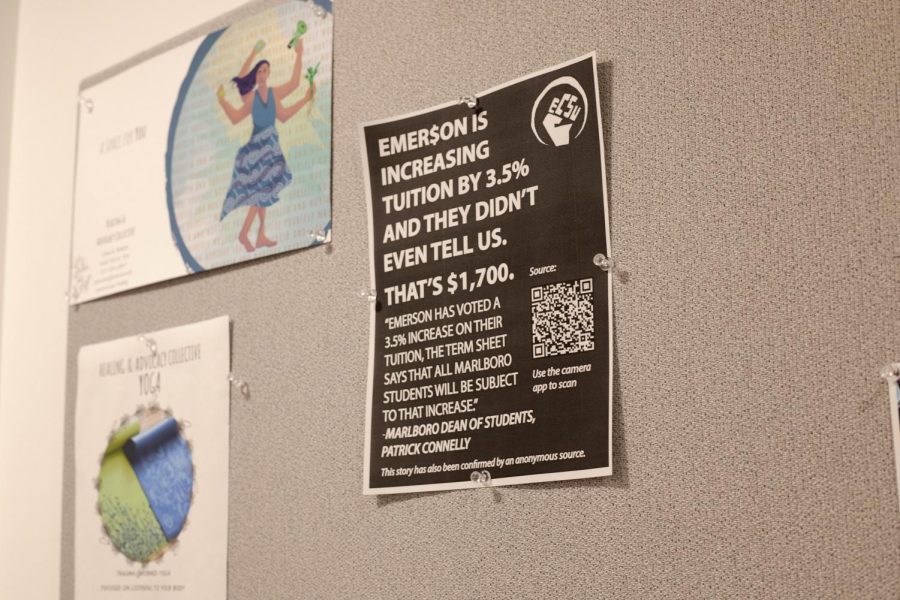
Something tells me the Burn Hard regime will ignore these concerns, as they have pretty much all of our concerns. “Hey, but here is a nice room for you to play games in! Oh, you need more food pantry support? That’s too bad, but here’s a ping pong paddle!”