

Staff layoffs, budget cuts, and investments in campus spaces are some of the recent results of a dip in enrollment that plagues Emerson College. This admissions season, Emerson has also surpassed a 50% acceptance rate, according to the U.S. News and World Report, leaving students questioning whether it still holds the same prestige as before.
Emerson applications dipped below 11,000 in 2024, down 1,000 from prior years. The school’s estimated acceptance rate has seen a 10% increase from the 2020-2021 academic year, when it hovered around 41%. It now stands at around 51%, according to the U.S. World and News Report and other online college comparison sites. The college hasn’t released official acceptance rates or enrollment numbers since 2022.
Emerson President Jay Bernhardt first announced the enrollment decline in an email to faculty in June 2024. He wrote that the decline was due in part to the negative press following the arrest of 118 students participating in the “Popular University Encampment” that year. The trend of low enrollment continued this fall.
In a written statement to The Beacon, an Emerson spokesperson cited external challenges for the acceptance rate increase, and maintained that Emerson remains “a moderately to very selective college by standard higher education nomenclature.”
“We are encouraged by the application numbers we are seeing, including a record number for some programs,” the statement read. “We are confident that our outreach efforts and work to strengthen our brand, informed by our Strategic Plan, will continue to advance our position as a leading college for communication, media, and the arts.”
Lily Rosputni, a freshman visual media arts major, speculated that raising the acceptance rate is reflective of Emerson’s moves toward higher enrollment and increasing revenue.
“I prided myself on the fact that I could get into this school that does these specific things with the specific media that I want to make,” she said. “Letting more people in just for the sake of getting more money, it is a little bit upsetting to me.”
The financial analytics firm S&P Global reported that Emerson performed with a negative 2.5 operating margin in 2025, meaning that for every dollar Emerson made, it lost 2.5 cents. At the end of 2025, Emerson reported a total outstanding debt of $466.9 million.
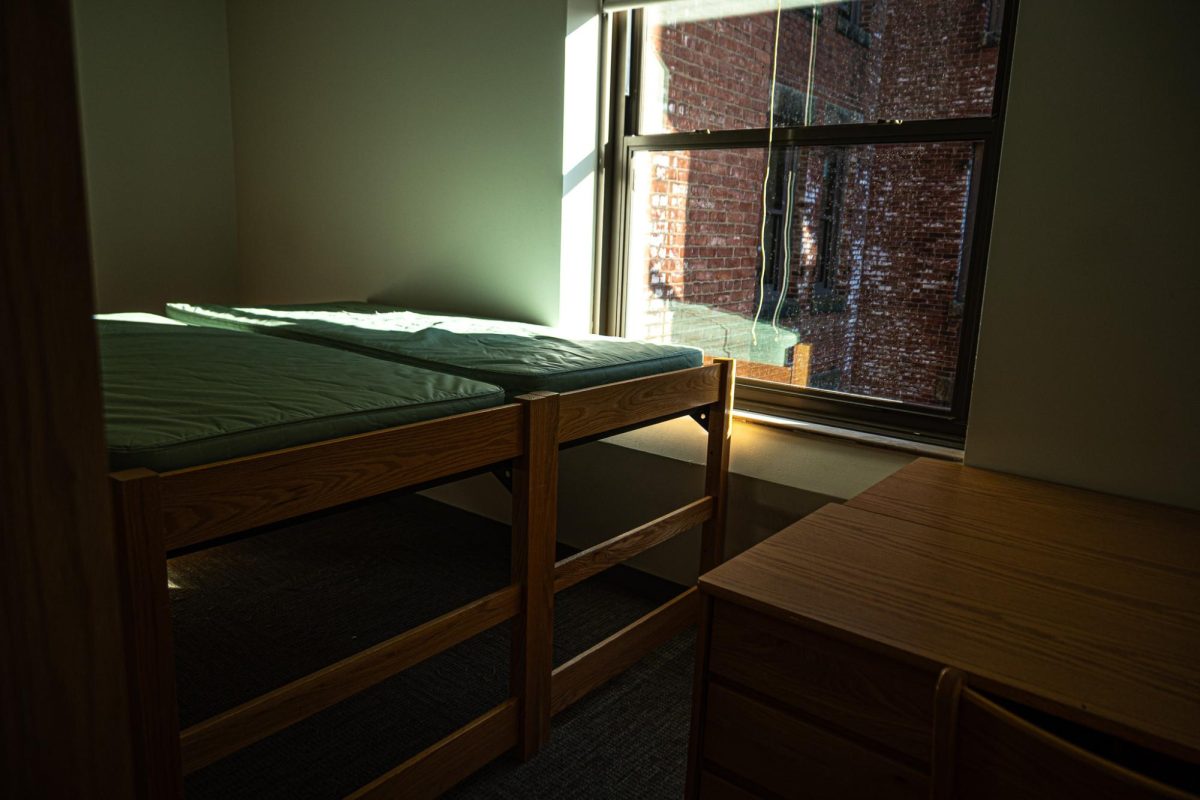
Emerson’s financial difficulties have presented themselves through the layoffs of 40 staff members in the past two years, cuts in programs for prospective students, and renting out floors of Emerson residential buildings.
Rosputni said she believes Emerson should focus on the students it currently has, not trying to bring in more.
“There’s a reason … students are not wanting to come. Because they literally don’t have as much freedom of expression as this school is supposed to promise them,” Rosputni said.
Rebecca Kasuba, a sophomore VMA major, echoed these sentiments, noting Emerson’s recent spending habits.
“I feel like they’re not going about this the right way to get new people in here. They keep spending the money and adding lounges when we don’t really need them,” she said. “We need the money to go into our programs.”
Emerson has attempted to add more third spaces throughout the semester, opening Griff’s Game Room in January and announcing the Cutler-Winn Commons this month. Both were funded with grants or donations specifically for campus improvements and could not be used for tuition relief, according to Emerson’s student government association..
Emerson’s relatively small endowment forces it to rely heavily on tuition and room and board to fund its operations. Tax filing for fiscal year 2023 — the latest available — shows that tuition revenue is approximately 81% of the school’s total revenue. Adding room and board revenue bumps the total percentage to nearly 99% of Emerson’s total revenue.
Madeleine Kendris, a senior VMA major, said she wasn’t surprised by the heightened acceptance rate, attributing it to the end of the pro-Palestinian protests in 2024.
“I think the protests, and [the police] arresting all the students, are probably the biggest reason,” she said.
Enrollment in higher education is declining across the country, as recent classes of high school seniors saw a lower number of students due to demographic shifts. Small, private liberal arts institutions are being hit harder, as applicants choose Ivy Leagues or larger universities. National trends show a shift in favor of state schools with a sports culture and research-based academics, a strong contrast to the liberal arts emphasis at Emerson.
In April alone, two liberal arts colleges in Massachusetts shuttered due to financial struggles.
“[Emerson is] not one of the major big colleges that you typically think of or see. We don’t have D-I sports. We don’t have the campus ‘rah rah’ kind of energy when it comes to that,” Alex Bisiewicz Sullivan, a freshman theatre and performance major said. “So, for their acceptance rate to go up, it seems typical of what’s happening around them.”
Natalie Suplick contributed to this report.