


Picture this: You get invited to a dinner party and you don’t quite know who invited you, but you show up anyway. Upon arrival, you discover that the four other guests and you all seem to be connected to a man named Edmund Ford, who has just died. What at first seemed like a refined cocktail hour quickly transforms into a murder investigation, for which you are all being blamed for.
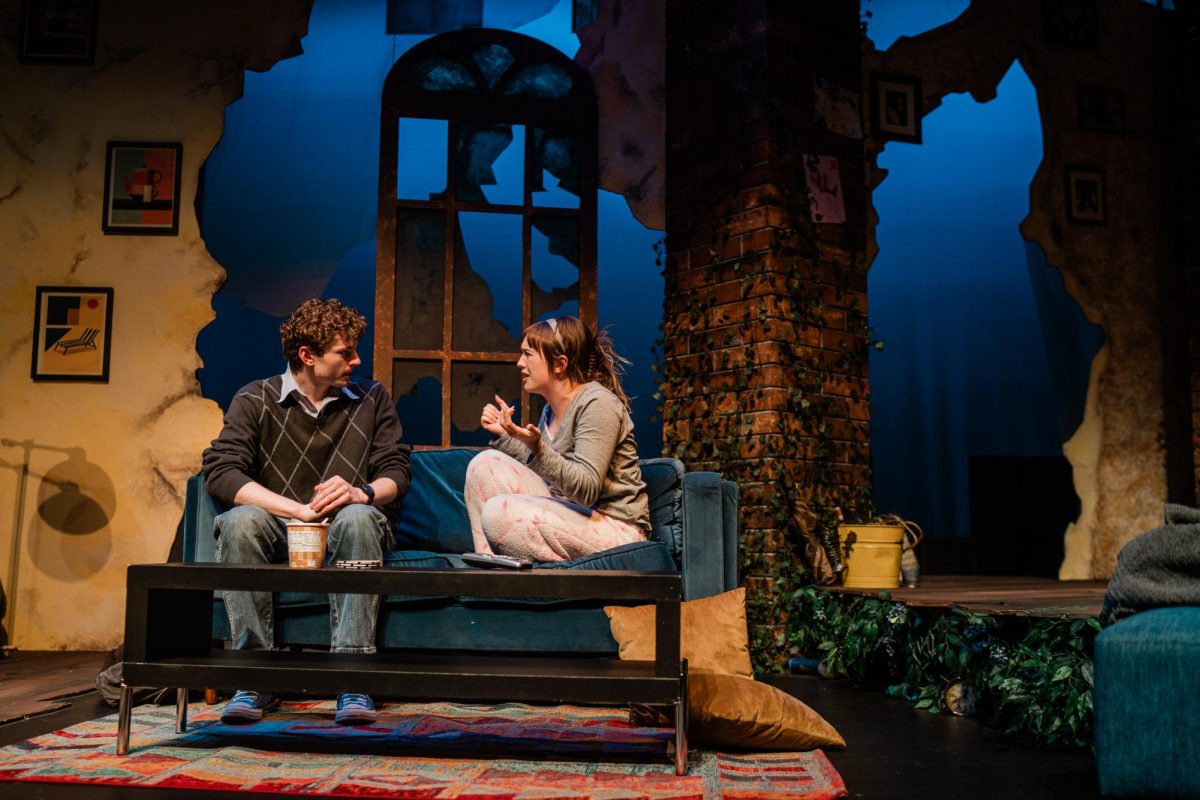
“When Death Crashes a Dinner Party,” written by sophomore interdisciplinary creative and dramatic writing major Katarina Claire Boskovic, had its opening night on March 25 in the Greene Theater. Boskovic began drafting the play when she was 17, and it was picked up by EmStage after it won the Rod Parker Playwriting Award.
The play, told in a singular act with a runtime around the one hour mark, adds a philosophical twist to the typical murder mystery theme. While the play is comedic, characters are challenged to face their inner selves as their secrets are unraveled and hidden grudges are brought to light.
“I didn’t want it to be your classic whodunit story, like ‘Knives Out’-esque, I wanted a bit of extra something there. I wanted more socio-political commentary to it,” Boskovic said in an interview with The Beacon. “You have all these characters who all play this role that they want the others to perceive them as, and they are all trying to uphold their performances while simultaneously judging other people’s performances.”
As a child, Boskovic read a lot of Agatha Christie, a British novelist known for her detective novels and plays and considered by some as the Queen of Crime. She was also inspired by Jean Paul’s play, “No Exit.” For her play, Boskovic said she drew upon the “existential grappling of one’s morals, rights, wrongs, and fails.”
Oscar Schuman, a junior acting major who plays the character Balthazar in the play, commented on Boskovic’s work.
“The play is brilliantly written. I really enjoyed a lot of the references throughout [the play] of other important works that connected the same themes of death and existentialism,” Schuman told The Beacon. “Her writing sets up the actors perfectly to play, be free, and have fun.”
Schuman’s character’s lines come from Boskovic’s personal journals, where she writes poetry and prose. As he is such an emotionally intuitive character, Boskovic felt that he required the most emotionally visceral and truthful lines — and what a better place to find them than in a personal journal.
“[Balthazar] is very interested in the human experience and the meaning of life and … how we come to open up our imagination and accept truths that we didn’t think were falsifiable,” said Schuman.
Balthazar’s role in the show pushes the other characters to figure out the truth about themselves through a poetic delivery of lines, full of alliterations and contradictions.
Another character that holds a special place for Boskovic is Juliette, played by Anna Grace Uehlein, a junior acting major.
“Her story definitely speaks to the experience of being a woman in a patriarchal society … especially a woman who is frequently objectified … and she sort of turns that experience on its head,” Uehlein said to The Beacon. “She is using her beauty, her looks, and the impact that those things have on the men around her to get herself ahead for her own benefit rather than letting it push her down.”
Regardless of the character’s background, the play is a comedy at heart. Uehlein said it gave her the chance to play a role that is very different from the type that she usually gets cast as.
“It’s been a really amazing opportunity for me to get out of my comfort zone and do something new, to play with more physicality, heightened acting and text, being big onstage, and for me specifically being super feminine,” said Uehlein.
The cast had the opportunity to work with director Joe Antoun, senior affiliated faculty in the performing arts department. Boskovic said that having Antoun there made up for any knowledge she lacked in the theater scene, since her major focuses on combining literature and philosophy in a sociopolitical context.
“Working with Joe was a very eye-opening experience … Observing him, going to rehearsals and seeing how he conducts these as a director, and as well as his eye for what makes a great show … has made me a stronger playwright,” said Boskovic.
The play promises to shower the audience with themes that touch on accountability, family, existentialism, and the idea of what death and life means, mixed with all the loved elements of a comedy.
“I can guarantee that you are going to sit in your seat, have a really funny time for an hour, and then leave and have a good rest of your night,” said Uehlein.
“It’s a really funny show with serious themes that are approached with levity … [and] it’s going to be different every night because we experiment so much,” said Schuman.
Apart from the fact that, in Boskovic’s opinion, everyone should go see a theatrical performance, she said that in witnessing theater, you are witnessing something live and ritualistic. For her own play, she believes that the show has a lot of existential value, as it portrays the moral grapplings that the characters face.
“I really hope people leave the theater thinking more about their own reality and their own performances that they’ve concocted,” she said. “They might think about the faces that they show the world and what is behind that mask, who is the genuine person that they are concealing.”