

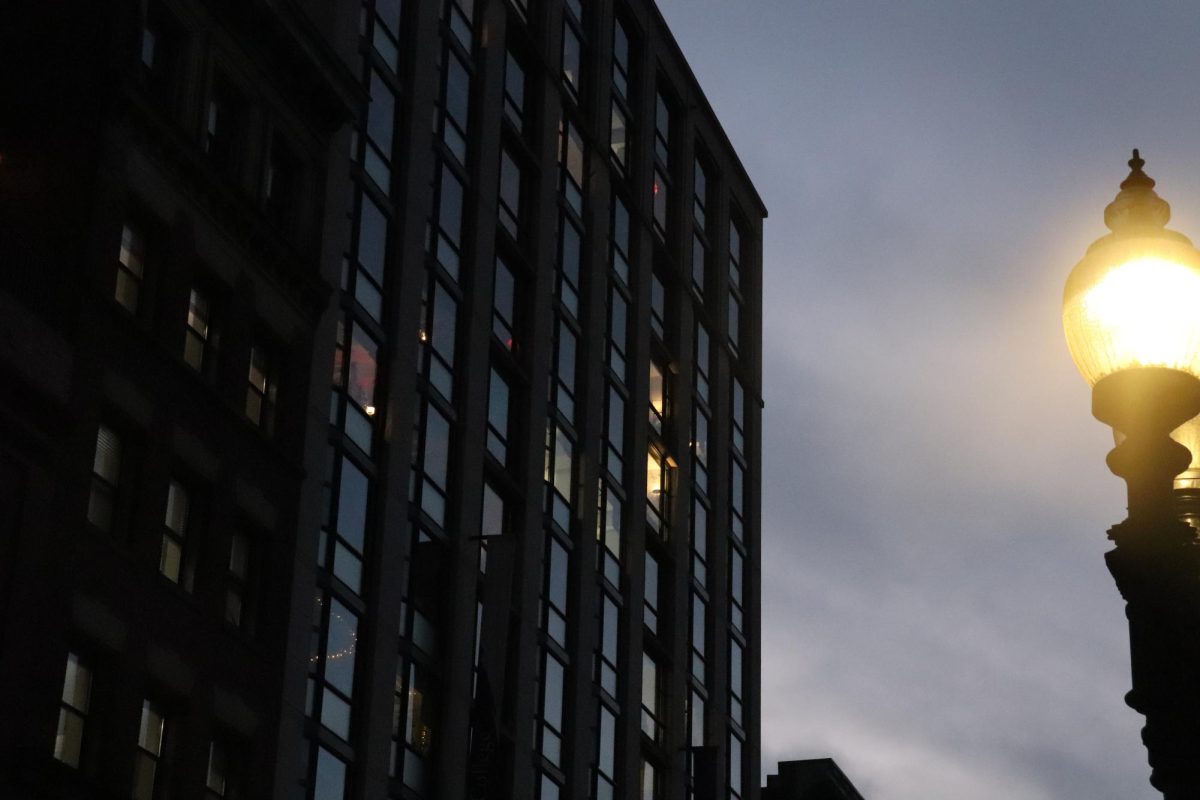
At 2 a.m. on Nov. 2, clocks across Emerson College and the country rolled back to 1 a.m. While some enjoyed the extra hour of sleep in the morning, Monika Krueger, a senior writing, literature, and publishing major, felt an immediate disruption to her routine when she awoke on Sunday.
“I don’t use my phone as an alarm clock,” said Krueger. “I was really messed up for the first day.”
As darker evenings and brighter mornings have settled in for her and millions across America this week, so has another routine: the recurring debate over daylight saving time, one of the most hotly contested practices in the United States.
It was first conceptualized in 1895 by New Zealand entomologist George Vernon Hudson, who suggested moving the clocks two hours ahead in October and two hours back in March in order to have more daylight to collect bugs. His idea was disregarded at the time, but on April 30, 1916, Germany became the first country to adopt daylight saving in order to save energy during wartime, with nearly every European country following suit.
The United States took up the practice in 1918 for the same reason, but reverted to standard time the following year after the war ended. It wasn’t reinstated until 1942 to save energy during WWII, after which its adoption was a state by state concern until 1966 when Congress passed the Uniform Time Act, which standardized it across the nation. Permanent daylight saving was enacted in 1974 to combat the 1973–1974 energy crisis; however the act was repealed when citizens complained that mornings were too dark. Most states since then have been turning clocks forward an hour in March and then back an hour in November.
In the United States, daylight saving time begins on the second Sunday in March and ends on the first Sunday of November.
Only about one-third of the world’s countries practice daylight saving time, mainly North American and European countries. In the U.S., Arizona and Hawaii do not enact it, citing the warm climate of the states. Because of this, students who are from those countries and states without daylight saving have had to adjust to the early sunrises and sunsets seen in places with it, like Massachusetts.
Grant DeMicco, a freshman creative writing major from Arizona, recounted a recent time when he noticed the nightly effects of daylight saving.
“I looked out my window, it was 4 o’clock, it’s already pitch black, I went ‘Jesus,’” he said, believing the sudden darkness to be the most shocking thing about daylight saving. Along with the distaste for longer nights, there are many controversies surrounding daylight saving—the main one questioning whether the practice saves any energy in the first place.
Daylight saving was originally intended to save electricity throughout households; however, since more technology has become widely used in homes in the past century, lighting only comprises 5% of residential electricity usage. In a time when electricity was only used for lighting, daylight saving was useful. But now, most appliances that use electricity do not depend on daylight, so a minimal amount of energy is being conserved. A study done by the California Energy Commission revealed a 3.5% decrease of energy consumption, but most reports show little to no savings.
Another issue that arises with daylight saving is the effects the clock change has on physical health. The human body follows a circadian rhythm, meaning it has a natural 24-hour clock that maintains a healthy sleep schedule. When the clocks are changed twice a year, the body’s internal clock becomes out of sync with the sun because it is less exposed to sunlight during the day.
Around 35% of students of all ages reported not getting enough sleep this year. Combined with daylight saving, this lack of energy can have detrimental effects on students’ academics and daily lives, researchers have found.
Due to the lack of sunlight that sets in after the time change, people’s emotions and mental health can also be impacted. Studies show that daylight saving can lead to spikes in depression and other mental issues, similar to how “seasonal depression” affects people.
Abigail Wright, a freshman visual and media arts major from Ecuador, a country that doesn’t practice daylight saving, said she is feeling the effects.
“It’s hard to adjust in the sense that if I wake up late [on the weekends], it’s already dark,” she said, also commenting that the darkness has impacted her mood and daily life. “[Daylight saving] has definitely had a toll on my emotions and being happy because I love the sunlight.”
In 2022, a version of the Sunshine Protection Act, a proposal seeking to instate daylight saving as the new, permanent standard time nationally and avoid “fall back” time changes, passed the Senate but not the House of Representatives in Congress. The bill did not become law but has since been reintroduced in succeeding legislative sessions. Currently, it has not advanced.
Around 56% of Americans are in favor of making daylight saving the new time standard, compared to 42% of Americans who prefer standard time, according to a recent poll done by AP. It also found that only 12% of Americans prefer the current system, where time shifts between the two orientations.
Sydney Guida, a freshman journalism major from Pennsylvania, echoed this dislike for the current changes.
“It’s granting us sleep and then it’s taking sleep away, and it’s just very disruptive to everyday life,” she said. “It’s virtually pointless. It serves no purpose other than to confuse the American public, and I think it is an incredibly outdated system that needs to be exterminated.”