


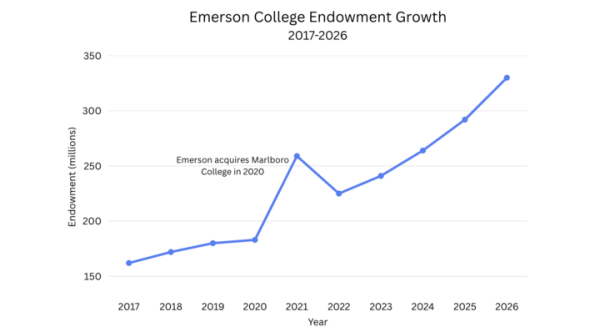
Emerson College’s endowment is currently $330 million this year, according to a college spokesperson, which indicates a growth of about 25% from 2024. So what does that mean?
The endowment is a collection of the college’s invested assets that supports student scholarships and aid programs, according to the college. Endowments are permanent funds that act as long-term sources of stability and safety nets in shifting economies. Its growth ensures the college can increase funding for educational opportunities at Emerson.
“Our endowment plays an important role, typically supporting student-facing expenses, including scholarships, financial aid, and other programmatic needs,” the college spokesperson said in a statement to The Beacon. “We are grateful to the support we’ve received from donors, which – along with savvy investment and financial management – has enabled us to grow our endowment to record levels.”
Emerson Student Government Association Vice President Angus Abercrombie said that in his experience, despite Emerson students’ interest in the college’s finances, they do not always understand the intricacies of them.
“A lot of students do care deeply about this institution,” said Abercrombie. “But if you show them a spreadsheet, they get a little scared, and that’s why we’re at Emerson, right? We’re not here to become accountants.”
At a time of increasing financial pressures and tuition increases for colleges across the country, endowed scholarships can be the difference in whether a student receives the support needed to attend a school like Emerson. Here’s what to know about the college’s $330 million endowment, where the money goes, and how it compares to other schools.
What is the endowment?
A college endowment is a large pool of money that a college invests for the long term, according to the American Council on Education. The money usually comes from donations and investments that schools possess.
Colleges save most of the funds and do not spend them. Instead, they use the money earned from investing it each year to pay for things like scholarships, programs, and other school needs.
Endowment funds, which at Emerson are managed by the Board of Trustees, are invested in different parts of the market, such as stocks, bonds, funds, and other assets. This ensures that the funding can grow as markets and interest rates grow.
The endowment spends 4% of the previous five years’ market value, or the trailing 5-year market average, in order to maintain long-term growth.
When funds are donated or added to the endowment, they can either be restricted or unrestricted. When restricted, donors can dedicate the funds for specific purposes, such as financial aid, while unrestricted funds go to broader institutional needs.
How does Emerson compare to other schools?
Emerson is not the only institution that grew its endowment. However, Emerson’s market value increase is far more than the growth seen by many other New England colleges.
In the fiscal year of 2025, large institutions such as Harvard University, Yale University, and the Massachusetts Institute of Technology saw their endowments grow by 6-11%, adding roughly $11 billion combined, according to Forbes.
Boston College and Boston University recorded 12% and 13% gains, respectively, with both endowments reaching over $4 billion for the first time, The Boston Globe reported. The University of Massachusetts system grew its endowment by about 16%, reaching around $1.8 billion, according to Institutional Advisor.
The current estimated size of Emerson’s endowment is $330 million, a number that has fluctuated within the last couple of fiscal years, with $241 million in 2023 and $259 million in 2021, tax documents show. One key moment in the history of Emerson’s endowment was the acquisition of Marlboro College in 2020. Emerson absorbed $22 million of Marlboro College’s endowment in the merger. This increased the college’s overall endowment assets and has funded the Marlboro Institute for Liberal Arts and Interdisciplinary Studies.
The endowment’s impact
According to the college, Emerson’s endowment only contributes to about 3.4% of total revenue for the college. The rest of the money comes from tuition; as a result, Emerson relies more heavily on tuition than other universities.
This means fluctuations in enrollment significantly affect the college. Emerson has experienced a decline in enrollment over the past couple of years. The college has previously said it is the result of national trends and negative publicity related to campus protests and arrests in 2024. The college laid off 30 faculty and staff last August, citing the enrollment decline.
“When we talk about how enrollment is impacting our budget, it’s gonna impact our budget more than other schools because we have an endowment on the smaller side,” said Abercrombie.
Concerns surrounding the endowment
Last year, SGA put forward a proposal to invest about $675,000 from the Student Impact Fund — a fund that came from unused student activity fees during COVID years — into the college’s endowment.
The proposal’s goal was to put the money from the Student Impact Fund to a dedicated purpose of investing in financial aid. By investing, the money from the fund could be replenished, rather than being a set amount.
“If that can help students for generations way beyond us, that is invaluable for an organization like the student government,” said Nandan Nair, the former president of SGA who oversaw the proposal.
During their deliberations, many students were concerned that the funds could indirectly support defense contractors or fossil fuel companies, as endowment investments are not accessible to the public. The proposal failed 8-7 in a secret ballot after months of debate last year.
“People were concerned the student fee money was gonna end up helping to supplement the work of defense contractors, and I think that’s a thing that’s worth concern,” Abercrombie said.
According to the college, Emerson does not control the endowment’s investments and does not hold any of its individual stocks. The endowment is instead invested by an outside firm, which a college board committee oversees.
Financial education and student engagement at Emerson
Throughout the proposal process, SGA made an effort to educate the student body on the endowment. Nair said that it was important for them to do what they could to educate students.
“What happens with the endowment impacts everyday students … It can impact whether a student is able to attend Emerson or not,” he said. “There is an obligation to explain to students how the endowment impacts the college’s day-to-day activities, because that, in turn, impacts our day-to-day lives and our college experience.”
Nair said Emerson should provide more resources for financial literacy, particularly the college’s finances.
“I do believe that it should be coming from the institution itself … It would be so much more valuable to come from someone within the institution who has the knowledge of all of this,” Nair said.
Abercrombie said that while he believes financial literacy is a problem at Emerson, he is unsure how much engagement there would be in the kind of education that the school would theoretically offer, such as workshops.
“I’m hesitant to encourage the college to take those steps, because I just don’t know if it would work,” said Abercrombie.
Seeing as tuition contributes to a large portion of the college’s finances, Nair said students deserve to be more involved and informed in the process.
“For how much we fund it, we deserve to have student representation of these conversations to at least understand the decisions and [have them] be conveyed to us,” Nair said. “I think the biggest issue in the last three years has been [that] there’s no communication.”