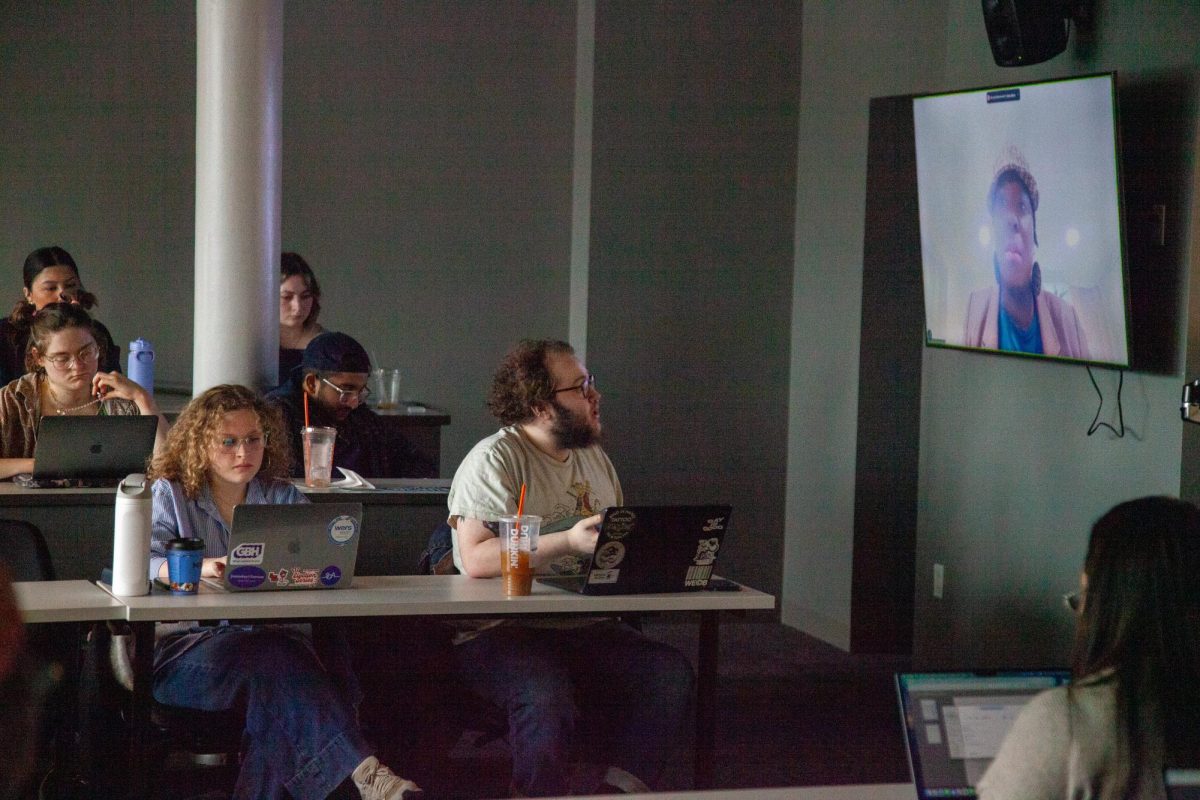



The first event of the inaugural Teach-In on Timely Topics was a workshop, craft talk, and lecture blend by Livia Meneghin, MFA ’21, an affiliated faculty member in the writing, literature and publishing department. For one hour in Piano Row’s Beard Room, a dozen teachers and students gathered to take part in Meneghin’s programming, exploring how poetry can connect individuals.
Meneghin shared multiple prompts with the group related to the idea of poetic ancestors — poets who came before the present day, whose work has influenced one’s own. She highlighted the importance of reflecting on what qualities, adjectives, or verbs are associated with these writers.
She also presented some of her favorite poems, including “We Real Cool” by Gwendolyn Brooks, the first Black woman appointed poet laureate of the United States. Meneghin then prompted the group to write a poem in response to Brooks’ by taking any part of the poem and “making it [ours].”
Meneghin presented an example of a response to Brooks’ poem, “The Golden Shovel” by Terrance Hayes. Hayes embedded Brooks’ poem into his own response, but found creative ways to expand upon the groundwork Brooks laid. “An American Sunrise” by Joy Harjo followed in the same footsteps, writing her own “golden shovel,” or an homage to a previously published poem.
Homage poetry, Meneghin said, is an example of keeping ancestors in mind, sometimes by including an epigraph, dedication, or mention of someone within a line. One form of homage poetry is “cento,” or a collage of various works, scavenged and rearranged to create a new piece of work. The example she gave was “ Cento Between the Ending and the End” by Cameron Awkward-Rich.
Meneghin presented the “Seven Generations Principle,” a concept originating from the Haudenosaunee Confederacy, also referred to as the Iroquois people. The principle teaches that “the decisions we make today should protect and sustain seven generations in the future, while honoring and learning from the seven previous generations that have passed.”
This, Meneghin said, is representative of the virtues of poetic ancestry, and how people can “honor and know who’s come before.” She said this knowledge is “greatly under attack,” threatened by technology, artificial intelligence, and waning attention spans.
“We exist in this continuum that we are all dependent [on] each other,” she said in her presentation.
The last prompt asked the group to draft a poem that includes one thing that connects them to their poetic ancestor, and to visualize a world that feels safe, sustainable, joyful, and free.
“We started by remembering who’s with us, then we honestly and authentically responded to art in our own way, then we’re finishing by thinking about what we want for our own future,” Meneghin said. “Those are the three things that I want you to carry with you.”