




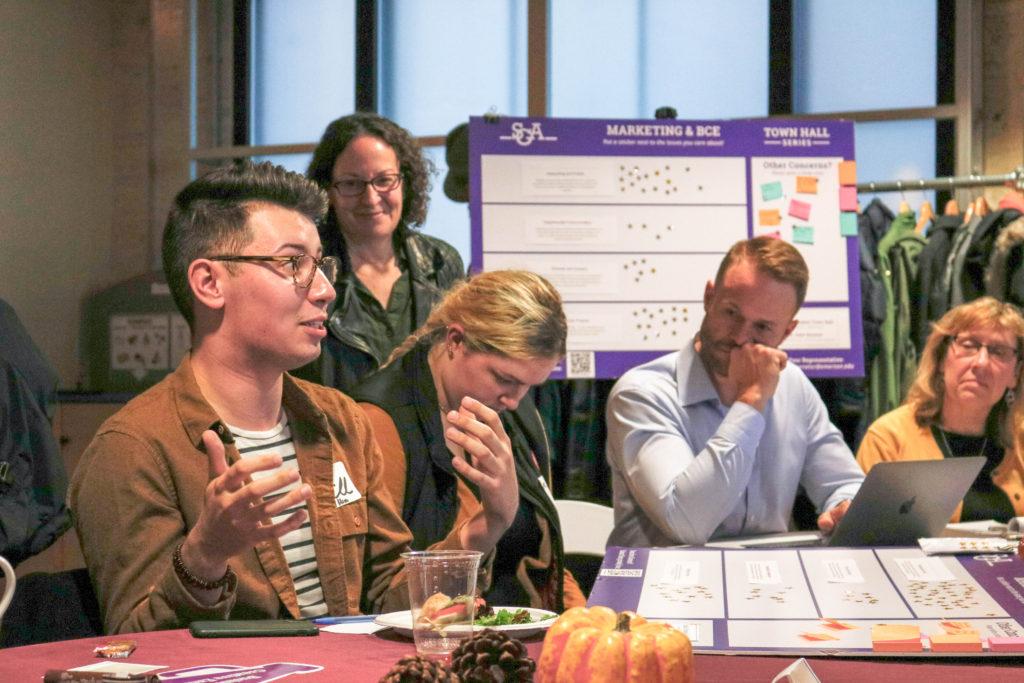
The venue booked for the keynote event of the inaugural Teach-In on Timely Topics can seat up to 570 people. But on Wednesday, March 4, only around 40 people showed up.
The program replaced the Teach-In on Race, which often drew over one hundred attendees per event. According to a spokesperson from Emerson College, the new Teach-In would continue the legacy of examining social issues, but with a broader scope.
In interviews with The Beacon, students and staff criticized the decision to remove the word “race” from the program’s content and marketing, and the lack of explanation as to why the program change was made.
Throughout the Teach-In on Race’s nine-year run, its events highlighted storytellers of color, life inside prison, and activism, among other topics. As the Teach-In on Race grew, so too did the length of programming, spanning two days.
The event was originally conceptualized by Jabari Asim, associate professor of writing, literature and publishing. The first Teach-In on Race was held in 2016 and lasted just one day. Its keynote address was hosted by Eddie Glaude Jr., chair of the Center for African American Studies at Princeton University. Former Emerson president Lee Pelton delivered remarks, as did several faculty, staff, and students, all with regard to race at Emerson.
The foregone Teach-In gave students of color an opportunity to see themselves represented at a college where they make up only a single-digit percentage of the population, and implored white students to reckon with what it means to be the majority population at a predominantly white institution.
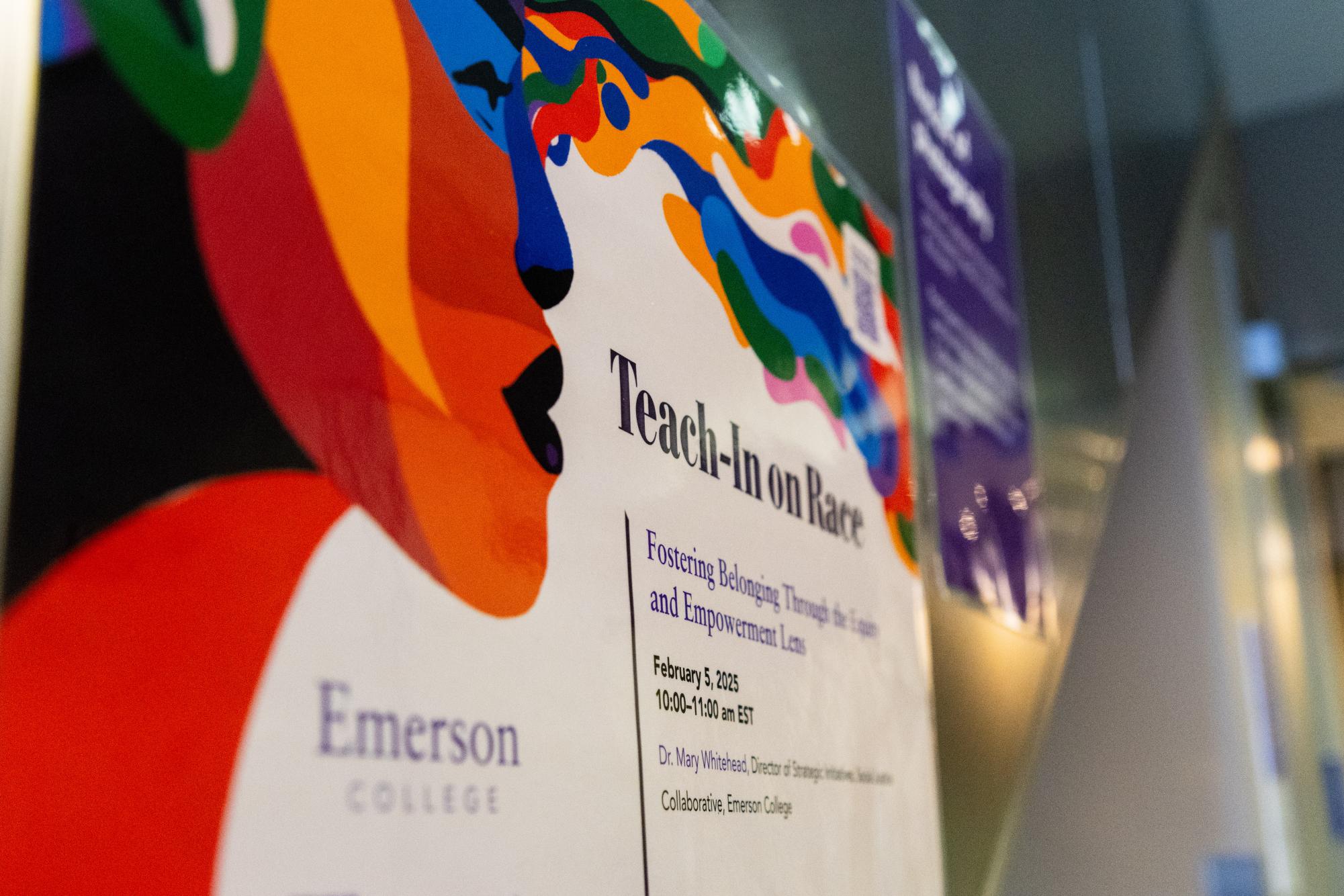
This year, the new teach-in led with marketing that featured splashes of watercolor paint instead of the previous imagery, a portrait of a multicolored miraged profile of a Black woman. No event mentioned the words “race” or “diversity” in the title.
“I thought the topics they talked about were good, but race is a timely topic. Especially at a predominantly white institution, it’s a timely topic,” said junior sports communication major Ally Evans, who attended this year’s event. “This is never not going to be a timely topic. I think it’s a little distasteful to scratch [‘race’] and replace it with ‘timely topics.’”
Student worry and disappointment about the program changes were reflected by lackluster attendance and further exacerbated by claims of a “disheartening” acknowledgment for Black History Month, as well as observations of a “disconnected” Black community at Emerson. During the Q&A portion of the keynote panel, one staff member remarked that “erasure” was taking place.
The program change was decided over a period of time from summer to fall 2025, according to the college spokesperson. They added that conversations surrounding the change involved a thoughtful process with involvement from former architects of the Teach-In on Race.
The college did not provide The Beacon with an on-the-record statement regarding the Teach-In on Timely Topics.
In reference to student turnout, the college said it will be looking into adjusting the timing of next year’s event to earlier in the semester — not as close to spring break — ideally making it easier for students to attend.
Shaya Gregory Poku, the vice president of the Division of Community, Culture & Belonging, said senior leadership, as a body, was responsible for decision-making processes that caused changes to the Teach-In. This included the Academic Cabinet, Provost’s Council, Library and Learning, the PAG for Community & Culture, the Division of CCB, and the President and Provost.
The Teach-In has historically been supported by Academic Affairs, which includes the Provost’s Council and the Academic Cabinet. It’s those two bodies, Poku said, that design the structure of the Teach-In. These events are intended to platform critical thinking, encourage dialogue, engage creatively with the Emerson community, and amplify the institution’s values, she said.
The program’s organizers asked attendees to share their memories and reflections on the shuttered Teach-In on Race for an archival project, a partnership with the Iwasaki Library, Academic Affairs, and the Division of CCB.
Poku said feedback from attendees has been robust, meaningful, and substantive. She said next year’s Teach-In will showcase a different theme.
“Making sure that we’re talking about and engaging in what are some of the most urgent questions at the intersection of societal issues, communications, arts and media, was something that the Teach-In on Race has done historically, and that is a continued through-line,” Poku said. “[The Teach-In] is about creating community space to grapple with these questions in an academic way.”
An Emerson staff member who was a panelist for the Teach-In on Race said they were “rubbed the wrong way” by the program change, specifically the removal of the word ‘race.’ The former panelist spoke with The Beacon on the condition of anonymity due to fear of retaliation from the college.
The panelist said they felt the change was made to comply with pressures on diversity, equity, and inclusion from the federal administration. In his second term, President Donald Trump has consistently attacked DEI and targeted schools that remain committed to community members of marginalized groups, as well as punishing those who oppose his efforts. The panelist added that efforts to try to prevent any such attacks from Trump were futile.
“I don’t know if it’s because they are in line with Trump’s rhetoric … or if they’re like, ‘Well, let’s just change the name because we’re losing money already as an institution, enrollment is down, and we don’t want to do anything to ruffle feathers,’” the former panelist said.
The panelist said that as an institution, making changes that go against core values makes schools like Emerson “complicit.”
“It’s a cowardly move,” they added. “Don’t you want to protect … the independence, the autonomy, the agency of the [college]?”
At Emerson, there has been a systematic removal of language regarding diversity, equity, and inclusion since last summer. The college’s reasoning was to ensure areas, like the former division of social justice and equity, work more closely with each other, as well as with students, faculty, and staff, to “create a strong, more interconnected Emerson community.”
Other higher education institutions across the country have also modified language regarding DEI. At Northeastern University, the DEI office was rebranded to the “Office of Belonging.” Boston University reorganized its Office of Community & Inclusion, which houses the Office of Diversity & Inclusion under the Office of the President. Both universities have been criticized by their respective students and faculty for backing down to the Trump administration.
Davey Shlasko, founder and director of Think Again Training & Consulting, which focuses on equity, inclusion, and organizational development in businesses and schools, said DEI language changes usually don’t fundamentally alter DEI efforts in an institution.
Shlasko said the language can change, as long as the principles, goals, and beliefs of the work being done remain the same. However, it’s going to be hard for that to be sustainable, Shlasko said, if the official language isn’t documented over time.
“At an institutional level, I think colleges hope this will keep them out of the spotlight,” they said. “It’s going to be very hard to undo that.”
Many DEI programs and other events geared towards inclusivity took years to build; to potentially rebuild again will take many more, Shlasko said.
Evans, the student who attended the Teach-In, added she feels like Emerson is trying to appease “higher-ups” by “watering down” social justice and equity initiatives. She noted that she’d love to see more discussion from leaders of higher education institutions about their role in the erasure of the words “race” and “diversity.”
“We can sit up here and talk about all these different topics, but we’re still perpetrating some of these oppressions that we speak of,” Evans said.
In an interview with The Beacon, Poku addressed some of the concerns around the name change and the decision to move the programming from February — Black History Month — to March. She said the timing was changed due to the need for a longer planning window before spring break, and added that the topic of race would not be lost in upcoming Teach-Ins.
“You can’t talk about pressing issues in society and have race not be among them … The critical and intersectional analysis of how these topics intersect with identity is not something that’s going to be lost in these conversations,” Poku said.
Poku said that the college’s status as a nonprofit — which receives federal funding, primarily for financial aid — requires it to uphold federal requirements like Titles IV, VII, and IX. These expectations, she said, are not new.
“There’s always been legal obligations. We’ve always been held to standards,” Poku said. “Ensuring our compliance with federal guidelines is always a priority for the college, and making sure that we meet our legal obligations is critical.”
Still, Poku said the changes being made at the college are primarily done with the intention of aligning with the college’s 2030 strategic plan. The Teach-In falls under “Priority C” of the plan, which is to “Build a Vibrant and Inclusive Campus Experience.”
“A lot of the changes that we’re making now are not as much about federal pressures as they are our strategic direction of the institution, which unfortunately coincides with lots of rapid and evolving changes in our legal and political landscape nationally and internationally,” Poku said.
She added that an assessment tool from the college was used to gauge people’s reflections on the Teach-In to measure its effectiveness and what next year’s program could look like.
The assessment tool used a 5-point scale with corresponding prompts about what attendees gained from the Teach-In, according to the college. The results from these questions averaged between 3.25 and 5. The questions asked recipients to rate how much the Teach-In contributed to their understanding of the theme, the accessibility of the format, and the degree to which the content was inclusive of their identities.
The college spokesperson told The Beacon they have received a positive response from those who attended the Teach-In. Feedback suggested expanding virtual access and student and faculty engagement, they said, and some attendees shared their disappointment about the Teach-In’s program change.
The previous Teach-In panelist said a lack of adequate communication about why the changes are happening has created animosity and a strained relationship between the Emerson community and administration.
“If you’re doing something that’s against your own will to defend the students, maybe you should let them know,” they said. “Something needs to happen, because the morale here between faculty and students is really low.”
Transparency behind the reason for language changes is key for preserving the core of DEI values, according to Nathanael E. Wright, a partner at CMBG3 Law and the firm’s director of DEI.
“Language shifts are not always a retreat, but silence after those shifts always is,” he said. “Communities need clarity, and it doesn’t help anybody to be guessing about what institutions are doing.”









RIP for Teach-In on Race – and correct students should beware the inauthentic “teach-in” of the failed President Jay?
Or as Big Bill Broonzy, the depression era blues singer, would caution his conscious Chicago audience, “If you’re white, you’re alright. If you’re brown, stick around. But if you’re Black, oh no brother, get back, get back, get back!”
“Timely Topics” sounds to me like a segment of a tv show for kindergarteners— can even hear the little song introducing it and see the aprin the teacher is wesring