



Editors note: This article has been updated to add context and clarity.
Black History Month started on Feb. 1, yet Emerson College didn’t acknowledge the annual celebration until an email nine days later.
Shaya Gregory Poku, the vice president of Community, Culture & Belonging, said in a statement to The Beacon that the college-wide email was one of the College’s key platforms to “bring visibility to the rich diversity within the College and opportunities for engagement and learning about Black History Month beyond our Boston campus.”
The statement further said that the Cultural Engagement Center and Emerson valued its Black students and was working to create a campus community enriched by “its diversity of voices.”
While this may be their goal, a lot of students aren’t feeling the effort being put into Black History Month. “I thought the fact that all they did was an email was really disappointing,” said Cassidy Morrison, a freshman political communication major. “I feel like that just kind of makes the Black Emerson community feel like they’re an afterthought to the institution.”
What made it even more of an afterthought was an embarrassing typo in the email that was not corrected for over an hour. The typo was regarding Mary P. Burrill, who the email referred to as “a pioneering playwright and educator during the Harlem Renaissance.” Burrill was born in August 1881 in Washington, D.C., graduated from Emerson in 2004, and died in New York in 1946 —
— Wait, that doesn’t make sense. How could Burrill have died in the 20th century, but graduated from Emerson in the 21st?
And therein lies the problem. Over an hour after the original email was sent, a correction email was sent out by Emerson’s Division of Community, Culture, and Belonging, stating that Burrill had actually graduated in 1904, and that they apologized for any confusion caused by the typo.
Upon further research, I found that the email failed to mention that she had a partner, Lucy Diggs Slowe, a Black American educator who studied at Howard University and was the first Black woman who served as Dean of Women at any American university. This would make Burrill not only the first Black woman to graduate from Emerson, but also the first Black queer woman to graduate from the school. While Emerson has written about Slowe and Burrill’s relationship before, that was more than five years ago. Why not mention it now?
The college’s underappreciation when it comes to celebrating Black culture is felt by many of the Black students here at Emerson.
“I think that the college has taken a disturbingly formal approach to Black History Month,” said Kayla Lewis, a freshman journalism major. “There’s more that can be done … considering it’s a very small number of campus students [who] are Black.”
According to Emerson’s current factbook — which only covers the 2023-2024 academic school year — Black or African-American students on campus only made up about 6% of Emerson’s student body in 2023. Four years prior, in 2019, it was only 4% of the student body meaning, in four years, the number of enrolled Black students barely increased. With the school’s enrollment down by 6% for the 2024-2025 school year, there are likely even less Black students on campus this year.
Just because Black students at Emerson make up a single digit percentage of the student body does not mean that we don’t deserve to be seen, or that our cultures don’t deserve to be celebrated beyond an email.
The official Emerson Instagram page, from the first day of February onward, highlighted solely upcoming guest speakers, the Super Bowl, and polling numbers on Bad Bunny’s halftime show, completely glossing over the fact that this Black History Month marks its 100th anniversary.
Furthermore, in the email at the end of the alumni highlights, there was a short blurb on how Black History Month was originally Negro History Week, and was founded by Carter G. Woodson in 1926.
What the email failed to include was why he wanted to start it.
As a journalist, author, historian, and the founder of the Association for the Study of African American Life and History (ASALH) in 1915, Woodson wanted people to know more about Black past. It’s believed he chose February so Negro History Week would encompass the birthdays of the abolitionist Frederick Douglass and former President Abraham Lincoln, two men who had done a significant amount for the Black community and diaspora.
And although he appreciated the two men, Woodson believed it was important that people didn’t just celebrate them, but all of the accomplishments of the Black race. In 1976, the ASALH expanded the week into what we now call Black History Month, and former President Gerald Ford issued the first message that acknowledged the month-long holiday for the Black community.
Kai Nichols, a freshman visual and media arts major, has noticed posters around campus of famous Black figures, such as former President Barack Obama, that are partially covered by other posters. She said she would also like to see other Black trailblazers around campus who aren’t often talked about.
For her, this includes people such as Philip B. Downing, an African-American man from Rhode Island who is widely credited for inventing the first modern street box, which is now the mailbox, in 1891, or Gladys West, a Black mathematician whose work on modeling the precise shape of the Earth was critical to the accuracy of the GPS — even though Bradford Parkinson, a white man, is considered the primary inventor and “father” of the system.
For freshman theatre and performance major Nathan Kikonyogo, this lack of visibility from Emerson, which is a predominantly white institution (PWI), is nothing new for him.
“I went to a private boarding high school in the middle of nowhere in Connecticut, and I went to a PWI in Massachusetts,” he said. “So I’m not foreign to feeling underrepresented.”
Emerson’s neglect regarding the recognition of Black people in America reflects a larger national problem. After President Donald Trump’s post and later deletion of a racist video that depicted former president and first lady Barack and Michelle Obama as apes, and his attempt to whitewash history with the removal of panels from a slavery exhibit in Philadelphia, it seems as though Black history and culture is being insulted into inexistence.
In the same statement, Poku said that another way that CEC was supporting the observance of the 100th anniversary of Black History Month was through collaborating with EBONI — Emerson’s Black Organization with Natural Interest, which was started in 1968 — “organize programming throughout the month highlighting Black history and culture,” which seems to be something that the division has gotten right, even though there has been no promotion on the official CEC or CCB Instagram.
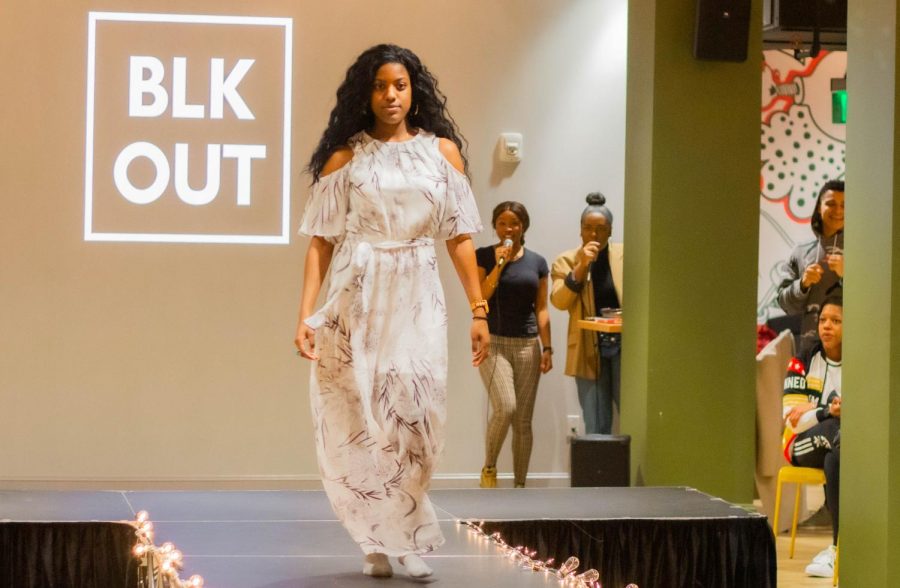
The planned events include line dancing, a self-care night, and more to help celebrate Black culture., These are the spaces EBONI president and junior business of creative enterprises major Layla Stewart has put it upon herself to create as a way for Black students to connect with each other.
“Coming into this position, I knew that I had to work 10 times harder just to prove that we’re here and we are present,” Stewart said.
Going forward, Stewart said she would like to see more changes at Emerson — changes not just pushed by EBONI and other student groups — such as bringing back BIPOC pre-orientation, which was a dedicated space in which incoming students of color would be able to find community upon their arrival.
For Stewart, as well as the generations of Black activists and leaders whose work led to this annual celebration, community is the bedrock of Black History Month.
“So I think when Black people come together … I think that’s the most beautiful thing,” she said. “That’s where creativity grows. That’s where everything just flourishes.”









Emerson has had a fraught relationship with Blackness throughout its history. Whether it is students, staff, faculty, administrators, trustees, or the outside community – all have felt a degree of distance and marginalization in their relations with the College.
So why is it a surprise that the current administration gave the story of Mary Burrill the short shrift in the trend of anti-Blackness? After all, the College has a reputation for neglecting the sad history of subordination of the authentic representation of Blackness in the classroom and on campus?
Even during the jazz age, former student Thelma Thornton recalled the racism that Black students faced in the dorm rooms, saying, “We had a lot of Southerners there, and at that time in Boston in the 1920s they didn’t want you to live in the dormitories.”
Students interested in a few cursory benchmarks of the Black experience on campus should check https://word.emerson.edu/victorystride/
And let’s not forget that the anti-Black attitudes of today are exacerbated by the role modeling at the top. Incidents like the President’s reluctance to publicly apologize to a Black art student shouted down by the former Chair of the Board of Trustees at a campus event sets a standard.
People may recall the incident as reported in the Beacon during the town hall for reconciliation after the mass arrest of students. Even now it would be hard to imagine a white student being told to “Back the fuck up” by a College trustee and the President sit by in silence?
The campus has regressed since the days of President M. Lee Pelton. But students may find encouragement in the exhortation of the late civil rights activist Jesse Jackson:
“I am somebody. I may be poor, but I am somebody. I may be young, but I am somebody. My face is different, my hair is different, but I am somebody. I must be respected, protected, never rejected. I am God’s child and I am somebody!”