


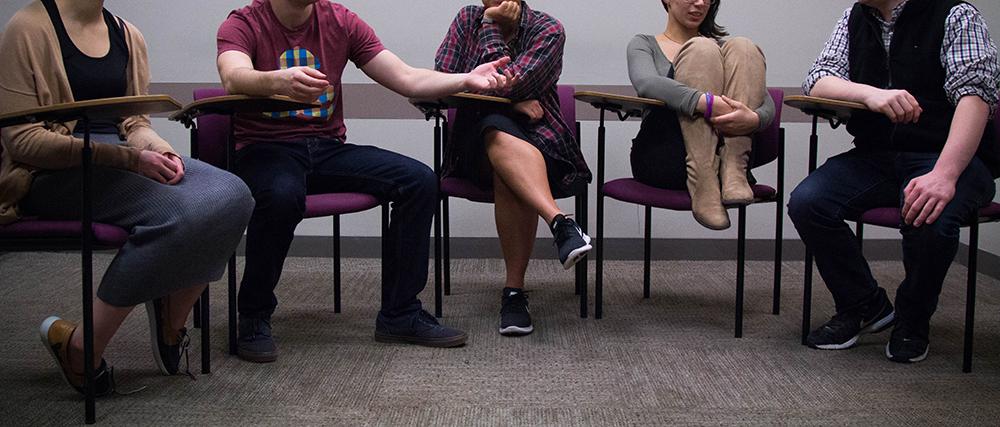
Emerson’s liberal arts requirements get a bad rap, and not for unknown reasons. Newly admitted freshmen are placed in random classes at often sub-optimal hours, and it can take two years of your education to run the liberal arts gauntlet.
But these required courses at Emerson fulfill a noble cause, covering a range of disciplines from philosophy to writing to history, and in my experience are usually taught by eager professors who take the opportunity to design niche curricula around their passions. Unfortunately, this enthusiasm often clashes with the overwhelming lack of interest of the students enrolled.
But before we go any further, we should address the question on every grandparent’s tongue: What even is liberal arts? No, the answer isn’t “The West Wing.”
Liberal arts derive from the Ancient Greek educational tradition, which classified astronomy, arithmetic, geometry, music, rhetoric, grammar, and logic as the core disciplines for a fulfilling life. While the monkeys have changed, the circus remains the same: Liberal arts educations emphasize holistic learning, reinforcing critical thinking skills that pay off far beyond the college years.
Unfortunately, this is usually contrasted with vocational education, the key tenet of which is getting a job out of college.
Though Emerson is a liberal arts school, many students come here for what is effectively a vocational education: They hope to be journalists, filmmakers, or actors right after graduation. But much of the value of studying here is gained through extracurriculars.
In fact, in my very first college course, our professor opened by telling everyone that many of his favorite upperclassmen were C students. Then, I thought he had weird taste in favorites; seven semesters later, I understand his point. Most efforts required for a career in journalism happen outside the classroom.
But effort is, of course, a zero-sum game. If a student has to divide their energy between on-campus orgs, internships, and jobs to actually pursue their chosen field, their engagement in classes will inevitably suffer. The optimal strategy for such a student is to select a course load that minimizes effort.
In my experience, Emerson has an engagement problem. I’ve found that before the 300-level barrier, the majority of students seem uninterested in regularly engaging with class readings or discussions. I don’t blame them — students’ career interests are at odds with the liberal arts curriculum.
So, is the liberal arts model serving its purpose at Emerson?
Emerson’s specific approach to liberal arts is, to put it charitably, comprehensive. The curriculum encompasses science, math, history, philosophy, and more, for a total of 14 requirements. For the worst-case scenario of someone entering with zero credits, that’s three and a half whole semesters of non-major courses.
Another problem is that these classes aren’t on an even playing field. Some classes fulfill two liberal arts requirements, which inevitably attract the students looking to cut as many corners as possible. These two-birds-with-one-stone classes discourage students from actually pursuing classes they’d be interested in, to the detriment of all involved.
In one of these dual-requirement classes I took, my professor ingeniously skirted this issue by not taking attendance, and allowing the classroom to filter down to students who were actually interested in the subject. But students shouldn’t need to be absent to make classes more engaging — rather, a much more sensible structural change would be to make all liberal arts courses fulfill one requirement, and perhaps lessen the requirements necessary for a degree.
This dilemma isn’t unique to Emerson. Liberal arts curricula nationwide face an existential crisis, due to a few different factors: Tensions between college administration and humanities departments continue to rise; states like Florida cut down on general education; and across all levels of education, fear and adoration of artificial intelligence fight for the wheel.
It might not be unreasonable to think that the world’s pace has outgrown liberal arts: No one would argue that critical thinking is unimportant, but no one seems to have time for it either.