


Griff the Lion joined around two dozen cheering students, members of the Student Government Association, and college administrators to cut the purple ribbon on the brand new Griff’s Game Room on Tuesday, Jan. 13.
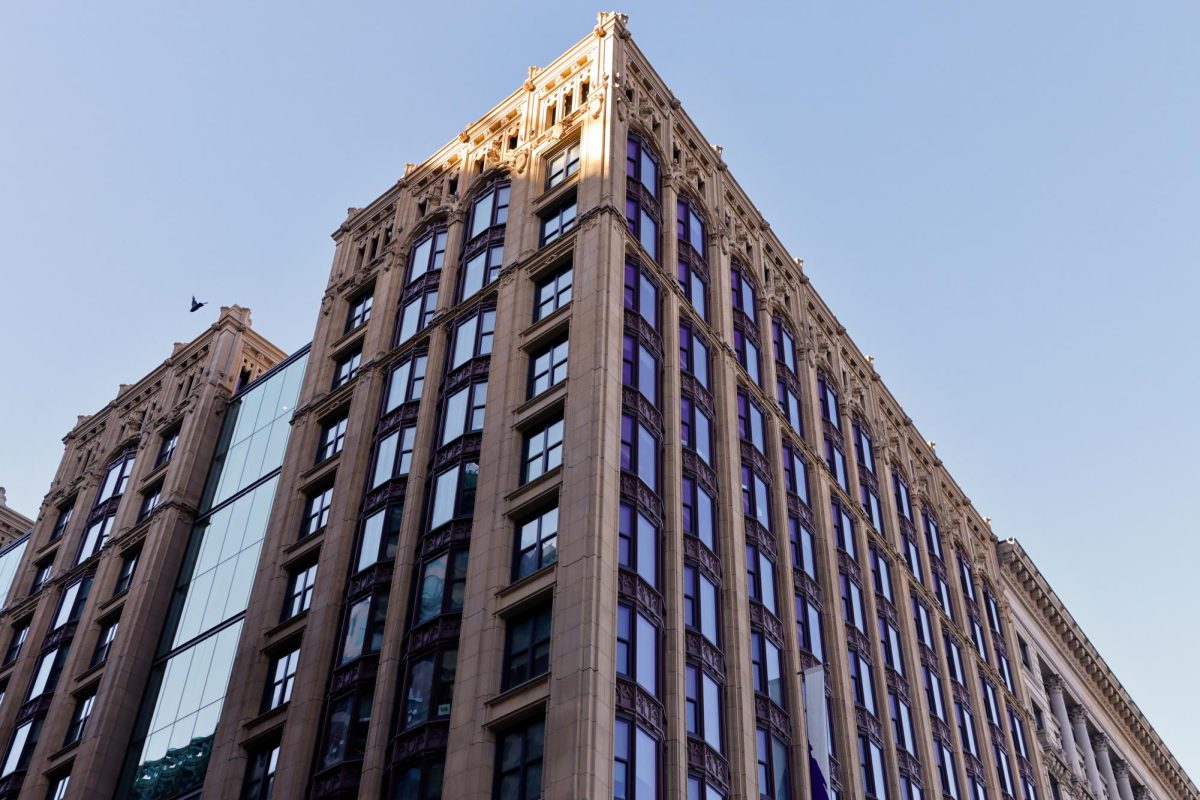
The game room, located on the second floor of the Little Building, replaces two large classrooms. Now, the spaces feature a pool table, air hockey, foosball tables, a Nintendo Switch, and a wide variety of board games. Pink walls and large marquee posters of movies that Emerson College alumni worked on now adorn the previously bare, off-white walls. A neon sign of the Griff’s Game Room logo can easily be seen from Boylston Street.
Georgia Winn, the executive president of SGA, kicked off the ribbon-cutting ceremony that included Griff and Emerson President Jay Bernhardt. She noted that creating third spaces for students to create organic community connections, rather than a study or workspace, has been a key point of feedback from students.
“[Third spaces] are an entry point for belonging,” Winn said during the ceremony. “They are places where conversations can happen organically, and friendships can form accidentally.”
Bernhardt said at the event that Griff’s Game Room is a “tangible piece” of the Extraordinary Emerson 2030 strategic plan and the college’s desire to build community through “new spaces and new opportunities.”
Bernhardt also hinted at future announcements about more spaces that will “bring Emersonians together.”

While it is not yet known where or what these spaces will look like, Christie Anglade, Emerson’s vice president for student affairs, said in a written statement to The Beacon that there is an intentional process to identify additional third spaces.
“That does not mean a large number of brand new buildouts, but it does mean being intentional about how existing areas can better support connection, relaxation, and community for all members of our campus,” Anglade said.
Priority C of Emerson’s strategic plan revolves around building a vibrant and inclusive campus experience through engagement, communication, and collaboration. Anglade noted that this also includes evaluating physical spaces to improve how they foster community connection.
“Griff’s is proof of the promise to build a stronger, more joyful community,” Anglade wrote. “We know how important third spaces are for students, and we are looking thoughtfully at where we can enhance gathering options across campus.”
Some known spaces that the strategic plan includes is a proposed Alumni Center on the Boston campus, which would host gatherings such as Alumni Weekend events and Alumni Board meetings.
“Building a vibrant and inclusive community and intentionally using our facilities to foster that community is a key part of Emerson 2030,” a college spokesperson said in a statement to The Beacon. “We are pleased to give our students a space they have been asking for and look forward to seeing our current and future students continue to find joy and connection at Griff’s.”
SGA Executive Treasurer Oliver Katz noted that community building is often part of many colleges’ strategic plans, Emerson’s being no exception. While schools such as Boston University have large student union buildings, Katz emphasized that Emerson’s students usually flock to the Lion’s Den and 172 Tremont. Griff’s Game Room, Katz said, will also benefit off-campus and commuter students.
“I think having the game room will be a way for off-campus students to access more informal spaces,” Katz said. “It will also just be a way to meet new people that you wouldn’t meet because you don’t live in the building.”
Executive Vice President of SGA Angus Abercrombie, who previously served as the organization’s vice treasurer, said that the administration held several meetings about third spaces on campus with SGA leadership.
“Ultimately, our priority was to see what could be done to make a meaningful change within the short time horizons that Emerson students today have,” he said.
Abercrombie noted that an unused “small pot” of money from the facilities budget was utilized to fund the game room, which he said amounted to roughly $200,000.
In 2023, Emerson was ranked worst for financial aid in the United States by the Princeton Review. The college has since moved to the third spot.
Since then, the college has seen a drop in enrollment, which has been attributed to “negative press and social media” following student-led pro-Palestine demonstrations and the arrest of 118 people in April 2024. The lack of enrollment has had an impact on Emerson’s budget; last summer, the college laid off 5% of its staff due to “budget reductions” and offered benefit packages for those who would voluntarily resign.
In response to students who wished the funding went toward tuition relief, to Katz’s knowledge, the money could only be used for facilities-related projects. According to Abercrombie, $200,000 of tuition relief across the board would not be substantial enough to combat the rising cost of higher education.
“This isn’t a million-dollar dream game room,” Abercrombie said. “But if you were to compare that to providing additional academic services…or reducing tuition significantly per student, it would be such a drop in the bucket.”
Anglade said that the administration was working to balance fiscal responsibility and strategic investments.
“We will always balance fiscal responsibility with investments that strengthen the student experience — creating opportunities for students to build community is an important part of that balance,” Anglade said.
Across campus, Winn said that there is a desire among the Emerson student body to understand the institutional finance process.
“We can put more effort towards helping to…demystify how budgeting occurs, what the scale of the budget is, and…where certain funds are allowed to be allocated,” Winn said. “College funds are pretty specifically allocated. You can only put certain money in certain places.”
Abercrombie said that third spaces like Griff’s Game Room could be a draw for prospective students.
“One of the most powerful things that makes students who come to Emerson stay at Emerson and not transfer out is having a solid and supportive community,” Abercrombie said. “Providing space for [students] to feel [community] here in Little Building in their freshman year will [make them] want to stay at Emerson.”