

Since rock ‘n’ roll first exploded in the late 1950s and ‘60s, critics have repeatedly declared that “rock is dead,” predicting that newer genres will permanently overtake the music landscape. But while the bluesy, rhythmic foundation of early rock ‘n’ roll has faded away, rock itself as a diverse and ever-changing genre remains very much alive.
The fear of rock ‘n’ roll’s demise first emerged in the ‘70s as disco rose to prominence, resurfaced in the ‘80s when electronic and pop music dominated the charts, and intensified in the ‘90s with the mainstream success of hip-hop and rap. Each era introduced a new genre that seemed likely to replace rock entirely, unsettling devoted fans and purists who believed the genre’s time was finally coming to an end. Now, with pop stars like Sabrina Carpenter and Tate McRae headlining an ultra-glossy new generation of pop, rock seems to be shaking its death rattle once again. This perception is reinforced by streaming algorithms and radio formats that prioritize easily marketable hits over instrumentally complex music, further pushing rock out of the mainstream spotlight.
While it is impossible to deny pop music’s overwhelming dominance since the ‘80s — an influence that has only expanded into the present — rock continues to endure through its fundamental differences from mainstream music. At its core, rock prioritizes raw instrumentation, artistic expression, and technical skill, often rooted in themes of rebellion and resistance to commercial conformity. Rock fans celebrate its emphasis on authenticity and individuality, values that foster strong emotional connections and a sense of community.
Pop music, by contrast, is built around mass appeal, reflecting current trends and relying heavily on polished electronic production, auto-tune, and predictable song structures. Its themes are typically delivered via inoffensive packaging, and are easily consumable, rejecting the gritty, imperfect qualities that define rock.
Rather than competing with pop on its own terms, rock survives by existing outside these constraints.
Throughout this ongoing tension between rock and pop, it becomes clear that rock has never truly disappeared; if anything, it has continually adapted. While the original sounds popularized by artists like Chuck Berry and Elvis Presley may have remained in the 1960s, the genres that followed did not kill rock, but instead reshaped it. Each challenge forced rock musicians to rethink their sound, image, and message, ensuring the genre’s longevity. Rock’s survival has never depended on chart dominance, but on its ability to evolve in response to cultural shifts and societal unrest.
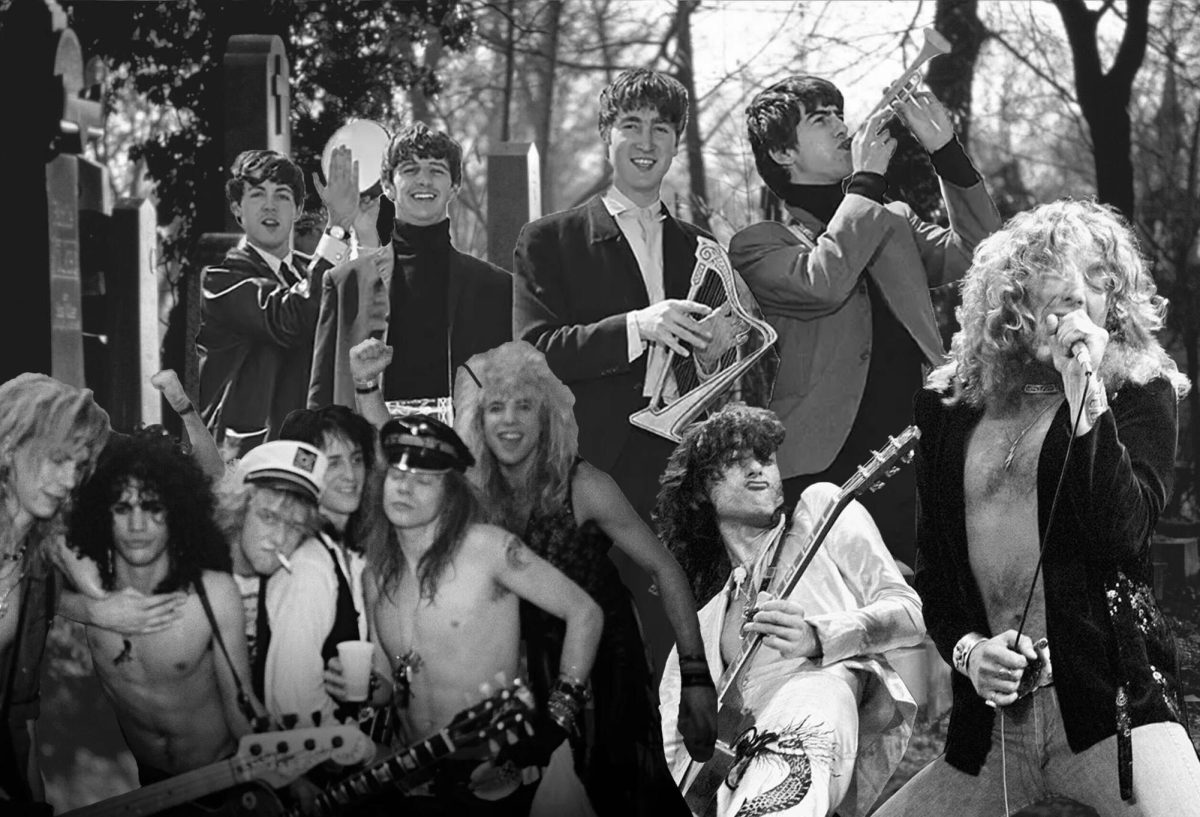
When disco dominated the 1970s, rock musicians responded by pushing creative boundaries, ushering in the era we now know as “classic rock.” Bands such as The Beatles — and subsequently Led Zeppelin and Pink Floyd — transformed rock from simple, feel-good songs for teens into ambitious, experimental works. Artists began layering instruments, manipulating vocals, and using emerging technologies to craft complex sounds that shocked the music industry. Rather than chasing commercial singles, rock turned toward immersive albums that demanded deeper listener engagement. This shift not only challenged disco’s polished consistency but also reflected broader social tensions, offering audiences both escape and emotional depth. Rock’s willingness to break musical conventions reinforced its identity as a genre that thrives on rebellion and innovation rather than conformity.
In the 1980s, as pop music surged, rock reinvented itself once again through heavy metal and its many subgenres. Bands like Guns N’ Roses, Metallica, and Def Leppard amplified rock’s intensity in direct opposition to pop’s synthesized sound. As the music industry increasingly commodified pop for mass consumption, rock responded by becoming louder, heavier, and more aggressive. Distorted guitars, powerful vocals, and high-energy performances appealed to younger audiences seeking an outlet from the rigid expectations of everyday life. While some gravitated toward artists like Madonna and Prince, others who were often pushed to the margins of society found identity and belonging in the raw force of heavy metal. Rock once again positioned itself as a refuge for listeners who felt disconnected from polished mainstream culture.
By the 1990s, the rise of hip-hop and rap once again shifted the cultural spotlight, prompting another transformation within rock. Heavy metal gave way to alternative rock, with bands such as Nirvana, Pearl Jam, and Green Day reintroducing punk and psychedelic influences through a lens of grungy rawness. Lyrics became more introspective and emotionally vulnerable, reflecting generational anxieties surrounding identity, mental health, and social alienation. Many bands from this era, such as Blink-182 and Foo Fighters, continue to create music today, evolving alongside the genre while maintaining its foundational spirit.
Currently, rock’s presence may be less centralized, but it is far from extinct. Modern artists blend rock elements with pop (Olivia Rodrigo); rap (Beastie Boys); and electronic music (LCD Soundsystem), creating hybrid sounds that blur lines between genre boundaries. While these artists may not fit traditional molds of guitar-and-drum glory, their work carries the genre’s rebellious energy and emotional intensity forward. Rock now thrives in live music venues, underground scenes, and digital communities where listeners value authenticity over mass appeal. Its influence persists even when it is not immediately recognizable.
Today, rock may not dominate the charts, but it continues to inspire community, challenge norms, and give voice to those who refuse to conform. As long as artists seek creative freedom and audiences crave music with emotional depth and meaning, rock will never truly be dead.