

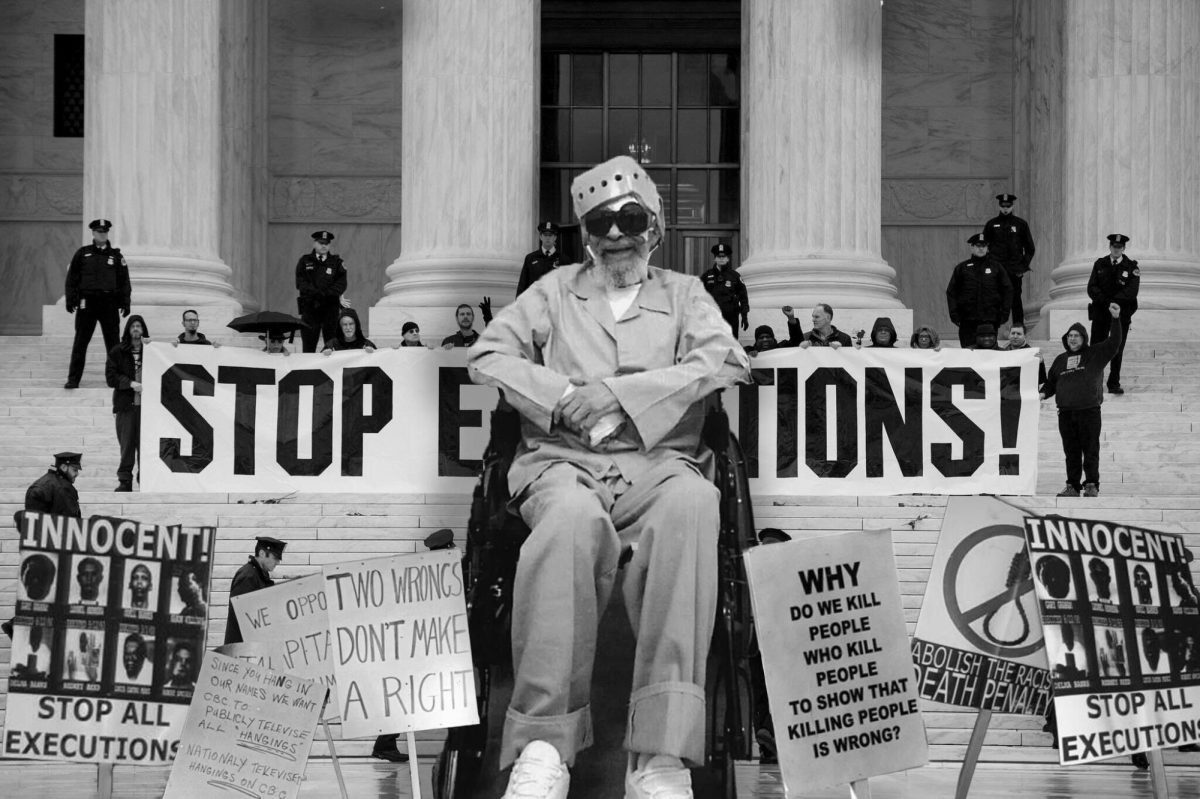
Charles Burton has spent more than three decades on death row and is scheduled to be executed March 12 — despite never killing anyone.
In 1991, Burton and five other men robbed an auto parts store in Talladega, Ala. Although Burton had already fled the store when Derrick DeBruce shot and killed customer Doug Battle, all six men were charged with capital murder under Alabama’s felony murder rule. This charge allows individuals to be sentenced to death even if they did not commit the killing.
The other four men reached agreements with the state of Alabama to avoid execution, and DeBruce’s death row sentence was reduced to life without parole. Now, Burton faces execution for a murder he neither carried out nor intended.
Burton’s case reflects a broader pattern within America’s legal system. The death penalty often extends far beyond who pulled the trigger, instead systematically targeting racial minorities.
The modern death penalty cannot be separated from America’s history of racial violence. The Equal Justice Initiative (EJI) has extensively documented how capital punishment evolved from the era of racial terror lynchings. As the founder of EJI, Bryan Stevenson, explained in an interview with Oprah Winfrey, “You can’t be in counties and communities where people have been lynched and threatened and menaced and terrorized, and then have a person of color taken to death row.”
As public lynchings declined in the early 20th century, executions increasingly moved into Southern courtrooms, and the death penalty became a legalized form of racial control that lynchings once enforced — particularly against Black men accused of harming white victims.
A landmark study by legal scholar David Baldus found that, in Georgia, defendants accused of killing white victims were significantly more likely to receive the death penalty over those accused of killing Black victims. That pattern persists nationwide: Since 1977, 78% of executions were cases with white victims. During that same period, 40% of those executed have been Black or Latino – despite only making up 12% and 19%, respectively, of the population, – while white individuals account for 56% of all executions, despite representing about 62% of the population.
Taken together, the numbers reveal a system in which the race of the defendant and the victim continue to shape who is sentenced to death.
The Supreme Court even confronted this evidence in 1987 in McCleskey v. Kemp, when Warren McCleskey challenged his death penalty on the grounds that it was racially biased. Here, the Baldus study was used as statistical evidence, but the Court declined to overturn the ruling.
Justice Lewis Powell, writing for the majority, described “racial disparities” as an “inevitable” part of the criminal justice system. If they were to accept McCleskey’s argument about racial bias impacting capital punishment, then that could bleed into comparable crimes.
Although the Supreme Court attempted to abolish the death penalty in 1972 for its roots in racial violence, it was reestablished in 1976. Hearing the Court then claim — nearly one decade later — that racial disparity was inevitable seemed like a clear retreat from their earlier insistence on confronting systemic inequality. This raises troubling questions about the Supreme Court’s commitment to racial fairness within the legal system.
The risk of wrongful convictions make these disparities, and the “inevitability” of these disparities, even more alarming. Since 1973, 202 former death row prisoners have been exonerated, with 109 of those being Black. Many of the wrongful convictions come from official misconduct, perjury, or false accusation.
Although it is hard to narrow down how many executed individuals were innocent, the Death Penalty Information Center has compiled a list of 21 individuals who were likely innocent, including many other individuals who were posthumously declared innocent. Knowing that the punishment is irreversible, the margin for error must be zero — and yet up to 4% of death row prisoners are later deemed innocent, according to a 2014 study.
Proponents of the death penalty often argue it deters violent crime and provides justice for victims’ families. However, decades of research have failed to provide reliable evidence that capital punishment deters homicide effectively. Since capital punishment is applied inconsistently among states and races, there is little evidence to provide a correlation between the death penalty and homicide deterrence.
As for victims’ families, it is subjective to each family whether they gain justice or not. But psychologists suggest that the process of the death penalty forces victims to be stuck in an endless rhythm of grief during the years-long process of trials, hearings, and appeals. A study by the University of Minnesota Twin Cities found that only 2.5% of victims’ families reported achieving closure.
In Burton’s case, Battle’s daughter has said that she wishes the state of Alabama would grant Burton clemency. Although her father was killed when she was just nine, she explains, “my father Doug Battle was many things,” but “he did not believe in revenge.”
Many have echoed this sentiment, with the case has sparked national outcry for the state of Alabama to grant Burton clemency. Factors such as Burton’s declining health and old age along with his inactive role in killing Battle has advocates urging Alabama Gov. Kay Ivey to halt the execution.
Burton’s story is not just about one individual awaiting execution; it is about a legal system that allows death sentences for those who did not take a life, a system in which the race of the victim determines execution, and a system in which marginalized communities bear the brunt of irreparable punishment.
Stevenson often returns to a single question when discussing the death penalty. The issue, he argues, is not whether a person convicted of a crime deserves to die, but whether we deserve to kill. In a justice system shaped by human error and racial bias, the moral burden shifts: If our institutions are imperfect — and the evidence shows they are — what authority do we have to make absolute decisions about who lives and who dies?